April 7, 2019
January 19, 2017
Wedding Preparation
Very happy to see my latest work for Church Publishing off the press, and delighted to see the kind words about it on the back cover.
"Kudos to liturgical scholar Tobias Haller for crafting this comprehensive guide to marriage in the Episcopal Church, based on canonical and liturgical changes authorized by the 2015 General Convention and presented in an easy-to-use format, for clergy, church musicians, and couples. Great to have this information all in one resource!"
-The Right Reverend Thomas C. Ely, Bishop of Vermont
"Preparing for a Wedding in the Episcopal Church is an invaluable resource for any Episcopalian involved in wedding planning and preparation. It thoroughly and concisely explores everything from balancing the sacred and secular to navigating liturgical options to managing photographers and florists. Firmly rooted in solid theology and liturgical practice, it is a timely and practical guide:'
- The Reverend Susan Russell, Senior Associate at All Saints Episcopal Church, Pasadena, California
"Here is a very practical, thorough, and theologically sound guide for clergy, couples, and church musicians on marriage in the Episcopal Church. The church's canon on marriage was updated most recently in 2015, and Tobias walks us through the changes and implications for planning, offering practical advice and guidance to assist all those involved."
- Carolyn Moomaw Chilton, Associate for Evangelism and Stewardship, Grace and Holy Trinity Episcopal Church, Richmond, Virginia
"Every parish priest should have this resource, which will help them become familiar with the marriage canon and marriage liturgies authorized in 2015. Tobias Haller offers wise pastoral guidance. Drawing from his years of experience, he explores the many options and recommends sound liturgical and pastoral practices."
- The Reverend Dr. Ruth Meyers, Dean of Academic Affairs and Hodges-Haynes Professor of Liturgics at Church Divinity School of the Pacific
February 16, 2011
Forests, Trees, and Finding the Way
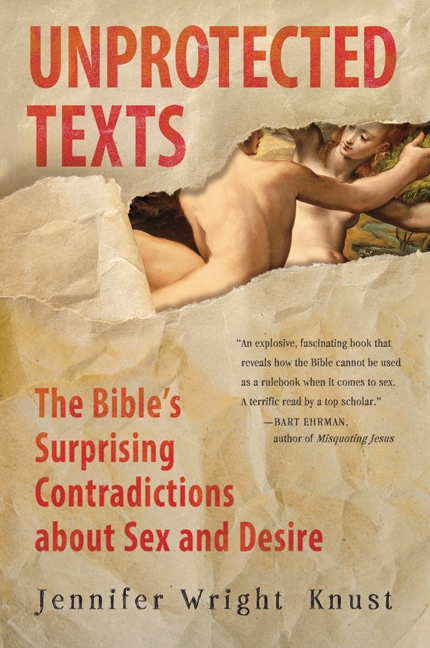
Jennifer Wright Knust’s Unprotected Texts does not explore a great deal of new ground, but the ground it explores it covers with considerable thoroughness, in a few cases with more than is needed. Writing from both her expertise as a biblical scholar and her life experience, Knust sets out to demonstrate that the Bible neither is nor should be a simple answer book for complex moral issues involving sexuality. Her primary method is to document the considerable concrete inconsistencies in the biblical text, as well as the seeming lack of discomfort the text evinces when particular biblical personalities stray from the purported strait and narrow.
She is much more successful, persuasive, and on firmer ground, with the former approach than the latter. The Bible is inconsistent or unclear on a number of topics related to sexuality, and while it shouldn’t take a scholar to point that out, it is helpful for one to do so, in particular to the extent Knust does. The second approach is far less useful — as is evident from a number of reviews written from a more conservative perspective than mine. That Rahab the harlot or Ruth the Moabite are lauded as persons will not be seen as an endorsement either of harlotry or premarital sex by anyone disposed to see these actions as sinful. Nor does the Scripture appear to endorse the actions themselves — or particularly to condemn them for that matter. This supports Knust’s larger case that we will not find easy answers to questions such as, “Is premarital sex immoral?” in a neat table on page 732 of a floppy Bible, next to the one for Biblical Weights and Measures. (Knust herself offers a number of tables that lay out biblical inconsistencies with great clarity.) But for a modern audience already well-settled in the cozy myth of a “biblical teaching on sexuality” more will be required than Knust offers to unsettle them and remove the scales from their eyes. It will take a brow of flint to confront the obdurate mind-set that looks but doesn’t see, hears but does not understand.
In spite of the weight of scholarship, insufficient as it might be in the long run, the book is a fairly easy read; it is divided and subdivided into fairly short sections with catchy subheadings. As the argument is not so much cumulative as a mosaic of individual elements, each of which highlights the central premise, the book is easily picked up or set down at leisure.
Although I resonate with Knust’s overall argument, I take some exception to a few of her particular readings. For example, when Paul counsels the Corinthians (1 Cor 6) not to be joined with prostitutes, I do not think Paul’s use of the word member is in reference to the sexual organ of an individual man. (The English member used for the male sexual organ is a relic of Victorian squeamishness, and a confusing word choice still with us in the NRSV, where member has another primary meaning; a better translation would be “meat” or “flesh” as in the KJV. The “member” of which Paul speaks is a different word entirely.) I must also note that transliteration of Hebrew is inconsistent, and in one case in error.
To the general reader, however, the greatest disappointment will be the last full chapter before the short conclusion. It includes an exhaustive, and somewhat exhausting, exploration of everything you ever wanted to know about circumcision, and much you didn’t want to know; and knowing, wonder why it is of help to know it. As such it seems to be at a remove from the primary concerns of the book. And in spite of the rousing coda which follows it, this long chapter comes as a bit of a letdown.
Still, Knust has some important things to say, and they are well worth hearing. It is unfortunate that much of what she says will fail to persuade those more comfortable with simple answers to complex questions. There is a difference between not seeing the forest for the trees and not seeing the trees for the forest — in this case, the “forest” as the largely unfounded belief that there is a “biblical teaching on sexuality,” which blinds most people to the actual complexity and richness of the biblical text. Knust’s book highlights these complexities, but not to the extent or with the clarity to shatter the myth once and for all. Some will insist — in spite of the detailed evidence Knust lays out — that there is still some clearly discernible sex ethic to be found in Scripture.
And to some extent, there is — just not the one they think. Knust is not claiming that there is no help from Scripture when it comes to sex. What she affirms is that the Bible will not give us easy or specific answers to the questions now being asked of it. It is not, as she suggests in her concluding chapter, about physical perfection but faithfulness. It is about treating the Bible not as a mere answer book but as a rich history and revelation, from which guidance will be gained only by an approach that engages with it as it is, finding the way through the forest by minding every tree and discerning every path. And the same goes for life itself, doesn’t it?
Tobias Stanislas Haller BSG
This review is part of the TLC Book Tour for this volume.
May 5, 2009
Book Update
Well, it's good to see that Amazon dot com has changed the ordering buttons on Reasonable and Holy from "Pre-Order" to "Add to Shopping Cart" — but now they also indicate that they are "Temporarily Out of Stock." Which I suppose is a good sign, in that they sold all the ones that they ordered from Church Publishing to fulfill pre-orders.
Also happy to hear that real live copies are available at the bookstore at the Olde Homestead at 815 Second Avenue.
Tobias Stanislas Haller BSG
April 18, 2009
Off the Press
I'm happy to report that Reasonable and Holy is off the press, and in keeping with Doubting Thomas Sunday I can attest I have actually touched and handled a copy courtesy of my angel and editor Susie Erdey.
My hope is that this volume can be a contribution to the "listening process" that the Lambeth Conference commended.
I've also set up a separate blog aptly named Reasonable and Holy, where I'm posting some additional resources (such as index material) and where I hope to focus some further discussion and comment.
Meanwhile, blessed Easter 2!
Tobias Stanislas Haller BSG
March 11, 2009
The Book: Reference Index
Reasonable and Holy was to have gone to press last week. As I await word from the publisher on final print availability, I've been busily at work preparing indexes for it, and have posted the first at the blog of that name which will provide such additional resources, and continue the discussion. As I noted earlier, this book is meant to be part of the "listening process" and continued dialogue, so I want to keep that open through the technology of the internet.
The book itself, due to cost considerations (it ended up being forty pages longer than originally planned as it is) lacks an index. So I'm providing such resources at the blog, and will eventually post them also as pdf files which can be printed out and kept with the volume for reference. Having detachable indexes might be a handy tool in any case!
So the first index, of Biblical and Other References, is up at the blog. This will give an idea of the range of materials referenced.
--Tobias Stanislas Haller BSG
July 7, 2008
Forecast: Less Blog
A quick note to all that my blogging will be a bit restricted over the next month or so. The good news (from my and I hope others' perspective) is that this is because I have signed a book deal to put into published format some of my ruminations on sexuality and theology. This is quite exciting, especially since it results from the publisher approaching me rather than the converse, so I know there is a real interest in seeing this happen. But it does mean a bit of work in rearranging, restructuring, and all-around writing, that will keep me a bit occupied — amongst my other duties as a vicar and member of the standing committee. I promise to post a note from time to time, and also to keep you posted on the progress of the project; and I will do my share of continuing to browse what others contribute to the blogosphere.
Tobias Haller BSG
May 21, 2008
Unread Books Meme
From Grandmère Mimi:
What we have below is a list of the top 106 books most often marked as "unread" by LibraryThing users. Bold the ones you've read, underline the ones you read for school, italicize the ones you started but didn't finish.
Jonathan Strange & Mr Norrell
Anna Karenina
The Brothers Karamazov
Guns, Germs, and Steel: the fates of human societies
War and Peace
Vanity Fair
The Time Traveler’s Wife
The Iliad
Emma
The Blind Assassin
The Kite Runner
Mrs. Dalloway
Great Expectations
American Gods
A Heartbreaking Work of Staggering Genius
Atlas Shrugged
Reading Lolita in Tehran : a memoir in books
Memoirs of a Geisha
Middlesex
Quicksilver
Wicked : the life and times of the wicked witch of the West
The Canterbury Tales
The Historian : a novel
A Portrait of the Artist as a Young Man
Love in the Time of Cholera
Brave New World
The Fountainhead
Foucault’s Pendulum
Middlemarch
Frankenstein
The Count of Monte Cristo
Dracula
A Clockwork Orange
Anansi Boys
The Once and Future King
The Grapes of Wrath
The Poisonwood Bible : a novel
1984
Angels & Demons
The Inferno (and Purgatory and Paradise)
The Satanic Verses
Sense and Sensibility
The Picture of Dorian Gray
Mansfield Park
One Flew Over the Cuckoo’s Nest
To the Lighthouse
Tess of the D’Urbervilles
Oliver Twist
Gulliver’s Travels
Les Misérables
The Corrections
The Amazing Adventures of Kavalier and Clay
The Curious Incident of the Dog in the Night-Time
Dune
The Prince
The Sound and the Fury
Angela’s Ashes : a memoir
The God of Small Things
A People’s History of the United States : 1492-present
Cryptonomicon
Neverwhere
A Confederacy of Dunces
A Short History of Nearly Everything
Dubliners
The Unbearable Lightness of Being
Beloved
Slaughterhouse-five
The Scarlet Letter
Eats, Shoots & Leaves
The Mists of Avalon
Oryx and Crake : a novel
Collapse : how societies choose to fail or succeed
Cloud Atlas
The Confusion
Lolita
Persuasion
Northanger Abbey
The Catcher in the Rye
On the Road
The Hunchback of Notre Dame
Freakonomics : a rogue economist explores the hidden side of everything
Zen and the Art of Motorcycle Maintenance : an inquiry into values
The Aeneid (excerpts in school)
Watership Down
Gravity’s Rainbow
The Hobbit
In Cold Blood
White Teeth
Treasure Island
David Copperfield
The Three Musketeers