Showing posts with label review. Show all posts

October 18, 2013

Mission [Not] Abort

A review of Gravity, a film directed by Alfonso Cuarón. (Note: contains spoilers. Just go see it.)

In this film technology and acting merge in probably the most effective blend since Avatar, though with a simpler story line and a more profound message. The plot can be summed up in a single headline: woman survives accident in space; but that would not do justice to the richness of the portrayal and the tension in the story-telling. For the technology not only portrays what an accident in weightless orbit would look like, but allows the director a God’s eye POV: a camera that can move from outside the swelling scene to a view from within the astronaut’s helmet and — one presumes — her eyes. In an almost dreamlike transition the audience moves from empathy to identity, from beholding to becoming. This has a powerful effect in drawing the viewer literally into the story.

This is a well-told story not just about survival, but about the choice to survive rather than to go gently into that dear night of death, a transition painfully easy in the vacuum of space, with the supply of oxygen expendable and the hermetically sealed refuges very few and very far between. The principle character — indeed for much of the film the only character, superbly played by Sandra Bullock — is presented with challenge after challenge, and ultimately with ghostly encouragement to surmount all challenges to come to a kind of rebirth. The message is not simply survival, but affirmation of life.

It might seem odd, indeed a massive misreading, to see a right-to-life message in a movie associated with a well-known liberal such as George Clooney (who also gives a fine, though rather chivalrously downplayed performance). However, one image in the film strongly suggested such a reading to me. After reaching the refuge of a sealed capsule, Bullock slowly removes her spacesuit and floats in fetal position surrounded by the umbilical of some piece of hardware. The image is unmistakable, and if unintentional more of a coincidence than I can imagine for a director so well attuned to the visual, and whose crew had to labor over every frame to produce the perfect simulacrum of life and death in space.


However, it is also possible to see this as a pro-choice message, as Bullock makes the choice to live — this is not just about life, but the choice for life. True, it is the ghostly reminder of some half-remembered aspect of the technology that presents this scientist-out-of-her-depth with the opportunity to choose life rather than death. But she makes that choice, she takes that slender chance, as fragile as a guy-line, as thin as the skin of a space suit, as hit or miss as shooting oneself out of a cannon at a net some hundreds of miles away.

Life is, after all, worth living, and this film supports that hope, and places that challenge: which would you choose. Bullock chooses life, and lives.

Tobias Stanislas Haller BSG


August 8, 2013

8.9.1945 11:02

The bombing of Hiroshima, falling as it does on the Feast of the Transfiguration, and having been the first wartime use of nuclear weapons, holds an ironic pride of place. But lest we forget, Nagasaki was bombed a few days later, with similar devastation. The event is dealt with in tender retrospect in Rhapsody in August, a late film in the oeuvre of the incomparable Akira Kurosawa. This is not, by far, his best film, nor is it my favorite. (That palm goes to Ikiru.) But it is a masterwork nonetheless, perhaps too talky and slow-paced for most audiences. 

One moment in the film, however, is worth seeing the whole thing. At 16'20" the three children, who have been wandering modern Nagasaki looking for signs of the past (as their grandfather perished in the bombing) come upon something in the playground of a school. Silently turning to behold it, the girl holds out her hand and points, and then Kurosawa's indomitable and unblinking camera-eye slowly moves in on the melted relic of a jungle-gym, marked with a simple plaque bearing the moment at which it took its present form, surrounded by a small garden. A solo alto voice sings a mournful melody, as the children approach and instinctively remove their caps. It is a powerful image, one of many delivered by the master's hand in this "small" film on a big topic.

Tobias Stanislas Haller BSG
Another image, and others from the film, can be seen at IMDB here.

February 25, 2013

Enough Oscar, Bring Back Felix

My thoughts on the distasteful and disappointing Oscar-fest: Glib, postmodern sexism is no more acceptable than crude, premodern sexism. Seth MacF is to humor what the other Mac is to cuisine, and he both reveled in and revealed the thin, mean, one-trick horse insubstantiality of his humor.

And the casual, clumsy, "cool" unpreparedness of too many of the presenters ended by making Jack Nicholson appear suave and debonaire in comparison. The cult of personality really does require some. Personality, that is. Just being beautiful and famous will not make you witty or wise.

There were on the whole too few moments of real humor and class -- and most of them came from classy people like Shirley Bassey and Barbara Streisand, Daniel Day Lewis and Christopher Plummer.

The rest were wannabes who couldn't.


Tobias Stanislas Haller BSG
ps: shopping suggestion for Mr. MacF.

February 18, 2013

A New Deck

a review of “House of Cards” — a Netflix original

There is a long history in American television of attempting to repackage British productions for an American audience. Some of these have been brilliantly successful, such as “All in the Family,” but others, such as the one substituting Bea Arthur for John Cleese in a version of “Fawlty Towers” (even the name of which I have mercifully forgotten) much less so.

The American version of “House of Cards” is loosely based on the BBC production of the same name — and for ease of reference from now on I’ll refer to them as Nhoc (for Netflix) and Bhoc (for British). The most important thing to note is that this is more a case of “inspired by” then “adapted from.” (Think of My Own Private Idaho in relation to Henry V — and the Shakespearean reference is not inappropriate, as I will note in a moment.)

But first let me offer a brief assessment of Nhoc on its own merits. Netflix took the unusual step (though perhaps not so unusual for them) of releasing all thirteen episodes of the first “year” at the same time, so viewers could move through the story at whatever pace they liked, rather like what you can do with a DVD of a whole season. It took me about two weeks, viewing just about one episode each evening, and sometimes two. So, yes, it is that good. There are uniformly good performances, tight scripting, and — always important when there is an original out there which is in the minds of at least some — enough twists and turns in the plot to keep even those familiar with the prototype guessing and hooked.

That being said, the two versions are very different. First is pace: Nhoc takes thirteen episodes to cover what Bhoc dealt with in four. (There are 12 episodes in Bhoc; the market only knows how many will be needed to flesh out its American cousin.) This allows the Americans to develop more characters to much greater depth and complexity than the British production permitted. This is perhaps most notable in the case of the principal character’s wife — she is almost a silent partner in Bhoc, but generates a significant storyline, including adversarial notes, in Nhoc.

In both versions, of course, the notable technique of the principal character in direct address to the camera, both with words and knowing looks, remains the same — but, ah, the difference in effect. Bhoc has, for all its political modernity, an underlying Shakespearean quality, which often emerges in textual citation, as well as general theme (Lady Macbeth, anyone?). And of course, Ian Richardson was a notable Shakespearean actor on screen as well as stage, and is a natural for the soliloquy and aside. Which is not to say that Kevin Spacey doesn’t carry off his relationship with the audience just as well.

But this is also where one of the significant differences of tone comes in: Francis Urquhart (Richardson) is a patrician Tory; Francis Underwood (Spacey) is a plebeian Democrat. The Englishman is all charm and wit, and draws the audience into his conspiracy; the American more brusque and snide — a self-confessed hardscrabble boy from South Carolina (the southern accent giving a bit of that suave gentility that came more naturally to Ian Richardson), but who seems not so much to care if we are on his side or not. The original F.U. (and unless I missed it the American version doesn’t pick up on the delightful acronym) romances the viewer and draws one into the plot; the later version keeps us informed — though as the plot twists reveal, not quite so well-informed as we might think. To cite the old distinction that Hitchcock made famous, Bhoc has suspense — we know what is going to happen and wait for it — while Nhoc indulges in a few mysteries to keep us on our toes. Each technique provides its own delight, but they are different in feeling.

The political difference also affords a tonal difference to the characters: Richardson is a conservative idealist; Spacey a pragmatic realist — which is not to say that both of them don’t know their way around getting things done — and while both of them are clearly working for their own ambitions and advancement, Richardson’s character seems to have at least convinced himself that there is a higher cause (particularly in the middle episodes of Bhoc, which Nhoc has yet to release, in which F.U. provokes and then prevents a constitutional crisis — so we shall see!) But this difference in tone pervades much of the general atmosphere and style: in spite of the fact that both versions deal with political corruption, and high crimes and misdemeanors (including murder), Bhoc is clearly satirical, with more wry and colorful humor, while Nhoc tends more towards the film noir end of the spectrum: even the musical scores reflect this difference, with British echoes of Purcell and Parry, while America’s suggests an upcoming episode of “The Sopranos.” Bhoc visibly comments on its own satirical roots, in shots of literal rats creeping on Westminster Bridge and the back streets near the Houses of Parliament; Nhoc takes itself much more seriously as a gritty political drama with occasional sly commentary and sidelong glances.

Both are well worth watching, and stand or fall on their own; which of them one prefers will likely be a matter of taste or what one is in the mood for. I greatly enjoyed the BBC production when it was first broadcast years ago, and recently re-viewed the whole series on Netflix itself, prior to the announcement of the American adaptation. My first thought on hearing that news was, to wonder how they will analogize the parliamentary government of England with the American system — and so far they have done so primarily by focusing on the conflicts within the party that happens to have the presidential chair.

Ultimately the true test of the value of Netflix’s effort, I suppose, is that I’m eager to see the next thirteen episodes and would start watching them this evening if they were available!

Tobias Stanislas Haller BSG


February 11, 2013

No To the Papacy

a review of Habemus Papam released in the US as We Have A Pope, a film by Nanni Moretti, 2011.
I watched and enjoyed this film some weeks ago on Netflix. Actually I enjoyed it so much that I watched it twice. Little did I know at the time how timely it might become. For this unassuming little film is about a man who resigns from the papacy — or I should say, puts the College of Cardinals into confusion and captivity by being elected, accepting the office, but then, in a crisis of conscience, refusing to be presented on the balcony — leaving them in the quandary of having a duly elected pope who refuses to be announced as such.

The film is billed as both a comedy and drama, and indeed that is what it is; there are any number of satirical pokes at institutions as various as the church and the press — including a delightfully gaffe-prone TV journalist who keeps making announcements that he must immediately correct. But the take-away for me is the poignancy of many of the characterizations; particularly that of the reluctant pope himself, beautifully crafted by Michel Piccoli. He captures both the gentleness and irascibility to which pastors who are also men of power are given, in a carefully graded blend of nostalgia for paths not taken, anger both at his own incompetence and at the misplaced help of others, and a sense of loss and dismay and incapacity. One might observe the director intended a commentary on the church itself; if that is the case, Piccoli serves well to portray it.

The cast is uniformly excellent in both large and small roles. I would take particular note of the director himself, who plays an atheist psychoanalyst made a prisoner of the Vatican, and who has delightful and meaningful encounters with the large (and convincing) cast of Cardinals who are similarly locked up until their dilemma can be resolved. Jerzy Stuhr as Il Portavoce, the Vatican press secretary, is a wonderful example of someone tasked with something inconceivable, yet managing to use all his wiles to cover the obvious embarrassment. This includes finding a Swiss Guard to hang out in the papal apartments and give the impression that all is well (the almost nonspeaking role of a man thrust into an inconceivable position is played with great charm by Gianluca Gobbi.)

I’ll stop there lest I give away too many spoilers, as there are many twists and turns in the plot — suffice it to say the film is well worth seeing, amusing and moving at turns, funny and poignant. But at this point, timely. Whether it is a parable of a church that has lost its way I will leave to you to decide, but it does raise some questions — now more than ever.

Tobias Stanislas Haller BSG


December 31, 2012

Christmas Special

The "must see and glad I saw it" of this Christmas season was the Call the Midwife Christmas Special --- apparently a last-minute decision on the part of PBS, as it didn't appear in the program guide. I only caught word of it because of a promo on the day itself. The new series ended its run for this season earlier this year, so the Christmas special came as something of a surprise.

And not only a surprise, but a delight. This is a wonderful tale of redemption, forgiveness, closure, thanksgiving for changing times, and the sufficiency of grace: good themes any Christmas. Keep an eye out for a rebroadcast, and keep a hanky handy. Wonderful performances by the standout cast.

Tobias Stanislas Haller BSG
November 28, 2012

Lincoln as Grand Opera

a review of Lincoln by Steven Spielberg

Steven Spielberg’s Lincoln is a film that will likely stand the test of time: a splendid script, well acted and well filmed, with a weighty subject and important themes. But beyond that it has the stamp of art about it; ironically, in my opinion, less the cinematic than the operatic. This is a film of arias, duets, trios, and choruses; a film that relishes the richness of language, indeed about people who relished the richness of language and were not afraid to speak in long sentences with polysyllabic cadences and periods that clunked down at the end to make a point with no misunderstanding possible: the ponderous solemnity of sober speech as well as the rollicking ribaldry of pungent insult. These were people suckled on the twin teats of Shakespeare and Cranmer, and the film shows off their language to good effect.

The actors are all up to the performance of these roles; Daniel Day-Lewis is the leading tenor hero alternately performing the comic aria and the solemn recitative. Sally Field portrays the complex female lead, a sorely tried and trying woman with the humility of Hyacinth Bucket, the rhetoric of Foghorn Leghorn, and the emotional stability of Bill the Cat. Her verbal duel with the baritone, Tommy Lee Jones as Congressman Stevens, is an acid-etched example of the most polite and politic vitriol, razors sheathed with smiles. Jones chews the rich language placed in his mouth like a fine malt, and clearly enjoys every nuanced syllable. The operatic analogy cannot pass without notice of David Strathairn’s Seward, the standard baritone “best friend” of the leading tenor, loyal to the end.

A dramatic high point in the film is the duet between Mr. and Mrs. Lincoln caught in the dilemma created by their son Robert’s desire to serve in the military. They are each in their own world, talking past each other simultaneously — the high-minded idealism of the president crashing in a restless wave of words against the impassioned anchored anguish of a mother already bereft of two sons and unwilling to lose a third. At the end of the scene, the defeated woman collapses like Violetta into her crinolines in a visible gesture of resignation and grief as powerful and evocative as the plunge of a white satin Hindenburg.

Not since Orson Welles have we seen such exercises in fugal dialogue as in this scene and another in which young Thomas Lincoln, also known as Tad (because he looked like a tadpole when he was a baby), prattles on while the adult conversation continues around him. Gulliver McGrath is splendid in the role, and provides what I found one of the most moving, and historically accurate, moments, reacting to the news of his father’s death; for he was also at the theater the night Lincoln was shot — in a different theater, watching an Arabian adventure unfold on the stage. Spielberg’s choice not to show the assassination but to allow us to hear of it as little Tad did, indeed as most of the nation did, secondhand, is a wonderful example of his artist’s delicacy — the cinematic equivalent of a mot juste, not unlike the red coat in Schindler’s List, a film also echoed in Robert’s following a barrow of amputated limbs to see them summarily disposed of in a lime pit. Even were it not for the high-flying language, this would not be a film for children.

Another reason this film will endure is the strong political message it sends, a timely one at that. It is a political world that is also a deeply personal world — this was before corporations were thought of as people. It reminds us that the body politic is made up of individual people. It moves from the writhing, entangled bodies of the opening battle scene, a sea of blue and gray — and red — to the political battle of Congress, and the unique individual people who make it up, each and every vote counting. These too are people who in the day of decision ventured much; one might even say that decision-making is at the heart of what this film is about — a theme not at all foreign to Spielberg’s best and most serious work, echoing the powerful sentiment of Hillel and Private Ryan both, concerning the worth of each individual life. We see decisions played out not only by Lincoln and his wife and son, but the cast of Congressmen, some bought and sold, set at a price as were the slave children whose images young Tad pondered, others throwing caution to the wind as they cast a vote they know will cost them dearly. Michael Stuhlbarg, as George Yeaman, is particularly moving as he finds his voice.

If I were to fault the director on any point of this film it would have to be the ending. I had thought it might end with that long-lens shot of Lincoln walking down the hallway — after all we know how the story ends. But then we would have missed the superbly handled presentation of the assassination itself, reported by messenger as in the best Greek tragic tradition. And then I thought it might have ended with those famous words, “Now he belongs to the ages.” Instead the director gives us Lincoln in a flame, an effect all too much like a Victorian faery photograph, or Lincoln as the Ghost of Christmas Past, and a snippet from an admittedly great speech. But it seems a false step to end in this way — and is a step away from the operatic form which had served so well up to that point. What, after all could be more operatic than the leading character lying dead surrounded by the other principal players, as the curtain falls on the closing chords?
 
Some will no doubt accuse me of quibbling at this point; and I will not say that this minor flaw undoes all that went before. Far from it; but in a film that is so nearly perfect a small flaw is all the more irking, particularly as it comes at the end.

This is a film that will last, and bear repeated viewings.

Tobias Stanislas Haller BSG

August 8, 2012

Seen and Heard

Finally got around to watching Margarethe von Trotta’s film on the life of Hildegard of Bingen, which has been languishing in the hermitage of my Netflix queue for several liturgial seasons. I’m not sure what took me so long; perhaps I thought it would be a pious and tedious tract. On the contrary it is a rather entertaining portrait of an extraordinary woman — extraordinary in her own day, and likely any day up until the present, and perhaps even now.

The atmosphere captures the era well, though things do seem a bit tidier than they likely were. The several books that make their appearances look just a bit too much like modern books, but that is a minor point. Friedrich Barbarossa wearing what appears to be a dalmatic or tunicle in his rec room seemed a bit more odd. But such items were transient distractions. There is much wonderful music in the film, as would be expected. But one would have appreciated, in a film with this title, a bit more focus on the illuminations of the famed visions.

But the main attraction is the interaction of the characters — and anyone who thinks that politics is new to the church ought to check out the interplay of abbots, bishops, archbishops, popes, Margravines, and even the odd would-be-emperor, with whom good Hildegard has to deal as she stakes out a patch to live out her vision. She is not portrayed as a plaster saint — far from it — but as a brilliant, charismatic visionary, subject to the same human perils of particular friendship, and the attendant presence of the Green Eyed Monster who looms periodically and occasionally steps into the foreground. The human drama is set against a spiritual and ecclesiastical tug-og-war, and while low-key for the most part, it is quite compelling.

Performances are good without exception. Barbara Sukowa captures Hildegard’s ambiguities and ambitions well;  Heino Ferch is sympathetic as the priest / counselor to the sisters; Hannah Herzsprung serves well as the cause of much envy, and Lena Stolz as its victim and exponenet.

My score: 8 out of 10. Well worth seeing.

Tobias Stanislas Haller BSG

January 18, 2012

Equus ex machina

a brief comment on Stephen Spielberg’s War Horse

I saw the film this afternoon and thoroughly enjoyed it, blubbering helplessly a couple of times, in spite of the sheer unbelievableness of it all. A miraculous horse indeed to survive the horrors wrought by humanity and emerge with its equinity intact. Horses such as this are clearly more humane than most humans.

This is a refreshingly old-fashioned film, the progress of its episodic story unimpeded by the presence of mega-star actors. A few faces were familiar enough to invoke recognition without being distracting, and there are fine moments all around. The message is simple, and obvious, and though the denouement is utterly predictable, when the whistle blew it struck a note so right that I dissolved. The catharsis was salutary and timely, as the recent state of affairs in church and world and politics has gotten me right depressed. It was very good to let go of these frustrations when faced with simple goodness, even if idealized and fantastic.

There aren't too many films about the “Great War” but this one will rank equal in value but at the sentimental end of the shelf opposite such brutal classics as Paths of Glory and Johnny Got His Gun. War Horse has its brutal moments, but is bouyed aloft with a sentiment of innocent, and perhaps therefore all the more poignant, hope.

Tobias Stanislas Haller BSG

December 2, 2011

Wounded healer

a review of Hugo, a film by Martin Scorcese

Hugo is a rich film with much to commend it to a wide range of audiences. There is enough action and youthful characters with whom the thoughtful younger set can identify, as well as some poignant older characters with whom any adult who has experienced disappointment or loss will be likely to resonate. The primary theme is brokenness and loss, but the film is about triumph through and over these obstacles. That a child is the bringer of healing — it does not go too far to say salvation — is all the more appropriate to this season.

That child is played by young actor Asa Butterfield, whom I’d only just seen in The Boy in the Striped Pyjamas the day before. He is a bit older and much wiser in this film, and I am very happy to say that unlike the sad emptiness and pathos with which I was left at the end of the earlier film, Hugo left me uplifted and bright with hope. All is not lost, it reassures us. It is just important to be sure you have all the pieces, and they must be there somewhere because that is how things are made. Things can break, or be lost or misplaced, but there is hope for repair, renovation, and restoration.

This film of many films within a film is also a love song to cinema, from one of its more daring artists. He has tried many things in the past, but this is Scorcese’s first foray into 3-D, and I’m not entirely sure it was necessary, even though the result is spectacular. I have to confess that while I find 3-D fascinating, I remain unsatisfied as it presents an image that is not really quite as the pair of human eyes sees it, since our brain wants to focus on whatever holds our attention. This leads me to become even more aware of the artifice, rather than suspending any disbelief. But then again, this is a film about artifice, so perhaps that is all to the best.

Ben Kingsley is his usual excellent self as a man slowly pulled from the depths of bitterness and despair into the literal magical light in which he had once reveled. Sacha Baron Cohen makes the most of what could have been a totally two-dimensional figure, and fleshes it out with poignant effect, as another broken man who finds his own completion and restoration. The other supporting players are quite fine, though I would have liked to have seen more of Christopher Lee as the bookseller — I wonder if something was lost in the cutting room, as his story seems a bit of a loose end. Keep an eye out for James Joyce and Salvador Dali in the crowded train station; I spotted the first but have to say I missed the second.

Enjoy this film this season of expectancy and restoration. There is much to delight the eye and lift the spirits here. And we could all use some of that.

Tobias Stanislas Haller BSG

November 30, 2011

Inhumanity

a review of The Boy in the Striped Pyjamas

This film has been around for a few years, but I only had the opportunity to view it last night. It contributed to troubled sleep the rest of the night.

Naturally for any film attempting to address the Holocaust, this work deals with the horrors of that surpassing act of inhumanity. But by placing the primary focus on a child, on two children, this work evokes an emotional level not reached by many other films. For behind these children’s suffering always lies the child’s unanswerable question, Why?

The film naturally addresses the reality of inhumanity, but neatly summarizes how easy it is to dehumanize others and then treat them inhumanely. When young Bruno asks his father about the people on “the Farm” (as he imagines the camp to be), he receives the halting answer, “Those people... well, they really aren't people.” That is it, in a chilling nutshell.

The film is beautifully made, with fine performances and skillful direction. It builds rather like a Mahler symphony to its inevitable and tragic end, and is profoundly moving and disturbing, perhaps most of all because that question is left hanging in the air: Why?

Tobias Stanislas Haller BSG

November 26, 2011

Lies and Consequences

a review of J.Edgar

Clint Eastwood’s latest film is a biopic in the more or less classic/modern mode, telling the story of the long and tortured life of a short and troubled man, J. Edgar Hoover (Leonardo DiCaprio). Although there are some fine performances, the film doesn’t click at the level of morality tale that one suspects Eastwood was reaching for, and falls short of the grand tragedy it might have been. The most effective elements are the touching interpersonal and domestic tragedies of Hoover’s relationship with Tolson (Armie Hammer), and the insidious relationship Hoover had with his mother — and let me say Dame Judi Dench is riveting as a twisted and twisting mother out of some private Hell.

But the larger tragic theme never quite seems to click: how a man supposedly so devoted to truth and justice could remain so blind not only to the lies he told himself but the lies he told others, and how by setting himself up as private arbiter of justice committed great injustices against the country he loved. The theme almost clicks in the late scenes in which Hoover (perhaps) recognizes in Nixon some of his own foibles and failings, but the connection fails to link with a satisfying chunk of dramatic inevitability.

Perhaps I’m asking too much — but it seems to me that here was a story of possibly Shakespearian proportions, complete with subplots and levels of resonance. Yet the personal and public levels of the story fail to align in this dramaturgical dance, and remain as clumsy as Hoover’s own first efforts at terpsichore.

The film could have been a morality play for our time: when the well-meaning and self-righteous commit crimes in the cause of justice, and promote real falsehood in support of some abstract truth. Perhaps in retrospect the film will be seen in that light, but for the present it fails to make the connections.

There is much to admire in the technical aspects of the film, in terms of decor, costume and sense of period, but the make-up imposed upon Hoover and Tolson in an effort to age the actors has to be the worst I’ve seen in decades. The high-resolution camera is a harsher critic than I will ever be; but it is astounding to me that the make up on the men is so poor (you can practically see the seams) while Naomi Watts’ is so subtle and convincing. (Different make-up artists were involved, and it is easy to see who has the knack and who doesn't) A minor point, to be sure, but a distraction in engaging with the characters, who, to the actors’ credit, do manage to move and engage.

So this remains an actors’ film rather than a director’s. See it for the performances, and perhaps with a goal to find among the remnants some hint of what it might have been.

Tobias Stanislas Haller BSG


November 9, 2011

Elegy for a Past that Never Was

a short review of Never Let Me Go, a film based on a novel by Kazuo Ishiguro

I came across this little film last night while scrolling through the offerings on HBO and thought it sounded interesting. It was more than that — it was riveting and disturbing and moving. Some have apparently found the formal element of its being “alternative reality” — or science fiction set not in the future but the past — confusing, but it added to its haunting quality. It would make an interesting double feature with the more spectacular Children of Men.

Some have wondered how people could treat other people in the manner they are treated in this film, but I think the evidence from the not so distant past is overwhelming, and the evidence from the somewhat more distant past (say the antebellum era in the American South) conclusive. People can and do treat other people as if they were not people. Q.E.D.

However, it would be a mistake simply to see it as a story about medical ethics or even the larger issue of how society “commodifies” everything. Rather, the situation and the story provide a matrix for a meditation on impermanence and what the poets call “intimations of mortality.” The title, ironically, says it all: ultimately letting go is part of the human condition. As the film's last line observes, using its own peculiar jargon, "We all complete."

This is a relatively “quiet” film — its emotional impact is cumulative rather than sharply punctuated. Like the author’s earlier Remains of the Day this film dwells in the subtle, muted world of restrained emotions and conformity to values and structures that seem irrational and oppressive, and yet which people seem willingly to embrace. And that is its terror.

Tobias Stanislas Haller BSG

ps An interview with the author on some of the themes in his work. Thanks to Paul Halsall for the link.

November 4, 2011

With You Anon.

I saw Anonymous on my day off, in an almost empty but palatial new movie theater in Yonkers.

Let me say from the start I am no fan of the “WS didn’t write the plays” theories. My major objection is to the Main Premise, with which the film starts off in its Prologue (and with which it doesn’t advance much further): the poorly educated son of a middle-class suburban glove-maker could not have had the mental or experiential bounty to bring forth the richness of these plays and poems. This accusation, reeking as it does of Good Old English Classism, reminds me of the thesis that the Egyptians couldn’t have built the pyramids because such backward people were incapable of doing so; it must have been aliens.

I utterly reject this premise because I was, in my former career, an actor. Actors with whom I have worked are among the most well-rounded and culturally well-informed people I know, as are not a few of the directors and playwrights. The upper-class English twits I’ve encountered over the years couldn’t hold a literary candle to some of my actor friends. I’ve sat backstage in dressing rooms with actors wiling away their off-stage moments doing the London Times crossword, or working on a monumental thesis on Finnegans Wake. In my undergraduate school, actors were treated to a superb course on “Theater in the Humanities” where faculty from across the college were brought in to lecture on the history, culture, science, literature, art and religion of the various eras in which plays were written and set — producing an enviably well-rounded liberal arts education that would put the specialists in other of those fields to shame. So don’t get me started on the impossibilist assertion in re WS’s capacity for brilliance. Oxford himself gives the verdict, of course, when he tells Jonson, “People like me don’t write plays.” Aristocrats are often the most boring and ill-informed people.

What about the film as film? Well, the underpinning “theory” and the attendant revisionist history aside, it was diverting and beautifully produced. Someone got the “secretary’s hand” down pat, and the costumes and CGI scenery were impressive. The use of the theatrical Prologue in the manner of Larry O’s Henry V was clever. The snippets of the Bard’s own words are inspiring and rather well spoken (Henry more than Hamlet, but I digress...). Vanessa Redgrave is as quirky and brilliant as ever, and there are other creditable performances.

But it is in how the film failed to make use of the ample possibilities of WS’s architectonic genius that it was most profoundly disappointing. One of the things WS was so brilliant at was the layering of multiple stories in parallel and counterpoint. Here we had two stories, both reflecting the issue of anonymity, running side by side: the authorship of the plays, and the “authorship” of the progeny of ER I. Yet this rich material just sits there, never truly woven together in the delightful way that WS could do, so that the great “A ha!” moment of revelation is more of a “Huh? Oh...” The things that ought to have clicked into place didn’t. There is little or no humor in the film, none of that brilliant interplay of “conceptual rhyme and rhythm” that carries you through scene upon scene. The time-shifting was not well handled (again, providing the audience with too few of the kinds of visual and verbal cues that would enable them immediately to know when was when and what, what — the very thing the Prologue of Henry V knows must take place in the viewers’ minds — and of course this lack is fatal to the story as the author intended it to be understood.

In short, it goes to show that not everyone can write with the genius of a Shakespeare — or perhaps even be aware of the technical aspects of what make Shakespeare’s plays so enduring: it isn’t just the stories, for goodness’ sake, or even the poetry, but the resonances and braided layers of a highly refined narrative art.

Tobias Stanislas Haller BSG


September 17, 2011

Quick Reviews 09.17.11

My reactions to some things I've seen recently — in condensed form.

The Debt — The BBC’s “MI-5” (aka “Spooks”) with falafel. Slow-starting but builds nicely towards the end. Some fine performances could have done without the mixed efforts at Israeli accents.

Don’t Be Afraid of the Dark — visually stunning (in del Toro fashion) but otherwise toothless allegory about old house with IBS. Kudos to the housekeeper and the handyman who seem to bring some emotion to the situation. Stepmom with cell phone and midlife crisis Dad... not so much.

“Torchwood: Miracle Day” — far too long mix of insightful political morality and "Huh?"-inducing SF non sequitur of the most Torchwooden sort. John Barrowman, I had no idea Max Factor had started a line in polyurethane. And career note to Lauren Ambrose: find a script about something other than death.

Tobias Stanislas Haller BSG


February 16, 2011

Forests, Trees, and Finding the Way

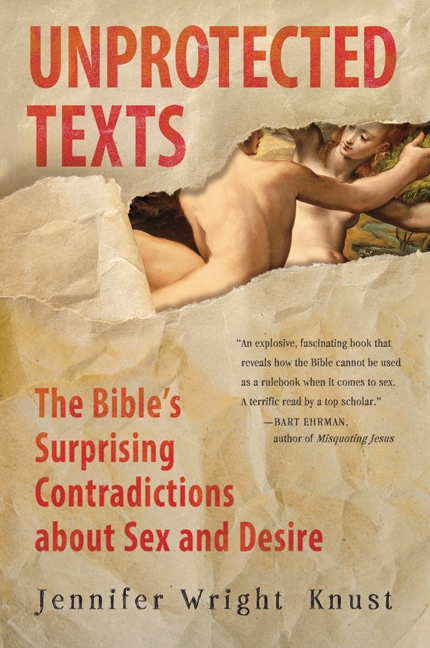
Unprotected Texts: The Bible’s Surprising Contradictions About Sex and Desire, Jennifer Wright Knust. HarperOne 2011.

Jennifer Wright Knust’s Unprotected Texts does not explore a great deal of new ground, but the ground it explores it covers with considerable thoroughness, in a few cases with more than is needed. Writing from both her expertise as a biblical scholar and her life experience, Knust sets out to demonstrate that the Bible neither is nor should be a simple answer book for complex moral issues involving sexuality. Her primary method is to document the considerable concrete inconsistencies in the biblical text, as well as the seeming lack of discomfort the text evinces when particular biblical personalities stray from the purported strait and narrow.

She is much more successful, persuasive, and on firmer ground, with the former approach than the latter. The Bible is inconsistent or unclear on a number of topics related to sexuality, and while it shouldn’t take a scholar to point that out, it is helpful for one to do so, in particular to the extent Knust does. The second approach is far less useful — as is evident from a number of reviews written from a more conservative perspective than mine. That Rahab the harlot or Ruth the Moabite are lauded as persons will not be seen as an endorsement either of harlotry or premarital sex by anyone disposed to see these actions as sinful. Nor does the Scripture appear to endorse the actions themselves — or particularly to condemn them for that matter. This supports Knust’s larger case that we will not find easy answers to questions such as, “Is premarital sex immoral?” in a neat table on page 732 of a floppy Bible, next to the one for Biblical Weights and Measures. (Knust herself offers a number of tables that lay out biblical inconsistencies with great clarity.) But for a modern audience already well-settled in the cozy myth of a “biblical teaching on sexuality” more will be required than Knust offers to unsettle them and remove the scales from their eyes. It will take a brow of flint to confront the obdurate mind-set that looks but doesn’t see, hears but does not understand.

In spite of the weight of scholarship, insufficient as it might be in the long run, the book is a fairly easy read; it is divided and subdivided into fairly short sections with catchy subheadings. As the argument is not so much cumulative as a mosaic of individual elements, each of which highlights the central premise, the book is easily picked up or set down at leisure.

Although I resonate with Knust’s overall argument, I take some exception to a few of her particular readings. For example, when Paul counsels the Corinthians (1 Cor 6) not to be joined with prostitutes, I do not think Paul’s use of the word member is in reference to the sexual organ of an individual man. (The English member used for the male sexual organ is a relic of Victorian squeamishness, and a confusing word choice still with us in the NRSV, where member has another primary meaning; a better translation would be “meat” or “flesh” as in the KJV. The “member” of which Paul speaks is a different word entirely.) I must also note that transliteration of Hebrew is inconsistent, and in one case in error.

To the general reader, however, the greatest disappointment will be the last full chapter before the short conclusion. It includes an exhaustive, and somewhat exhausting, exploration of everything you ever wanted to know about circumcision, and much you didn’t want to know; and knowing, wonder why it is of help to know it. As such it seems to be at a remove from the primary concerns of the book. And in spite of the rousing coda which follows it, this long chapter comes as a bit of a letdown.

Still, Knust has some important things to say, and they are well worth hearing. It is unfortunate that much of what she says will fail to persuade those more comfortable with simple answers to complex questions. There is a difference between not seeing the forest for the trees and not seeing the trees for the forest — in this case, the “forest” as the largely unfounded belief that there is a “biblical teaching on sexuality,” which blinds most people to the actual complexity and richness of the biblical text. Knust’s book highlights these complexities, but not to the extent or with the clarity to shatter the myth once and for all. Some will insist — in spite of the detailed evidence Knust lays out — that there is still some clearly discernible sex ethic to be found in Scripture.

And to some extent, there is — just not the one they think. Knust is not claiming that there is no help from Scripture when it comes to sex. What she affirms is that the Bible will not give us easy or specific answers to the questions now being asked of it. It is not, as she suggests in her concluding chapter, about physical perfection but faithfulness. It is about treating the Bible not as a mere answer book but as a rich history and revelation, from which guidance will be gained only by an approach that engages with it as it is, finding the way through the forest by minding every tree and discerning every path. And the same goes for life itself, doesn’t it?

Tobias Stanislas Haller BSG

This review is part of the TLC Book Tour for this volume.

October 27, 2010

Bully Church

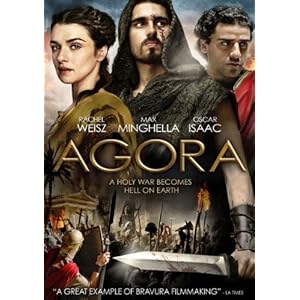
On my flight back from London Monday I saw a beautiful but disturbing film, "Agora," telling the story of 4th-century Alexandrian struggles between Christians, Pagans and Jews, centering on the figure of the philosopher Hypatia, whom even early Christian historians record was treated horribly by other Christians. It is beautifully filmed, if slow-paced; most of the "action" arises from the zealotry of some of the Christian mob, employing literal hubris to make their points against Jews and Pagans alike, and it is not exaggerated. The formerly persecuted become the chief persecutors. The church "wins" but at a terrible cost to reason, human dignity, and, I think, to its own best interest, and better self.

The film provides an interesting commentary on fanaticism, liberty of thinking, the terrible pressures of conformity to majority rule to the point of tyranny. When the gospel becomes not "this is what I believe" but "this is what you must believe" we have crossed a fearful boundary from grace to law — in contradiction to the very message intended. The church becomes a bully, a crowd of bullies, who stone and burn, and crucify. It becomes the thing it rightly rejects, and rejects the one whom the builders rejected. It lays waste while it claims to edify.

[Update: I neglected to mention that I watched this film in conjunction with rereading the Apostolic Fathers and other Ante-Nicene texts. I'm towards the end of Justin Martyr, writing in a period prior to that of Hypatia, when the Christians were on the sharp end of the stick. However, I have to say that I can see why Justin was martyred, and see the seeds of the very intolerance later displayed in Alexandria. Justin is contemptuous of pagans (the Apologies) and Jews (Dialogue with Trypho, A Jew) to the point of insult. His arguments are specious and tendentious, and when they fail to persuade he says it is just because his interlocutors are either demon-possessed pagans or God-damned Jews. Not a pretty sight; but it helped provide a context for "Agora."]

Speaking of paradox, however, the film also got me thinking — relying as it does on the symbol of the conic sections and the ellipse — about the divine and human natures of Christ. The ellipse is the actual course of our island home's orbit round the sun, not in fact the ideal shape, the circle. The ellipse has two centers, and its realization — its incarnation if you will — revolves around them so that the sum of the distance to each is always constant. As Hypatia says — in the film; I have no idea if she ever said such a thing in reality — "A circle is merely an ellipse in which the two centers coincide."

In any case, this is a commendable film, and I look to a second viewing at an altitude below 40,000 feet. (Though one repeated visual theme of the film is a God's-eye-view of earth from space, zooming in, or out, of the oculus of the temple of learning, which though round, from an angle forms the double-centered and paradoxical ellipse.)

Tobias Stanislas Haller BSG
Another update: Please check out Faith L. Justice's analysis of the historical realities as represented in the film, at a blog I will definitely revisit "Historian's Notebook."

October 13, 2010

Something Borrowed, Something New


A review of Ancient Faith, Future Mission, edited by Steven Croft, Ian Mobsby & Stephanie Spellers. Seabury Books 2010. (The Episcopal New Yorker, Summer 2010).

Just about 200 years ago, Presiding Bishop William White recorded his thoughts about enlivening the worship of the Episcopal Church with additional hymns:

As to the loading of our book with the same truths in a diversity of language and of metre, or, in any other way, the seeking of variety for its own sake, there is pleasure in recording the opinion, that it will never tend to the sustaining either of truth or of devotion. (Memoirs, the Convention of 1808)

There is nothing new about the search for novelty, or of such cautious warnings not so far to expand the edges as to lose touch with the center. In our present day, the urge to expansion and experimentation has been fueled and energized by “The Emergent Church.” The present collection of essays provides a helpful overview this exploration, as well as providing cautions of its own.

The voices in these 16 essays, introduced by our present Presiding Bishop, range from the scholarly to the pragmatic; from the Archbishop of Canterbury to leaders of emergent congregations. The editors, in a brief foreword, indicate that each contribution was made without reference to the others; so there is considerable repetition of primary themes as well as occasional disagreement. However, the dissonances tend to resolve harmoniously, and converge upon a basic drive for mission.

Echoing William White, this movement is not about variety for its own sake; nor is it a formulaic solution to the problems of decline. This is not merely about new vestments, rearranging the furniture, coopting some ancient tradition (whether Gregorian chant or the labyrinth), or adopting the latest thing in electro-pop. Nor is this a game of children dressing up in their grandparents’ clothes, but a call to deep engagement with what is emerging — to borrow Thomas Brackett’s phrase, “midwifing the movement of the Spirit.” In her contribution to the collection, Phyllis Tickle suggests that the present Great Emergence is the next wave in the 500-year cycle of seismic changes that have rippled through the Church. Something new is coming — and the present Church is both mother and midwife to the change, both subject and object. We are all part of this process, whether we know it or not.

It is no surprise that most of the essays in this collection deal with liturgy. Anglicans have long understood their faith to be constituted in their worship. It is therefore welcome to find several reminders — drawing on such luminaries as Frank Weston — that worship without mission is precious at best and scandalous at worst. It is heartening to see that a number of the emergent experiences in these pages are based on outreach to people living on the fringes of society — and to see cathedral churches revivified and renewed by taking such human treasures seriously, and embracing them.

The quality of the essays is variable, and as already noted there is a good bit of repetition. But each of them offers a thoughtful suggestion or correction to take to heart, as the whole Church engages with its ministry of bringing its own new self into being.

Tobias Stanislas Haller BSG

February 25, 2010

Another (Re)View...

...of Reasonable and Holy


Anglican Christianity has long had a tradition of scholarly parsons. At the head of this line stands Hooker, of course, and it is Hooker who presides over Reasonable and Holy, the learned work of another learned parish priest. It is one thing to quote Hooker’s words, as Tobias Haller frequently does, and something more difficult, more admirable, and more worthwhile to emulate his approach and his temperament. Haller does that too.

Hooker’s was in the first instance controversial theology, aimed at answering and controverting a stated position, strongly held, on matters of practical import for the church as a whole. Likewise, Haller seeks to meet opponents on their own ground, assessing their arguments carefully and refuting them courteously, rather than simply dismissing them and insisting on his own alternative. The ground, in this case, is primarily biblical. However important the natural-law tradition has been or may still be in addressing the questions at issue, that is not where Anglicans who disapprove of same-sexual relations commonly take their stand. Accordingly, neither does Haller. On the one hand, he does not take the standard line of appealing to the moral virtue of justice, which would be a form of natural-law argument; on the other, he need not and does not deal with consequentialist arguments to the effect that any change in longstanding prohibitions with regard to same-sexuality will have evil effects. The arguments that are relevant here are arguments from authority, and the relevant authority is that of canonical texts.

Nevertheless, for Haller as for Hooker, it remains that not even scriptural texts are self-interpreting. They have to be understood, and understanding them calls for rationality. The relevant passages—all the usual ones—need to be examined reasonably, which is quite a different thing from submitting them to a priori judgment. In other words, there is exegetical homework to be done. It is true that Haller does not dive into the maelstrom of “higher,” historical-critical interpretation. He takes the Bible, deliberately, as it stands, and takes it as holy Scripture, in the way that the church has taken it and that Paul and Jesus took it. In that regard, as in others, Reasonable and Holy is quite a conservative book. Yet by no means does it follow that scholarly investigation is superfluous. Quite the contrary. Haller does not parade his erudition; he does exercise it. Where the nuances of Greek and Hebrew are relevant, he refers to them. He also brings into the conversation a good deal of rabbinic exegesis, with which his own has perhaps a certain affinity.

There are no sweeping judgments here. To use his own phrase, Haller does not offer a Grand Unified Theory of Sexuality, in which everything the Bible has to say finds a clear-cut, logical place. In fact much of his book is aimed, explicitly or otherwise, at those who have put forward such artificial, totalizing schemes as the answer to current disputes. That is not what he means by being reasonable. He means—to judge by what he does—drawing careful distinctions, gauging the merits of possibly relevant interpretations, and mounting a case that depends on the cumulative weight of all its components. “Judicious” might be the right word.

That being so, even if it were possible to summarize the argument, a summary would be out of place. The value of Reasonable and Holy lies not in its conclusions alone but chiefly in the way Haller reaches them. What should, however, be emphasized is the user-friendliness of his book, its learnedness notwithstanding. The sidebars and callouts will help readers keep their place. Headings are memorably phrased, and just occasionally over the top (“Don’t be so shellfish”). There are no footnotes and, more seriously, there is no index—not, that is, in the book itself. But an index of names and another of textual references can be consulted online. Now that the General Convention of the Episcopal Church has committed itself to “an open process for the consideration of theological and liturgical resources for the blessing of same gender relationships,” whoever is charged with compiling those resources will want to add this book to the list.

CHARLES HEFLING
Boston College
Chestnut Hill, Massachusetts

From The Anglican Theological Review Winter 2010, Volume 92 Number 1, 225-226.


March 22, 2009

Fruit of the Rule of Love

a review of Find Your Way Home: Words from the Street, Wisdom from the Heart; by the Women of Magdalene with Becca Stevens. Nashville: Abingdon Press, 2008

The Rule of Saint Benedict is commonly credited with being one of the instruments by which Western civilization was supported and maintained through some difficult times in its early middle age. The Rule’s sanity, generosity, and above all, charity, are the means by which a community of persons can foster stability, through inward conversion from inordinate focus on the self towards living with and for others.

The remarkable elasticity of the Rule led to many adaptations and revisions — and reforms — down through the years. But I think that none even of the most ardent revisers or reformers would ever have conceived that an adaptation of the Rule would bring new life to scores of women who until that transformative encounter had been living on the streets as prostitutes and drug addicts. But as the old song says, grace is amazing.

A little over a decade old, Magdalene is a two-year residential and support community for women coming out of correctional facilities or off the street, from lives marked by abuse, prostitution and addiction. It began with the Reverend Becca Stevens, Episcopal chaplain at Saint Augustine’s (Vanderbilt University). She conceived of creating a safe place for women, a place not merely as a house but as a home. We all know there is a difference, a crucial one.

We also know how sadly true it is for the church both to get and to give the second-best (“I’m buying a new microwave so I’ll give the old one to the church...” You know how it goes.) Becca insisted that this home would be properly furnished, with decent furniture and a real comfortable living room, and bedrooms with beds with clean sheets. It would also be located in a residential district; not just outside the prison doors or the city gates. Soon one house grew to two and then another, as those who lived there truly found new life. Magdalene has expanded to include programs helping male first-time offenders understand and come to terms with how demeaning their use of women is, and the harm they do in contributing to a brutal system. Thistle Farms, a nonprofit maker of all-natural body care products, was launched in 2001. It is named for the hardy plant that is the sole survivor on streets the women walked in their former lives — and again in their new lives as angels of mercy helping other women to move from the old life to the new.

In Find Your Way Home the women of Magdalene recite their Rule and tell their story. In some ways reading this tender volume is like being present at a Greater Chapter, where by tradition the members of the Benedictine household would hear their Rule and reflect on it. True to Benedict’s own injunction that the youngest shall be heard, this collection of voices reflects the range of participants in the Magdalene households.

A major feature of these households is that they are not “run” so much as lived in. Although there are staff and volunteer supporters, it is the women themselves who form the community and learn to work out their differences within that community by following the Rule and living into it. Such is its generous charity that women who had been hardened by abuse — both by others and of themselves — have found themselves transformed by love.

The Rule itself, broken down chapter by chapter into short segments, is a wonderful adaptation of Benedict’s charitable and sane spirit. The reflections by the women of Magdalene that follow each section of the Rule form a powerfully moving recitation. Remember, for many of these women this will be the first time they have lived in a real home or experienced love from another person, or in some cases for another person. Imagine the experience of a woman fresh from prison being given a key to the front door and a room of her own with clean sheets on the bed. Well, you don’t have to imagine — her testimony is there for you to read. And it will move your heart.

I am tempted to cite other of passages but instead I simply urge you to obtain a copy of this short book. I began reading it on the subway on my way to a diocesan meeting and found tears running down my face as I read of the gratitude that woman felt on being given a key, as she knelt down to kiss the floor of her new home. There are many such moments of healing, thanksgiving, and transformation in this little book. It is a reassurance that God is at work.

The Rule of the women of Magdalene has something to say to us all as well. By that I mean all Christians, but particularly in these days of tension in the Anglican Communion, it is well to remember that Gregory the Great, who sent Augustine to England and so in some sense founded the Church of England, was an admirer and first biographer of Benedict. And so I will end this brief review with one of the chapters of the Rule to which I think it would do us all good to attend:

Chapter 8: Let God Sort It Out
In community our job is not to judge or say, “I told you so.” We trust that God will sort things out, so we don’t have to second-guess every decision someone else makes.
We are here to love one another in the most radical way possible, without judgment, and to pray that others can love us in the same way.
We give drink to the thirsty, food to the hungry, comfort to the sorrowful, clothing to the naked, and companionship to the imprisoned and dying. We wash one another’s feet.

Couldn’t the Anglican Communion learn something from the women of Magdalene? They have surely grasped an aspect of the life-saving, life-giving Gospel that many of us seem to have forgotten. It is not too late to learn from the thistle and its farmers, not too late to follow the example of the woman who loved much, rather than the Pharisee who sat in judgment.

— Tobias Stanislas Haller BSG


You can hear more from the women of Magdalene at the new blog, Voices of Thistle Farms.