Showing posts with label scripture. Show all posts

May 21, 2016

The Importance of Being Articles

I don't have the time to flesh it out in full just at the moment, but I want to flag how important close attention to text is to any case made concerning marriage. There are two places in Scripture where inattention to the difference between definite and indefinite nouns has wrought havoc with a consistent and canonical comprehension of the texts.

First, when Genesis 1:27 and 5:2 speaks of "male and female" (zakar u'nqebah) it is using nouns, not adjectives. It would be better to translate as "a male and a female." Reading this text as referring to classes of people instead of two individuals has given rise to much unproductive theological reflection concerning everything from the nature of the image of God to a defective anthropology that squeezes the understanding of humanity into a dualistic, yin-yang strait-jacket.

Evidence for the correct reading (as nouns and not adjectives) comes in part from Jesus' reading of the passage to be about a pair: the "two" who become one. (Mark 10:8; as in Matthew, Jesus picks up the LXX version of Genesis which refers to "the two" -- an emphasis not needed in the Hebrew). Jesus uses this as his starting point for the durability of marriage. (I've noted elsewhere that the Qumran texts follow this reading concerning "the two" in support of the call for radical monogamy.)

Additional canonical support for this reading comes from Genesis itself: whenever the phrase occurs in Genesis it could (and should) be translated with the indefinite article to indicate nouns are being used, rather than cast as adjectives. This is perhaps clearest Genesis 6:19 and 7:3,9, and 19 (the only other uses of this phrase in Genesis), all of which refer to the pairs of animals to be saved in the ark. Each pair consists of one male and one female. (Note that other uses of "male and female" in English translations of Genesis, such as references to "male and female slaves" add further confusion. No words for "male" or "female" occur in these passages; there are separate Hebrew words for "a male slave" and "a female slave.")

The second mistaken reading (unfortunately well enshrined in the tradition) is the reading of Ephesians 5:32 that forces "Paul" to make the very unlikely statement that marriage is a great mystery -- understood as a sacrament. Again, I've written about this at some length elsewhere, but want to flag the problems with this reading here. First, it is obviously inconsistent to suggest that the Pauline School (if not Paul himself -- there being some disagreement as to the authorship of the epistle) would attach a quasi-divine status to an institution elsewhere in "his" writings given scant honor beyond its social utility. Second, this is not the only verse in the epistle to refer to "mystery" -- and as the author makes clear in the following clause, he is talking about that same mystery that is addressed throughout the document -- the mystery of Christ and of the Church, how the two become one, a mystery reflected in -- but not consisting of -- the marriage of a man and a woman. And, of course, that is what the text says, though bad translations have twisted it in such a way as to have the author speak of "a" great mystery -- one such marvel among many. But a literal translation of the verse, far from saying "This is a great mystery," would read, "This mystery is great -- but I speak of Christ and of the Church." Not marriage, not the verse from Genesis; but the mystery of salvation in Christ, in which all of humanity, Jew and Gentile, is taken up and redeemed. And if that isn't a genuinely Pauline message I don't know what is.

Tobias Stanislas Haller BSG


March 10, 2016

Disagreement, Good and Bad

The Church of England is in the process of exploring the limits of disagreement on matters of sexuality. One might say the Anglican Communion as a whole is doing the same. England already reached a settlement on the propriety of women bishops, allowing "both integrities" to flourish side by side in peaceful contradiction. (The nation that gave us Lewis Carroll has done itself proud in this.)

The goal, of course, is a peaceful detente, going by the name "good disagreement." The church has been plagued by disagreement -- good and bad -- from the days of Peter and Paul. Ultimately it is the object of the (dis)agreement that determines whether it can be (a) a peaceable willingness to bear with difference or (b) a cause for schism. "It seemed important at the time" is the watchword of warning for any church tempted to divide over what may turn out in the long run to have been a minor point of dispute. Remember the common cup, and vernacular liturgy? Or circumcision? The church's history is draped with conflicts that in retrospect have faded and lost their color; so much so one is tempted to ask, "What was the matter?" What matters — the living Text — is Christ, and him crucified, died, buried, risen and ascended. All the rest is gloss.

Tobias Stanislas Haller BSG

June 13, 2014

NT Wright: Wrong Again

NT Wright is a distinguished scholar in the area of New Testament studies, but when he gets off his primary topic and into the muddy waters of the marriage equality debate he does not serve either himself or his reputation well, particularly when his comments are off-the-cuff in an interview. That being said, it should be expected that any competent scholar would be able to avoid the shoals of error upon which Wright founders in this conversation.

And a strange conversation it is. Wright begins by launching into an ill-informed and curmudgeonly argument about the meaning of the word marriage. His claim is that applying marriage to a same-sex couple is a total novelty — not just in English but across all cultures — and implies that the effort to give it that meaning is similar to word-torture by Nazis and the Politburo. Marriage, he claims, has “always been male plus female.”

He is obviously wrong when it comes to English; perhaps he is to be forgiven for not having heard of the 19th century “Boston marriages” in Durham. But as a scholar he is distressingly ill-informed when it comes to the language of Scripture. It has to be admitted that the Hebrew and Greek texts do not have a simple word for the concept of “marriage” — or for “husband” or “wife” for that matter, as the common words are simply the words for “man” and “woman” or (in the case of men, the equivalent of the word “lord.”) The Hebrew words for “marriage” normally revolve around the concepts of taking or carrying off — a relic of which still exists in our marriage rite as each spouse “takes” the other. And this language was applied to same-sex couples in the rabbinic tradition: it is used in Sifra Aharei Mot 8:8 in its interpretation of what Leviticus forbids in terms of the practice of the peoples distinguished from God’s people. “A man married a man and a woman a woman, a man married a woman and her daughter, and a woman married two men.” The word translated “married” here is the same used in Scripture in Ruth, Ezra, and Nehemiah. So the Hebrew mind was capable of wrapping itself around the notion of same-sex marriage, even while disapproving of it. Whether such marriages actually were a part of the Egyptian and Canaanite societies is beside the point, though if they were that would undercut Wright’s thesis as well.

So Wright can assert his counterfactual on word usage as much as he likes, but marriage not only has been used to refer to same-sex marriages for millennia, but it is now part of civil law in many countries. His response: “Simply at that level, I think it’s a nonsense. It’s like a government voting that black should be white. Sorry, you can vote that if you like, you can pass it by a total majority, but it isn’t actually going to change the reality.” Obviously he is also unaware that the English word “black” derives from the Anglo-saxon blæc — meaning “white.” (Think “bleach”). But let that pass.

More serious is Wright’s assertion that what he calls “complementarity” of “pairs that work together” lies at the heart of the created order. But it seems very odd to talk of “heaven and earth” and “sea and dry land” as “working together” in the way a man and a woman do. I have no doubt that the narrative shows a man and a woman working together — but I do not see any evidence that heaven and earth or sea and dry land “work together”; to say nothing of the many other “binaries” in Genesis 1: light and dark, fish and birds, plants and trees — to say nothing of the triads such as the sun, moon and stars. Wright is either just straining to read something into all of this to support his exclusion of same-sex pairs (which, after all, are also pairs who work together!) or indulging in a reading that would be more appropriate to the I Ching, which does indeed conceive the cosmos as being built up from opposites.

Moreover — and again Wright should know this but his antipathy towards marriage equality appears to have induced some biblical blind spots — the “marriage” portrayed in Scripture is not complementary or balanced. The institution of marriage in both Testaments is tilted strongly towards male privilege and power. This is why in the allegories the husband figures God or Christ, and the wife the people of God or the Church. It is true that there are some passing descriptions of real marriages where some sort of mutuality is enjoined or enjoyed, and the Pauline tradition attempts gingerly and modestly to even the scales ever so slightly, but when it comes to imagery the balance tips to the man, away from the woman.

In the final section of the interview Wright show all the signs of frustration at a lost cause. I can almost hear him holding his breath at the end, after a final foot-stomp. He compares the movement for equal marriage to the pressure towards war in Iraq (and why is it that all of his comparisons are violent and over the top). He seems to think that being on the wrong side of history is a statement about trends and pressures. History doesn’t force things, it records them. In this interview, Wright is wrong about history as well as being on the wrong side of it.

Tobias Stanislas Haller BSG


June 4, 2014

Thought for 6.4.14

When we approach the Scripture, we bring to it all of the many traditions and past understandings that can obstruct our seeing what the text would reveal if we could approach it with new eyes. It is like a beautiful wooden cross that has been given coat after coat of varnish, so that what we see is the varnished surface rather than the beautiful grain of the wood beneath.

Tobias Stanislas Haller BSG

April 9, 2014

Sabbatical Leave: How Jesus Dealt with the Law

Jesus said to them, “I will ask you one thing; Is it lawful on the sabbath days to do good, or to do evil? to save life, or to destroy it?” And they were filled with madness; and communed one with another what they might do to Jesus. (Luke 6:9,11)

One of the major conflicts between Jesus and some of the religious leaders of his time concerned the nature of Sabbath observance. It is good, first of all, to acknowledge that this dispute is not, as sometimes portrayed, a conflict between Jesus and Jews. This is a dispute among Jews on a Jewish question, concerning a law which they all would have agreed was a Jewish law. That is, although the principle of the Sabbath went back to creation itself, the ordinance to do no work — to stop, for that is the root meaning of the verb from which Sabbath likely derives — was part of the Law given to Moses on Sinai.

Where Jesus differs from his interlocutors in this conflict is in his moving outside the formal definition of the Sabbath as a time to cease all activity. Jesus recasts it as a time in which to perform acts which he holds to be virtuous in themselves: not mere work but actions that are “good” in that the works represent, in themselves, a thing that is undeniably good: release from bondage — a central theme in the Jewish story. In short, Jesus does not see the Sabbath as an end in itself, or a restriction to be maintained apart from a larger context.

In various of the encounters Jesus has over the Sabbath, he offers differing explanations, and engages in classic rabbinic debate. For example, in Matthew 12 there are two successive arguments about the Sabbath. In the first, his disciples are eating grain they pluck as they walk along (technically not a violation of the Sabbath as it does not constitute harvesting; but Jesus does not engage that quibble). Jesus offers two responses to those who object to this action: he cites David’s violation of the temple-bread taboo, and the present day violation of the Sabbath by the temple priests who go about their work within the sacred precincts. Jesus responds that “here is something greater than the Temple,” making use of a standard rabbinical exegetical tool, qal wa-homer (light to heavy, “then how much more,” identical to the classical rhetorical device a fortiori). Jesus raises the bar with a biblical citation, that God desires mercy, not sacrifice (Hosea 6:6), and asserts that the Son of Man is Lord of the Sabbath. (Mark’s version [2:27] of this controversy includes the important transitional teaching based on the sequence of events in Genesis 1, that “the Sabbath was made for man, not man for the Sabbath” as the reason, again all the more, that the Son of Man should be its Lord.) This "greater than the Temple" theme may be seen as a part of a general anti-Temple trend in the Jesus tradition (one shared with some contemporary sectarian movement such as the Yachad at Qumran), but it also begins to establish a context: that things are good and virtuous as they serve the furtherance of God’s will for human well-being, not simply in and of themselves. Even the Temple is good only in so far as it is not misused, but remains available as a "house of prayer" rather than a "den of robbers."

The point is emphasized in the following scene. Here (in Matthew) it is the opponents who pose the question about whether it is right to heal on the Sabbath. Jesus responds with another qal wa-homer comparison of the rescue of a sheep from a pit with the healing of a human being. The pericope of the woman in Luke 13 (16-17) is treated in a similar way: if you are kind to your domestic animals, releasing them to be led to water, how much more ought you to rejoice in the liberation of a woman from bondage to illness — noting once again the theme of delivery from captivity so central to the People of God.

In all of this it is possible to see how Jesus contexualizes and even relativizes the commandment to cease work on the Sabbath, by holding that acts — particularly acts of deliverance, restoration, and human flourishing — that are good are still good even when done on the Sabbath. That is, they do not become bad because they are done on the Sabbath, and it is not the Sabbath that makes them good, but the good acts which give honor to the Sabbath. Perhaps in giving honor to the Sabbath the works become even more virtuous. His opponents have come to see the Sabbath as an end in itself, not as a context for doing good, but only about "not doing" or ceasing from doing, regardless of how good the action.

In the same way, some see marriage as an end in itself, rather than as a context for the flourishing of loving human relationships, and a sanctified means (though not the only means) for liberation from the primal situation of isolation. Observe that according to the account in Genesis 2 (taking Jesus' lead in noting the sequence in Genesis 1) that people are not made for marriage, but marriage is made for them: that is, the human comes first, and marriage is instituted as a solution to the problem of human isolation, and that only after the first attempt to find a mate for Adam among the animals.

Tobias Stanislas Haller BSG

January 23, 2013

Thought for 1.23.13

Political fundamentalists read the Constitution in the same way that religious fundamentalists read the Bible: without context. While claiming to be faithful and literal, their understanding often wanders very far both from the text and its original intent.

Tobias Stanislas Haller BSG
Thinking particularly of those who imagine a militia was designed to attack the government rather than to serve it...

October 30, 2012

Cultural Dissonance

Many conservative Christians are willing to acknowledge that the Scripture reflects the cultures of its time when it comes to social and economic issues, but seem to be unable to see the same influence of long-gone culture on attitudes towards sex and sexuality. They will sometimes find ingenious ways of sheltering the latter from a social or cultural critique or amendment, such as asserting that some things are creation ordinances while others are mere management of human weakness — which doesn't hold up well on examination, since some of the commands issued at creation have since been eliminated or ignored; or by claiming that the Law of Moses can neatly be divided between "civil" and "sacred" matters — a notion the theocrat Moses would have found to be very odd indeed.

It is fine to say that the church should not bend to the culture of this age, but also fair to point out that the church need not bend to the culture of some former age, merely on the grounds that the culture in question was dominant at the time the scriptures were recorded.

Tobias Stanislas Haller BSG

May 14, 2012

In Africa, The Spirit Leads Us


Conversations on the Scripture in South Africa 2011

In October 2011, some 25 Anglican leaders from across Africa gathered with more than a dozen Episcopalians from the United States for a consultation on issues of justice and human sexuality.

For three days the group prayed, studied the Bible, listened to presentations and talked about issues of theology, sexuality and culture. When formal sessions ended, they talked into the night, all in an attempt to better understand one another, and the unique context in which each participant lived and ministered.

The Chicago Consultation was proud to sponsor this event at the Salt Rock Hotel in Durban, South Africa with our partners from the Ujamaa Centre at the University of KwaZulu Natal.

This 11-minute video captures some of the high points of the gathering, including moving personal testimony from several participants.

The “Listeners’ Report, written by a team led by the Rev. Canon Janet Trisk, the Church of Southern Africa’s clergy representative to the Anglican Consultative Council, gives a comprehensive account of the time the group spent together.

The list of participants includes several people who attended at some risk to their careers and ministries, but permitted their names to be made public nonetheless.

Members of eight African provinces participated in the consultation, including a bishop from Nigeria, the general secretary of the Council of Anglican Provinces of Africa, the provincial secretary of the Church of Tanzania and numerous seminary faculty.

The delegation from the Episcopal Church included Bishops Jeff Lee of Chicago and Mark Beckwith of Newark, the Rev. Gay Jennings, the Episcopal Church’s clergy representative to the Anglican Consultative Council and the Rev. Bonnie Perry, co-convener of the Chicago Consultation.

Interfaith and ecumenical guests included a gay imam, representatives of the Church of Sweden and clergy of the Methodist and Dutch Reformed Church.

During much of the recent upheaval in the Anglican Communion over issues of sexuality we have been told that those of us who favor the full inclusion of lesbian, gay, bisexual and transgender people in the church have no partners for conversation, in Africa no brothers and sisters who will join us in ministry.

The experience of the consultation tells us that this is not true, that the bonds of affection that sustain the Anglican Communion remain strong, and that generous-spirited Anglicans around the globe are more eager than ever to enter into the deep, prayerful, scripturally-informed conversations on which the future of the Communion will be built.

March 20, 2012

Meaning and Intent: Porneia in the Apostolic Fathers

Peter Carrell of Anglican Down Under (and Hermeneutics and Human Dignity) and I engaged in what for me was a fruitful discussion a while back. I hope it was for him as well. It grew out of his response to my book Reasonable and Holy and my efforts to answer some of his concerns and questions about my method and conclusions. One of these involved my reliance on rabbinic sources to try to come to an understanding of the meaning of the porneia word group, in response to the assertion by some, such as Robert Gagnon, that Jesus’ use of the word must necessarily include condemnation of same-sex relationships. This derives in part from the paired assertions that the word and its relatives refer both to any sexual behavior forbidden by Scripture (with particular reference to Leviticus 18) and that it had a broad and imprecise range of meaning, covering any kind of sexual immorality, as a few lexicons claim and a few versions of ancient texts translate. All of this stands in contrast to the understanding that relates the word to harlotry ("whore" being the meaning of the root), and the evidence that the overwhelming use of the word-group in the Hebrew texts refers either to (1) prostitution or (2) figuratively to idolatry.

My goal was to assess the accuracy of the assertions and translations, and discover what the word and its relatives actually would mean to hearers in those contexts, and if it is was as broad and inclusive as some lexicons suggest, or rather designed as a more limited category, and if so, what. Peter further wondered why, in my search for answers, I turned to the rabbinic texts rather than looking more to early Christian texts. In addition to offering an explanation, I will take the opportunity to do just as Peter suggests at the end of this exposition.

First, though, I wish to establish one basic principle, which I hope goes almost without saying. However, I had better say it just to be clear. And that is the evident truth that words change their meanings — both the meaning intended and the meaning conveyed. A word may have an explicit meaning in the mind of the speaker, but if it is capable of conveying a range of meanings, a listener may well misunderstand the speaker's intent. In normal conversation one can correct such misapprehensions, but when the "speaker" is a "writer" and the text some centuries old, other tools for understanding need to be employed. This is a particular challenge to translators of ancient texts, if they are to convey to modern readers a sense of what the ancient author intended.

So an accurate translation of a text or definition of a word requires the translator or the lexicographer to be immersed in the world and culture of the time in which the texts were written. Those familiar with the Hebrew Scriptures or classical Greek or Roman literature should not be surprised to know that there are human activities, some of them sexual, that were considered moral or morally neutral, or perhaps even virtuous, in those cultures that we now consider definitely immoral; and vice versa: there are actions considered serious breaches in Leviticus and the Pauline Epistles that scarcely raise an eyebrow in these latter days. Thus, to translate porneia (or its Hebrew equivalents) as vaguely as “sexual immorality” fails to take due notice of distinctions that careful study reveals would have been made by the speakers or writers, and easily allows a modern reader to think the ancient author may have been condemning something that we find offensive but which the author may have found neutral or even acceptable. (It may well be that this broadening has come about second hand through a broadening given to the word fornication — a standard translation for porneia. Originally a fairly narrow category, this word came, in popular speech, to be used as a synonym or euphemism for any sexual act, including between married couples!)

A case in point is some lexicons’ suggestion that porneia means “adultery.” The fact is it can be used to mean adultery as we understand it today, but this blurs an important distinction from the times of the writing. Our modern equality-of-the-sexes understanding of adultery does not match the double standard of the cultures of the biblical period. Under Jewish law a man was free to have intercourse with unmarried women (prostitutes), or to take another wife. Under Roman law, though monogamy was the rule, a man could have a mistress or concubine, or freely resort to prostitutes. Given the inequality of the sexes, married women did not have these options. Male adultery meant violating another man’s marriage, female adultery meant violating her own. In Hebrew Scripture the word for adultery (na’af) covers “sexual intercourse with the wife or betrothed of another man,” in contrast with zana, “illicit heterosexual relations but not necessarily in violation of the marriage vow,” the latter being the equivalent of porneia and so translated in Greek. (TWOT, na’af) The Greek word for adultery, moixeia, is used in the Greek version of the Hebrew Scriptures and in the New Testament.

I would venture an even more precise distinction, however. There is a clear overlap with porneia and moixeia when it comes to women: a woman who strays from her husband is "playing the harlot." But a man who visits a prostitute or has a mistress is not legally guilty of moixeia — though we would consider him an adulterer, the ancients would not have done so. If they wished to cast opprobrium on such a man — and they often did, particularly under the influence of growing moralist movements in rabbinic Judaism, Christianity and Greek and Roman culture under Stoic influence — he would be tagged precisely with porneia. This is why the two words often appear together in lists of immoral behaviors, to condemn both men and women who are guilty of sexual relations in violation of marriage — but specifically to bring men under the same moral standard that applied to women, which moixeia alone did not accomplish.

See, for example the passage in Hebrews 13:4, “Let all honor marriage, and the marriage bed [be] undefiled, for God will judge the pornous and the moixous” — that is, those who are violators of their own or others’ marriages. This same pairing occurs in 1 Cor 6:9 where the employment of the pair to cover both categories is even clearer, as the words are separated by a disjunctive ou construction: neither porneia nor moixeia are acceptable. Similar pairings of the term occur in other Biblical texts, and in the early Christian writings, about which more in a moment)

But first I want to explain my primary reason for expounding the rabbinic evidence on this subject, rather than the early Christian usage. That is: the nature of the rabbinic discussion. While early Christian writers make use of the words porne and porneia, the rabbis actually engage in detailed discussion as to what the words (the Hebrew equivalents zonah and z’nut) mean, and what is included under the various shades of meaning. In short, while the meaning of the word has to be gleaned from verbal and cultural context in the early Christian sources, the rabbinic texts go to great pains precisely to define exactly what they meant — as fine points of law (halakhah).

Which brings me to the Apostolic Fathers and my other reason for not bringing them up: they add little to the discussion. The use of the porn- word group in the Apostolic Fathers is consistent with that in the canonical scriptures, though the words of this group do not appear very often. The most frequent use is paired with moixeia, in order to include men who have sex outside of marriage with an unmarried woman (whether a prostitute or a concubine). Again,this conflicts with our modern understanding of adultery as including extramarital sex by men or women, a notion foreign to the biblical and imperial Roman double-standard culture; hence the pairing in order to provide the equivalent of the modern inclusive concept of "adultery." This is, no doubt, what the lexicons mean when they say that the range of meaning for porneia includes adultery; it is adultery in the modern sense of the word, rather than in the sense that moixeia is used in those cultures. The point is that we no longer have a word that corresponds directly to what the ancients meant by moixeia, because we no longer maintain that double standard. I am reminded of the telling phrase my Hebrew professor, Dr. Richard Corney, used to cite: Traduttore traditore — to translate is to betray [apparently even this phrase!].

Some details from the Apostolic Fathers:

The root word porne occurs once, in 1 Clement 12.1, with reference to Rahab the harlot. This is the normative use of the equivalent word in the Hebrew scripture, referring to real or virtual (i.e., idolatry) harlots or harlotry.

The derivative words of this group occur a handful of times, always in conjunction with or paired with adultery. Hermas Mandate 4 1:1 gives a good example of the thinking behind this usage (note the use of fornication in these translations):

“I charge you,” said he, "to guard your chastity, and let no thought enter your heart of another man's wife, or of fornication, or of similar iniquities; for by doing this you commit a great sin. But if you always remember your own wife, you will never sin.”

This is clearly designed to rule out both adultery (as understood in the period) and resort to prostitutes or concubines.

Other examples include “vice lists” (Didache 5:1, Hermas Mandate 8 1:30) in which porneia and moixeia are paired. A twist on this in Hermas Mandate 4 1:5 deals with the case of a man with a straying wife and refers to her persistent “porneia” — which if a man tolerates makes him a “sharer in her adultery.” A similar note is struck in Didache 3:3, which is reminiscent of the proverbs concerning youth staying clear of loose women: “My child, be not a lustful one; for lust leads the way to fornication; neither a filthy talker, nor of lofty eye; for out of all these adulteries are engendered.”

Polycarp’s Letter to the Philippians 5:3 similarly quotes 1 Corinthians 6:9 as a particular counsel to youth to avoid being pornoi, as well as malakoi or arsenokoitai. This mention of the porn- root in conjunction with, though distinguished from, words commonly held to refer to male same-sex behavior (most likely prostitution or pederasty, as these were tolerated under Roman law), is echoed in the remaining uses of the word group. Barnabas 19:4 includes this trio: “You shall not commit fornication: you shalt not commit adultery: you shalt not be a corrupter of youth (paidophthoreseis).” This is echoed in Didache 2:2, which includes a long list of forbidden behaviors, including theft and murder. As I have noted before, these lists appear to indicate a distinction (even when not separated by “ou = nor” as in Didache 2:2 or 1 Corinthians 6:9) between the various items in order to include all possibilities. Ultimately, if the word porenia already included these possibilities as a kind of catch-all for any sexual indiscretion the lists would be superfluous.

It is thus clear that the early Christian use of the term and its relatives was closely related with prostitution and concubinage, equated with adultery by women, who were also classed as guilty of porneia by virtue of their straying: which for men we would call "adultery" but which the ancients distinguished from adultery on the basis of their legal codes.

To apply it to any form of sexual immorality (so judged either by the ancients or by us) is a translational step too far.

Tobias Stanislas Haller BSG

November 2, 2011

Hidden in (Not So) Plain Sight

One of the more interesting discussions at the recent conference I attended in South Africa concerned the nature of homosexuality in those parts of Africa where its presence is most vehemently denied or persecuted. Several of the lay and clergy leaders from those areas indicated that “homosexuality” was widely seen as some kind of alien import. They allowed, however, that as long as a man was married and had children, a concurrent sexual relationship with another man could — while still being viewed with opprobrium — likely be given a pass. Such a man would not be labeled as “homosexual.”

This reminds me, of course, of the situation in many communities even in the United States — thinking in particular of some Latino and African-American communities — based on their cultural construction of homosexuality. That is, a “man who sleeps with men” might well not be seen as “homosexual,” while an effeminate man or sissy-boy might be described as such even if he is a virgin and completely heterosexual in his orientation.

This is in part due to the confusion of the many variable axes that combine in human personality to define one’s identity. It isn’t just a matter of male and female (biological sex, and allowing for the reality of intersexuality), but of feminine and masculine (cultural or societal gender), attracted to one’s own sex or the other (sexual orientation), and so on. The simple fact, put simply, is that many gay men are not effeminate, and many effeminate men are not gay.

More importantly, the African situation reminds me of how it is that David and Jonathan’s relationship (with the emphasis on Jonathan’s attraction and attachment to David) can also be covered from perception as a same-sex relationship (which it no doubt is, regardless of whether acted upon erotically). The fact that both are “manly men” and warriors, both married (in David’s case we have quite a bit of evidence along that line), shields them — in cultures that cannot distinguish sexual orientation from notions of gender — from any suggestion of being what C.S. Lewis so revealingly called pansies. (The Four Loves, 62) While it is questionable to attempt to craft a psychological profile at such a remove, it is fair to say that David’s relationships with women all seem to be based either on the desire to possess and control or some kind of political or dynastic interest (as indeed may be true of his relationship with Jonathan in taking advantage of the latter’s attraction to him), while the relationship of Jonathan to David appears to be one of deep and lasting love. At least that is the language of the text. “Pansies”? No. Oriented towards a romantic relationship towards each other?” Very likely yes. At least David is not reported to have shed any tears over his female partners, and Jonathan’s testimony of complete dedication and what the text reveals as “love at first sight” is amply clear.

The role of choice

The question, “Is homosexuality natural or a choice?” also came up at the Conference in South Africa. The implication is that if it is a choice, it is a wrong choice, or at the least a choice that need not have been made, or could have been made otherwise. In earlier times it was assumed that the choice was a conscious act to choose wrongly — a perversity: doing deliberately and willfully what is known to be wrong.

Most gay and lesbian persons do not feel their orientation to be a choice, but something about which they become aware at some point in their life — just as do heterosexual persons of their sexual orientation. Most people, it seems, do not have much of a conscious awareness of sexual attraction in very early childhood, and begin to become aware of sexual attraction later in childhood or in early adolescence.

At this point the question of choice arises: do I choose to accept my inclinations? to act on them? to suppress them? Some people choose celibacy, while others choose relationship.

This leads me to reflect on the question, “Is choice a bad thing?” Aren’t we blessed to be chosen by the one who chooses us for life? The language of choosing and taking to oneself is intimately (!) connected with both salvation history and the life of human relationships; so much so that marriage is held to be an image of God’s relation to God’s Chosen.

Can this apply to same-sex relationships? Let me take another look at the relationship from Scripture that is often held up (and at the same time denied) as being homosexual, to which I alluded above: the story of the love of David and Jonathan. This is clearly a relationship between two men, but some do not see it as sexual in nature. It is true that sexual acts are not clearly recorded (though in a few places suggested) in the text — but this is true in large part of the Scriptural attitude towards descriptions of sex, which are usually veiled in metaphor or euphemism.

But let me start with a strongly negative view of the relationship between David and Jonathan from the text of Scripture itself. Jonathan’s father Saul verbally assails his son, when he says, “You son of a perverse, rebellious woman, do I not know that you have chosen the son of Jesse to your confusion, and the confusion of your mother’s nakedness.” (1 Samuel 20:30) Jonathan’s choice, is of course a choice, but it does not come from perversity. He has no wish to see the kingdom of his father fall to confusion, and to see the swift end of that dynasty. But Jonathan knows that he had little power not to chose the one whom he has chosen; the one to whom he knew his whole being to be bound when he first laid eyes on him, the one whom he loved as his own soul. (1 Samuel 18:1) This covenanted love (1 Samuel 18:3; 20:8,16,41-42; 23:18) was the greatest love he would ever know, the love for which he would eventually risk everything (1 Samuel 20:33) and lose his life; this wonderful love surpassing the love of women. (2 Samuel 1:26)

Was Jonathan wrong so to choose? I don’t think so.

Tobias Stanislas Haller


September 22, 2011

Scriptural Exhaustion or Inclusion

There are two primary ways to read Scripture. Both are “literal” in that they focus on the text itself, but they differ in how they attribute meaning to the text. The exhaustive view believes that a single correct reading excludes any other and exhausts the possibilities of meaning; the inclusive acknowledges that a given text may be capable of many meanings, including that discerned by the exhaustive school, but remaining open to meanings not yet discerned. The exhaustive view asserts clarity, often assumes perspecuity, and a univocal certainty. The inclusive accepts a degree of ambiguity, recognizes that texts convey meaning, that the meanings can be manifold, and the readings provisional.

The inclusive manner of reading is that of the rabbinic and the Patristic eras, of the Catholic tradition and (ironically) also of liberal protestantism; the exhaustive is represented in several strands of protestant conservatism. The inclusive manner allows the church to hold a number of interpretations, and part with those that science or reason eventually show to be untenable. The exhaustive, in the long run, often finds itself unable to navigate the waters of reality, having run aground, not on the text, but on the inflexibility and failure of their own interpretations to offer a credible word to a skeptical world.

Tobias Stanislas Haller BSG

March 24, 2011

No New Revelation

When addressing controverted subjects, we are called to look back on the Scriptural text for guidance in dealing with things about which those texts are themselves silent. The issue is not, "What would they have said?" on a topic about which they did not speak; but rather, "What do we say based on what those texts say about other things, using natural reason and knowledge gained since their writing to interpret old texts for new principles."

This is not about any new revelation. As one important story from rabbinic history shows: Revelation is now closed, but interpretation is open -- even a voice from heaven, even from God, cannot contravene the findings of the living interpretative community because, "It [i.e., the Law] is not in heaven" -- that is, God has given the Scripture to the people of God and it is up to us to wrestle with it.

People may well disagree about the outcomes of the wrestling match. And the question, "What Would Jesus Do?" is not entirely out of place, but has to be asked by positing Jesus not of his time, but as he is with us in our time -- as I believe he is, in his church, through his Spirit, which is now engaged in addressing challenges he did not address in those earlier days. There is no new revelation, but there is always new understanding.

Tobias Stanislas Haller BSG

March 5, 2011

Asking the questions

Mark Vernon's Guardian column has a great catchline at the head, and while the article as a whole doesn't quite live up to the pugnacity and poignancy of the slug, it is well worth reading. The catchline or slug is,

Why do we have such an unbalanced attitude to doubt, demanding certainty where there is none, and pretending to doubt what everyone knows?
This got me thinking about the level of certainty with which some approach the question of same-sex marriage: they are completely sure it is ruled out by Scripture, in spite of the fact that the evidence is indirect and circumstantial (that is, the Scripture does not rule out SSM in so many words, unlike, for instance Sifra on Aharei Mot in the Jewish tradition); and yet they take a very chary attitude towards the evidence of the experience of those who live in or witness the evident virtues of such longstanding relationships, and dismiss it as if living "experience" were somehow less reliable than their just-possible interpretation of ancient documents, venerable though that interpretation may be.

One can sense this tension in the papers and responses that grew out of the House of Bishops Theology Committee blue-ribbon panel of theologians and scholars, recently published in the Anglican Theological Review. I've just finished reading them and am allowing them to percolate before saying any more in detail, but I did sense, in the "traditionalist" papers and responses a growing awareness of this dissonance between ideology and reality.

The question is, in reference to Vernon's catchline, How long are people expected to submit to an unverifiable requirement when the experience of their own lives and of those closest to them casts more and more doubt on its veracity?

Tobias Stanislas Haller BSG

February 20, 2011

Thought for 02.20.11

Why is it so often the case that people who offer the challenge, “Where in the Bible does it say X?” are conservative Christians who should know perfectly well where in the Bible it says X but apparently don’t know, and who when shown where in the Bible it says X immediately try to explain it away is irrelevant, immaterial, and unimportant?

Tobias Stanislas Haller BSG

February 16, 2011

Forests, Trees, and Finding the Way

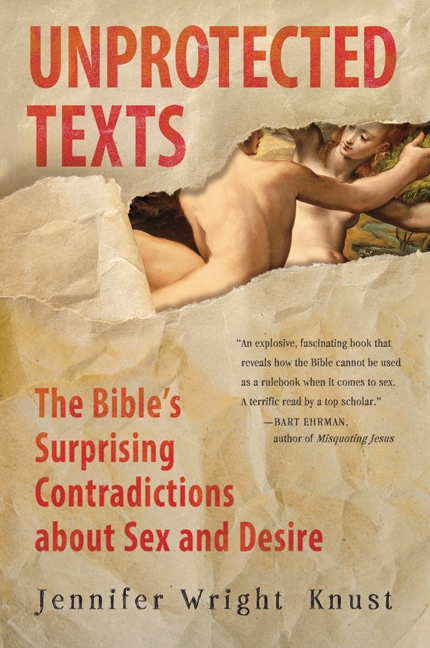
Unprotected Texts: The Bible’s Surprising Contradictions About Sex and Desire, Jennifer Wright Knust. HarperOne 2011.

Jennifer Wright Knust’s Unprotected Texts does not explore a great deal of new ground, but the ground it explores it covers with considerable thoroughness, in a few cases with more than is needed. Writing from both her expertise as a biblical scholar and her life experience, Knust sets out to demonstrate that the Bible neither is nor should be a simple answer book for complex moral issues involving sexuality. Her primary method is to document the considerable concrete inconsistencies in the biblical text, as well as the seeming lack of discomfort the text evinces when particular biblical personalities stray from the purported strait and narrow.

She is much more successful, persuasive, and on firmer ground, with the former approach than the latter. The Bible is inconsistent or unclear on a number of topics related to sexuality, and while it shouldn’t take a scholar to point that out, it is helpful for one to do so, in particular to the extent Knust does. The second approach is far less useful — as is evident from a number of reviews written from a more conservative perspective than mine. That Rahab the harlot or Ruth the Moabite are lauded as persons will not be seen as an endorsement either of harlotry or premarital sex by anyone disposed to see these actions as sinful. Nor does the Scripture appear to endorse the actions themselves — or particularly to condemn them for that matter. This supports Knust’s larger case that we will not find easy answers to questions such as, “Is premarital sex immoral?” in a neat table on page 732 of a floppy Bible, next to the one for Biblical Weights and Measures. (Knust herself offers a number of tables that lay out biblical inconsistencies with great clarity.) But for a modern audience already well-settled in the cozy myth of a “biblical teaching on sexuality” more will be required than Knust offers to unsettle them and remove the scales from their eyes. It will take a brow of flint to confront the obdurate mind-set that looks but doesn’t see, hears but does not understand.

In spite of the weight of scholarship, insufficient as it might be in the long run, the book is a fairly easy read; it is divided and subdivided into fairly short sections with catchy subheadings. As the argument is not so much cumulative as a mosaic of individual elements, each of which highlights the central premise, the book is easily picked up or set down at leisure.

Although I resonate with Knust’s overall argument, I take some exception to a few of her particular readings. For example, when Paul counsels the Corinthians (1 Cor 6) not to be joined with prostitutes, I do not think Paul’s use of the word member is in reference to the sexual organ of an individual man. (The English member used for the male sexual organ is a relic of Victorian squeamishness, and a confusing word choice still with us in the NRSV, where member has another primary meaning; a better translation would be “meat” or “flesh” as in the KJV. The “member” of which Paul speaks is a different word entirely.) I must also note that transliteration of Hebrew is inconsistent, and in one case in error.

To the general reader, however, the greatest disappointment will be the last full chapter before the short conclusion. It includes an exhaustive, and somewhat exhausting, exploration of everything you ever wanted to know about circumcision, and much you didn’t want to know; and knowing, wonder why it is of help to know it. As such it seems to be at a remove from the primary concerns of the book. And in spite of the rousing coda which follows it, this long chapter comes as a bit of a letdown.

Still, Knust has some important things to say, and they are well worth hearing. It is unfortunate that much of what she says will fail to persuade those more comfortable with simple answers to complex questions. There is a difference between not seeing the forest for the trees and not seeing the trees for the forest — in this case, the “forest” as the largely unfounded belief that there is a “biblical teaching on sexuality,” which blinds most people to the actual complexity and richness of the biblical text. Knust’s book highlights these complexities, but not to the extent or with the clarity to shatter the myth once and for all. Some will insist — in spite of the detailed evidence Knust lays out — that there is still some clearly discernible sex ethic to be found in Scripture.

And to some extent, there is — just not the one they think. Knust is not claiming that there is no help from Scripture when it comes to sex. What she affirms is that the Bible will not give us easy or specific answers to the questions now being asked of it. It is not, as she suggests in her concluding chapter, about physical perfection but faithfulness. It is about treating the Bible not as a mere answer book but as a rich history and revelation, from which guidance will be gained only by an approach that engages with it as it is, finding the way through the forest by minding every tree and discerning every path. And the same goes for life itself, doesn’t it?

Tobias Stanislas Haller BSG

This review is part of the TLC Book Tour for this volume.

January 26, 2011

Mouneer Gets It Wrong

Titus1:9 has posted the full text of Bishop Mouneer Anis' address on the role of Scripture in the Anglican Communion, delivered as part of the Mere Anglicanism Conference in South Carolina. As far as Anis is concerned, I'd say "Hardly Anglicanism" would have been more accurate. To paraphrase the host of that website when referring to others, there is so much wrong in this short speech one hardly knows where to begin. But I will cite two or three problems that immediately show themselves.

Most importantly in relation to the theme of the address, the good bishop has completely misunderstood Richard Hooker, and thus misrepresents him. This arises from basing his understanding of Hooker on a citation widely quoted as a description of the "stool" or "threefold cord" of Scripture, tradition and reason. Divorced from its context and place in the massive philosophical work in which Hooker was engaged, this might barely support Anis' thesis that, "In Hooker’s teaching, Scripture comes first, reason comes second, and the voice of the church, the tradition comes third. In other words, people need to examine human reason and traditions of the church in the light of the Word of God."

But this is very far from the overall understanding Hooker seeks to unfold, particularly in terms of hierarchy. Hooker deems Scripture primary in those matters of salvation that are not attainable by natural reason and only become known through revelation; most importantly, that Christ is the Son of God. But he also affirms that natural reason can demonstrate truths apart from and prior to revelation, echoing Paul in Romans 1 and in the address in the Areopagus. Moreover, Hooker teaches that reason is no mere supplement, but a necessary tool even to understand what Scripture reveals; so it plays a prior and subsequent role in relation to the sacred text.

Ultimately, Hooker affirms that apart from the core doctrines of revelation — the "eternal Gospel" of salvation through Christ — reason can and does have the power to set aside the application of portions of Scripture that are demonstrably either no longer applicable, or formerly held as literal but now understood to be figurative. He joins the Anglican mainstream in making a distinction between the "Moral Law" (the Decalogue) and the various other commandments in the Law of Moses — a distinction not clearly evident in the sacred text itself, which presents all of the laws as binding, and most of them in perpetuity.

On a related matter, Anis seems to be unaware that Hooker spends a considerable portion of his work contradicting another notion Anis holds up as an Anglican truth: "If it is not written in the Scripture, it cannot be accepted as a norm..." That was the Puritans' position, not Hooker's. (There is a difference between a norm and a requirement, by the way!)

Finally, as readers of this blog know, I have been waging a long-standing battle against the misunderstanding of the legal principle "What touches all must be agreed to by all" as mangled and misrepresented in the Windsor Report. (See here, and here, and even tangentially here.) Bishop Mouneer repeats and lauds this perverted understanding of the principle, getting it precisely backwards.

It is not about unanimity or majority rule; quite the contrary: it is about the protection of the minority. On the basis of a real application of the principle, Lambeth 1998.1.10 is out of order because it imposed (actually, it "recommended") a position not agreed to by all, abridging the scope of an authority possessed by all provinces in governing their internal policies on ordination and marriage. Most notably, those most concerned with or "touched" by this action — gay and lesbian Christians — were not a part of the decision, except perhaps as represented by a few bishops at the conference (who may well have voted in favor as part of their protective coloration). Be that as it may, the vote was far from unanimous, and the principle, "What Touches All," was violated.

I hope that the adulating fans of Bishop Mouneer, and he himself, might get a copy of Mike Russell's helpful little book as a guide to Hooker, if they are unwilling to spend the time, as some of us have, to read his work in complete form.

Tobias Stanislas Haller BSG

January 22, 2011

Uriah Welcomes His Step-Son Into Sheol

2 Samuel 11:2-12:18

Your father stole your mother from my breast —
he spied her while out strolling on his roof
and saw her in her nakedness, undressed
while bathing, reckless of his lust.

My loyalty was soon put to the proof,
a soldier under orders, as I must
obey my Lord. Abandoned in my trust,
an arrow pierced my breast, a lance my side,
and so it was I came to rest in dust.
In fighting for your father — so I died.

A prophet gave your father a reproof,
a promise you too soon would find your rest;
you died a few days after your first breath.

Come, greet your foster father here in death.

Tobias Stanislas Haller BSG
January 22, 2011


July 13, 2010

A Question of Authority

Over at the House of Bishops/Deputies Listserv a discussion started concerning the so-called “supremacy” or “authority” of Scripture — particularly in relation to which leg of Hooker’s putative three-legged stool constituted the greatest “authority.” It is commonly asserted, for example, that reason cannot trump Scripture. This notion runs contrary to one of Hooker’s basic principles: that reason is a necessary implement without which Scripture cannot fruitfully be used. He also said,

The force of arguments drawn from the authority of Scripture itself, as Scriptures commonly are alleged, shall (being sifted) be found to depend upon the strength of this so much despised and debased authority of man? Surely it doth, and that oftener than we are aware of... Even such as are readiest to cite for one thing five hundred sentences of holy Scripture; what warrant have they, that any one of them doth mean the thing for which it is alleged? Is not their surest ground most commonly, either some probable conjecture of their own, or the judgment of others taking those Scriptures as they do?... That some things which they maintain, as far as some men can probably conjecture, do seem to have been out of Scripture not absurdly gathered. Is this a warrant sufficient for any man’s conscience...? (Lawes, II.VII.8)

So which is of the greater “authority”?

From my perspective, before such a question can be answered, we have to say what we mean by “authority.” I have long used the definition, “the capacity to issue commands with a reasonable expectation they will be followed.”

With that in mind, my view is that Scripture is not a source of “authority.” (Any more that “Reason” is — Reason is how we think, a tool, a method, not a “source of authority” in and of itself. As for Tradition, I’d say it is also not an authority, but a record of previous decisions, all of them subject to re-examination and change by the real authority — the church. But I'm getting ahead of myself.)

So back to Scripture. It is — as it calls itself, or as it has been called for so very long — testimony or covenant. It is evidence presented for our acceptance, or something to which we agree to bind ourselves. The fact that our acceptance or agreement is voluntary rather than coerced indicates that this is not a question of authority, but of relationship.

As testimony, the Scripture functions in the way any good prophet or witness would — pointing not to itself but to God. It is a “ministering (ev)angel” and a servant of God sent to tell us certain truths about God. This is the whole point of “revelation.” But Scripture is not that to which it points. It is not God.

It is obvious that the Scripture does contain a number of commands issued with an expectation that they will be obeyed — and in many cases presented as the commands of God. But the interpretation and implementation of those commands — even those from God — are under the church’s authority. The church believes itself to be competent to amend or even to set aside some of these commands — even divine commands. (One of the things that brings discredit on churches — even some of the most fundamentalist — is their pledge of allegiance to inerrancy of Scripture or “sola Scriptura” combined with their manifest failure always to abide by “plain readings,” or their inconsistent or selective application of Scripture to situations and circumstances. I have no beef with Orthodox Jews who really do attempt to live by the Law as closely as they are able; or the few Christian sects who actually do attempt to live a first-century life of apostolic simplicity — but the demonstrable inconsistency of most evangelicals and fundamentalists is simply scandalous — in the classic sense.)

The fact is, most Christian churches do interpret and apply the Scripture — demonstrating their decisive authority over it. Various criteria have been provided for making such decisions over the years — beginning with the earliest understanding that Jesus himself had set aside the dietary commandments (a setting aside which Peter seems to have been unwilling to adopt until his vision of the sheet let down from heaven — a vision he soon came to understand wasn’t about food at all).

The Apostles later set aside the whole of the Law — for Gentiles — except for provisions either designed to maintain table-fellowship, or as part of the Noachide tradition (these are two prevailing theories — though I have argued in Reasonable and Holy that in setting aside the Jewish Law they understood that Gentiles still had to forgo things already forbidden under Gentile law, such as murder or adultery, but only felt the need to add to the list of forbidden actions permitted to Gentiles under their law, such as idolatry and eating blood).

The early and later church exercised its authority and further finessed these understandings. The Church of Rome has long, and rightly, and bluntly, asserted its authority over Scripture. Anglicans came up with the fudgy notion concerning authority in rites and ceremonies, but also in fact felt free to, and did, alter moral teachings — and to be fully above-board and frank, the “testimony” of Scripture itself does not make such distinctions concerning its laws. (Even amongst the Ten Commandments — the only portion of the Law considered to have been written with God’s own hand — the Law of the Sabbath is plainly “ritual.” And, in fact, the church felt free to alter the observance of the Sabbath by a day, and now scarcely holds a memory of the fact that, biblically speaking, Sabbath-breaking is a capital offense!)

All of this indicates that the real authority is the church — whether it wants to make this a matter of stated doctrine, as Rome does, or fudge it as Anglicans do. The church makes the decisions on the meaning and application of Scripture. And by “church” I mean any church that declares itself to be such. There is no “authority” to gainsay such actions, since the demise of the coercive power of a church in league with the secular arm of its nation or empire to require obedience on threat of punishment or death. Some may bemoan that fact, but that it is a fact is incontestable.

So, in short, I think the word “authority” should be retired when referring to Scripture. I prefer to stick with the classical Anglican understanding of “sufficiency” unto salvation, the end to which it was given by God.

Tobias Stanislas Haller BSG


June 1, 2010

Unrecognized Love (2)

I want to say a few more words about Jonathan and David based on the comment stream in the preceding post. First of all, let me clarify that my distinction between love and friendship is based on the one that C.S. Lewis made some years ago. While he went too far in his efforts to draw hard boundaries between “the four loves” — failing to recognize how in actual usage there is significant immigration and emigration between the lands of Eros, Philia and Agapé in particular — his distinction between love and friendship is very usefully applied to the relationship of David and Jonathan. Ironically so, as it occurs in a passage in which Lewis was attempting to downplay any suggestion of Eros in that relationship. His mistake lay in trying to separate the categories of Eros and Friendship completely, even while he recognized that they can and do overlap. Beginning with that logical paradox, Lewis wrote,

[We] know that though we can have erotic love and friendship for the same person yet in some ways nothing is less like a Friendship than a love-affair. Lovers are always talking to one another about their love; Friends hardly ever about their Friendship. Lovers are normally face to face, absorbed in each other; Friends, side by side, absorbed in some common interest. Above all, Eros (while it lasts) is necessarily between two only. But two, far from being the necessary number for Friendship, is not even the best... In this, Friendship exhibits a glorious “nearness by resemblance” to Heaven itself where the very multitude of the blessed (which no man can number) increases the fruition which each has of God...

The homosexual theory therefore seems to me not even plausible. This is not to say that Friendship and abnormal Eros have never been combined. Certain cultures at certain periods seem to have tended to the contamination. In war-like societies it was, I think, especially likely to creep into the relation between the mature Brave and his young armour-bearer or squire. The absence of the women while you were on the war-path had no doubt something to do with it. In deciding, if we think we need or can decide, where it crept in and where it did not, we must surely be guided by the evidence. (The Four Loves, 91ff)

The passage degenerates into some rather dated language which demonstrates Lewis’ inability to distinguish homosexuality from effeminacy — really, Jack, “Pansies”? — an all too common cultural failing. The traditional patriarchal mind is horrified by the idea of a man acting like a woman, of a man treating another man like a woman, or of women acting independently of men. Ultimately, for the culture-bound heterosexist, homosexuality is “all about Eve,” and he finds it difficult to grasp that sexuality, biological sex, and gender identity are three different axes or spectra which may describe any individual person. For instance, not all gay men are effeminate, and not all effeminate men are gay — even though belief in the converse is the basis for much cultural homophobia or heterosexism, even today. It is this same cultural understanding that explicitly underlies the one biblical legal prohibition against male same-sexuality: it is understood and expressed as one man treating another like a woman. No mention is made of a man treating another as a man! Such sexual egalitarianism is inconceivable to a culture in which sex is about “use” of one by another.

In the present instance, Lewis is unable to conceive of David and Jonathan as homosexual because for him homosexuals are, as he says, “pansies.” Moreover, while intentionally setting out to “defend” David and Jonathan, Lewis outlines precisely the points of evidence which are key to reading their story. In addition to the “warrior setting” into which Lewis grudgingly and censoriously acknowledges that Eros “creeps” or can “contaminate,” the rest of the tale matches Eros far better than Friendship, by Lewis’ own description.

Jonathan and David are not simply two men brought together because of an intense common interest. They are in fact always talking to one another about their love — and it is the two of them against the world; or at least against Saul and the Court. The story begins with Jonathan’s intense attraction to David as David; he loved him as he loved his own soul, apparently on their first encounter. There is no such thing as “friendship at first sight” and this cannot be conceived simply as great admiration for a brave and daring military action. It appears that David eventually reciprocated this love — perhaps the only relationship in his life without ulterior motives. This is Love writ plain for all who care to see it. Call it “Platonic” if you will; but recall that Platonic love is based on Eros. Eros need not necessarily entail sex, since sex is one culmination of Eros but not its necessary companion, and sometimes is a stranger to it.

Finally, I want to take note of the discomfort factor that arises for so many when this possibility or reading is raised. It may stem from a need to protect the Scripture even from a hint of approbation of such a relationship. As Hooker taught, not everything in Scripture is of God, and this is an historical, not a doctrinal or legal passage. Why cite it then? Because it provides to gay men a positive image of a deep and caring love story, which happens to find itself enshrined in the tradition; and it represents and reflects the actual issues before us far better than the cultic legal prohibitions whose applicability to our present concerns is tendentious at best.

Meanwhile, it is the abreaction to the suggestion of a possibility that is so telling. Whether those who suggest that it somehow tarnishes or reduces or contaminates this love even to suggest the possibility of an erotic element are driven by heterosexism, homophobia, or mere prudery, I cannot tell.

But in closing, let me just point out that the biblical literature definitely and explicitly “eroticizes” the love of God for Israel and Israel for God — both in its successes and its failures — and no one seems to be bothered by that, or feel that it “diminishes” that love. If the church can model its relationship or that of the individual Christian with Christ upon those images, there is no reason for gay couples not to recognize in Jonathan and David something admirable for their own loving and self-giving relationships.

Tobias Stanislas Haller BSG


February 19, 2010

Faithful Readings

I would like to conclude my response to Ephraim Radner’s review of Reasonable and Holy with a few comments on his views of my biblical hermeneutic. Perhaps the strangest thing in this strange review is that Radner appears not to recognize what I am doing as entirely within the range of the classical Biblical interpretation. I suspect his assumption must be something like, “If your result disagrees with the doctrinal tradition, then your technique or method must diverge from the exegetical tradition.” I may be putting words into his mouth, but this is the only premise that can make sense of his further comments. Taken on its own, as a premise, it is clearly false, as many people using identical exegetical methods, at various stages in the history of engagement with Scripture, have come to very different conclusions as to its meaning and application.

However, the least accurate characterization Radner makes of my biblical approach is to call it “Liberal Protestantism.” Liberal, perhaps, but only in the sense that Richard Hooker was liberal in comparison with Walter Travers. Protestant, but only in the sense of the classical Anglicanism of the Elizabethan Settlement, or the Evangelicalism of Luther, and certainly not in the mid-19th to mid-20th century meaning of the word. If seeking a cohesive message from Scripture — such as my own that its sufficient purpose is salvation through grace by faith in Christ (an aim Radner seems to find less than fruitful, as he puts save in scare-quotes!) — then he is equally guilty of such an appeal, when he criticizes me for not developing a “larger scriptural vision” along the lines of John Paul II. If anything, Radner’s approach, and what he appears to be asking me to do, is more along the lines of the liberal protestant academy of the late 19th century.

To take one example, which I referred to in the earlier post: Radner accuses me (I think) of misrepresenting Rob Gagnon on the question of Jesus’ use of porneiai. Here is Radner:

...On the issue of whether Jesus actually says anything about homosexuality, [Haller] attacks Gagnon on his reading of porneiai in Mark 7:21ff. as possibly implying homosexual practice.

Haller provides some straightforward initial questions, ones that are worth noting, and then pursues his general theme of same-sex references in the Bible as being primarily aimed at cultic prostitution. One might think that Gagnon is a rather silly man on this basis. But the reader is never told that Gagnon himself doesn’t put much weight on the very argument Haller attacks (half a paragraph, on a verse he questions as “authentically” Jesus’ in any case), while Haller, on the other hand, deals with the question at length (four pages).

First of all, to the accuracy of Radner’s characterization of Gagnon. From his reference to my book, one would think this was Gagnon’s only statement on what Jesus thought about homosexuality. In fact, it is the only text Gagnon can attempt to twist so as to put an actual condemnation of homosexuality (in his mind) into Jesus’ mouth. Gagnon, after all, is capable of such astounding statements as, “Jesus, both in what he says, and what he fails to say, remains squarely on the side of those who reject homosexual practice.” (B&HP, 228, emphasis mine) So much for actual fidelity to the text! However, I was addressing Gagnon’s earlier statement:

...No first-century Jew could have spoken of porneiai (plural) without having in mind the list of forbidden sexual offenses in Leviticus 18 and 20 (incest, adultery, same-sex intercourse, bestiality). The statement underscores that sexual behavior does matter. If Jesus made this remark, he undoubtedly would have understood homosexual behavior to be included among the list of offenses. (ibid. 191-2)

Contrary to Radner’s assertion, Gagnon expresses no doubt whatsoever that porneiai “undoubtedly” includes “homosexual behavior.” In addition, Gagnon holds very lightly indeed any doubt he may have that this verse is an actual statement by Jesus (“If Jesus made this remark...”) — for Gagnon, Jesus damns if he does say it, and damns if he doesn’t. This is a bizarre combination of Jesus Seminar color-coding and pure eisegesis — hardly what I would call sound scholarship. And yet this passage from Gagnon is quoted widely as a definitive summary of Jesus’ position on the subject, including in the Church of England’s House of Bishops’ position paper, Some Issues in Human Sexuality. Do I think Gagnon a “rather silly man.” No, but perhaps a dangerous one, whose agenda is at all costs to spin either what the Scripture says or what it doesn’t into an overarching message of disapprobation.

+ + +

I, too, of course, do have a “larger Scriptural vision,” though it may be that Radner cannot grasp it because he doesn’t share it. He dismisses my hermeneutic based on the “Summary of the Law” as if it were not in fact “a consistent moral ‘principle’ (discerned somehow as divine)” by which we are to understand the Scripture. I think that is exactly what it is, and from the mouth of Jesus himself.

This view is not some modern concoction out of Liberal Protestantism, as Radner thinks, nor is it a means simply to dispose of difficult passages, but the means to place them in their proper perspective in the over-all plan of salvation. This principle of biblical interpretation is the basis of Jesus’ and Paul’s own engagement with Scripture — and it is the font that waters the best reflections of the early church. As Saint Augustine put it,

Whoever, then, thinks that he understands the Holy Scriptures, or any part of them, but puts such an interpretation upon them as does not tend to build up the twofold love of God and neighbor, does not yet understand them as he ought. If, on the other hand, a man draws a meaning from them that may be used for the building up of love, even though he does not happen upon the precise meaning which the author whom he reads intended to express in that place, his error is not pernicious, and he is wholly clear from the charge of deception. (On Christian Doctrine 1.36[40])

As Augustine later says, it is better to be accurate than not, and error should be corrected. But let the correction itself by clear and sound and specific — and not like the dense circularity of Gagnon, or the flippant dismissal of Radner.

Tobias Stanislas Haller BSG