Thought for 03.29.11
Tobias Stanislas Haller BSG
(a thought not unrelated to another.)
The serious and sometimes satirical reflections of a priest, poet, and pilgrim —
who knowing he has not obtained the goal, presses on in a Godward direction.
The Church Times of London has produced a very good and helpful (imho) document discussing the relative merits and weaknesses of the Anglican Covenant. It offers many sides of the debate, from thoughtful people across the spectrum, or at least the visible wavelengths.
(It is a fairly slow download, so be patient. I had trouble reaching it in Firefox and so bowed the knee to Gates and switched to Internet Explorer just for this.)
The last section is an "annotated" Covenant that looks vaguely Talmudic, which appeals to me!
Tobias Stanislas Haller BSG
When addressing controverted subjects, we are called to
look back on the Scriptural text for guidance in dealing with things about which those texts are themselves silent. The issue is not, "What
would they have said?" on a topic about which they did not speak; but
rather, "What do we say based on what those texts say about other
things, using natural reason and knowledge gained since their writing to
interpret old texts for new principles."
This is not about any new revelation. As one important story from
rabbinic history shows: Revelation is now closed, but interpretation is
open -- even a voice from heaven, even from God, cannot contravene the findings of the
living interpretative community because, "It [i.e., the Law] is not in
heaven" -- that is, God has given the Scripture to the people of God and
it is up to us to wrestle with it.
People may well disagree about the outcomes of the wrestling match. And the question, "What Would Jesus Do?" is not entirely out of place, but
has to be asked by positing Jesus not of his time, but as he is with us
in our time -- as I believe he is, in his church, through his Spirit,
which is now engaged in addressing challenges he did not address in
those earlier days. There is no new revelation, but there is always new
understanding.
Tobias Stanislas Haller BSG
Friday the 25th of March will be the 100th anniversary of one of the
most terrible and tragic events in New York history, the deadly fire at
the Triangle Shirtwaist Factory. Most of those who perished in the fire,
or leaped to their deaths rather than burn, were young immigrant women
making a paltry wage in conditions best described as poor; 146 died in
the flames and smoke, or on the pavement below. Witnesses at the time
were helpless to do anything more than listen to the distant screams and
the dull, repeated thuds of the falling bodies as they struck the
street. It is a horror that led to changed laws governing safety, and
spurred the growth of the labor movement.
In the midst of the tragedies of today, it is good to remember those of
the past. In the face of injustices and inequalities, and the
exploitation of workers in substandard circumstances at home and abroad,
it is even better to do something positive, and to be well-informed
about those who make the goods we purchase, who grow the food we eat,
who care for us and those we love.
Let us do justice, love mercy, walk with God in our sisters and
brothers, for as we do to the least of them we do to the greatest of
all.
Tobias Stanislas Haller BSG
The Kheel Center at Cornell University has a superb online exhibit and resources about the tragedy.
C S Lewis once observed that those who have been most effective in this world are those whose hearts were set on the next. There is a destinationalism, an unrealized eschatology, at the heart of our yearning for God, to whom our earthly quest Godward is always and must be asymptotic. God forbid we should put our craft in the place of God. (As Lewis also reminds us, God has forbidden it!)
Anglicanism as it has been at its most effective in this world will never appeal to those who want an object rather than a process, who want final answers instead of follow-up questions, arrival instead of journey, the bonds rather than the affection. As with the Christian faith itself, our particular take in Anglicanism is a Way. Efforts to fix it in static forms rob it of its vitality, its life.
Tobias Stanislas Haller BSG
Episcopal Church and the Visual Arts has opened a Lenten gallery "Word and Example" and one of my "rapid icons" (a technique I use in teaching iconography as a means to seeing what is to express what might be) forms what might be called "the last Word."

The icon is called, "The widow waits for justice." She is the widow who persists in knocking at the judge's door, and will not give up until her righteous claims are recognized and met.
The model for this icon is the African-American actor Ruth Attaway. I had the pleasure of working with her many years ago when I designed the lighting and took the company and production photographs for the Theatre Off Park production of Harlem poet Owen Dodson's The Confession Stone — a powerful retelling of the story of Christ through the lens of the African-American culture and tradition. Ruth, whom some may recall from her role as housekeeper to Chance (Peter Sellers) in Being There, played Mary Magdalene at the age of 86, still keeping witness, still waiting to join her Lord and God. Her fierce characterization struck me as so suitable as the subject of this icon, written late last year. Ruth died some years back, in a fire in her apartment building in Harlem. She too has joined her Lord and God, and if she waits for justice, it is the justice we all await, tempered with the mercy of God.
Tobias Stanislas Haller BSG
Mark Vernon's Guardian column has a great catchline at the head, and while the article as a whole doesn't quite live up to the pugnacity and poignancy of the slug, it is well worth reading. The catchline or slug is,
Why do we have such an unbalanced attitude to doubt, demanding certainty where there is none, and pretending to doubt what everyone knows?This got me thinking about the level of certainty with which some approach the question of same-sex marriage: they are completely sure it is ruled out by Scripture, in spite of the fact that the evidence is indirect and circumstantial (that is, the Scripture does not rule out SSM in so many words, unlike, for instance Sifra on Aharei Mot in the Jewish tradition); and yet they take a very chary attitude towards the evidence of the experience of those who live in or witness the evident virtues of such longstanding relationships, and dismiss it as if living "experience" were somehow less reliable than their just-possible interpretation of ancient documents, venerable though that interpretation may be.
Over at what calls itself the Anglican Mainstream, Andrew Carey reflects on the impossibility of same-sex marriage based on the fact that "The essential nature of marriage as complementary union of a man and a
woman, and the stable nature of marriage for children remain appealing." Marriage, by definition, is thus and so.
Andrew is smart enough to recognize this is not entirely true. He even raises the obvious counter-argument: "We are constantly being told that marriage has come in many forms over
centuries and millennia and that if it has changed in the past, why
can’t it change now?"
Unfortunately, rather than make a cogent response, he merely points out that while such an argument may gain traction outside the church, there enough people in the church who find the old notion "appealing" to be able to communicate this to the larger society, and argue passionately in defense of the ideal.
Andrew's "definitional" approach is a classical example of begging the question. It reminds me of the thwarted efforts of word-purists to resist the changes in meanings of words (based on their actual usage). It is as impossible a task as Canute trying to stop the tide. Reality will always win over false idealism. Andrew, welcome to the real world.
Tobias Stanislas Haller BSG
h/t The Lead
I was at a meeting of my diocese's Covenant Task Force last week. We are working on educational resources to inform the parishes and members about the proposed Anglican Covenant. The topic of other covenants came up, especially the Lambeth Quad and the one based on the Marks of Mission. I noted that they are both there in the proposed draft, and the following image occurred to me:
The elements of the Chicago Lambeth Quadrilateral and the Marks of Mission, and bits of Scripture and dollops of assorted Anglican Premises have been folded into the batter of the Anglican Communion Covenant like so many raisins, candied citrons, cherries, and whatever those semi-gelatinous green things are, go to form part of the conglomerate of Fruitcake.
It has long been observed that few people actually eat Fruitcake, and yet this does not prevent its seasonal appearance as a "gift-giving opportunity." Someone once wrote that his family used fruitcakes towards building a fallout shelter in the basement. (Remember fallout shelters?) So people keep giving them to each other, in spite of not actually eating them. And it would be considered rude to refuse one, or, once the habit has commenced and taken root, suddenly to stop giving them. They serve as tokens of affection or respect, rather than as food.
It strikes me that the Covenant has become a Fruitcake. We are being urged to adopt it and accept it, in spite of the fact that it offers little in the way of novelty towards solving any of the current or possible future woes of the Communion. It confers no powers on any bodies or individuals they don't already have, though it lays out patterns by which recommendations can be made to those bodies or individuals that might lead them to take actions they could well take without the recommendations. It imposes no mandatory restraint on anyone beyond a call to self-restraint, with the possible consequence of changes in relationships -- which changes, some of real consequence, also have happened and could happen without the Covenant being adopted.
In short, the Covenant is a Fruitcake: we can smile nicely and say thank you, and put it in the cellar with all the other fruitcakes (many a well-meaning scheme or resolution of General Convention or Lambeth or the United Nations); we can refuse it with an equally polite smile, and watch faces fall and lips quiver at this implicit rejection of affection. For Fruitcake it is: a token of habitual affection; and little more.
I continue to be torn between these options, and am grateful for the time remaining before the virtual postal worker struggles up the walk with the burden of the 6-lb. confection, and General Convention is forced to say either, "Why, how nice!" or "Return to Sender" or something in between.
Tobias Stanislas Haller BSG
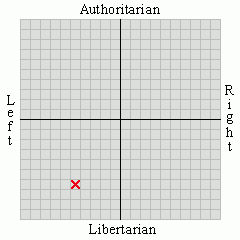
My Political Views
I am a left social libertarian
Left: 4.33, Libertarian: 6.47
Political Spectrum Quiz
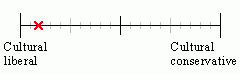
My Culture War Stance
Score: -8.18
I am happy to see that a group of diocesan chancellors has issued a response to the claims of the ACI and South Carolina that Title IV grants unconstitutional powers to the Presiding Bishop. I am also pleased to see that even as a legal amateur I anticipated a number of the arguments in defense of the authority of the PB that appear in this paper. The strangest of these claims by the ACI and SC is that the Presiding Bishop requires permission to exercise tasks assigned to her in the Constitution and Canons, based on the restriction of bishops’ exercise of their office to the diocese for which they are consecrated. The present paper defends the PB’s right, and indeed duty, to carry out these responsibilities, and there is no indication that permission is needed to do something mandated by law.
Good work. (Note, the link to the paper in the Episcopal New Service release is incorrect. Use this one.)
Tobias Stanislas Haller BSG
One of the things I have found so unsatisfactory in discussions on sexuality is the fallaciousness that makes up so much of the argument from the conservative perspective. I am not saying that the conclusions the conservatives reach are necessarily false — but that their arguments often are not really arguments. That is, they may begin with true premises and reach true conclusions, but the mode of getting from one to the other is not properly formed, and fails to prove what it intends to prove. One can, after all, reach a true conclusion by faulty means — but proof of the truth of a conclusion must rest on a train of what Hooker called “demonstrative reason.”
Let me give a simple example of a fallacious argument with a true conclusion. Let us for the sake of simplicity accept A and B as true. (It is admitted that a cat can lose a leg or two and still be a cat!)
*Update: the famed clock is described in one of the "Difficulties" Lewis Carroll (Charles Dodgson) prepared for The Rectory Umbrella, a miscellany of short occasional pieces and drawings. It is, of course, exactly the sort of clock that Alice would have. I believe it can be seen in Tenniel's illustrations of her entry into Looking Glass House, on the chimney piece. The LGH version has a very snarky expression, no doubt very satisfied with itself at its precise accuracy twice a day. The advantage, of course, to Alice, is that between them she has the ability to be sure of the time precisely four times a day. How to do that? In LC's example, the clock says 8:00, and all you need do is "keep your eye fixed on your clock, and the very moment it is right it will be eight o'clock." To further protests, he advises, "That'll do... the more you argue the farther you get from the point, so it will be as well to stop." Which indeed sounds familiar.
What are the grapes or grain
that you could leave untouched
for others to
be nourished by?
Perhaps it is the wheat and grapes you leave behind
that go
to make
the bread and wine that will become
the Body and the Blood of God.
What
extra miles have you trod down,
or coats or cloaks provided —
and has your
cheek once felt
the sting of an unearned slap,
and yet you’ve not
returned it
with a blow or protest?
Tobias Stanislas Haller BSG
I believe the proposed Anglican Covenant is more problematical in the things it might lead us not to do than in the things that might be done to us.
Tobias Stanislas Haller BSG
ps Blame (or credit) Mimi, who brought this thought to mind in the comment thread below.
“a clear-sighted companion.... If you are passionate about the vitality of today’s church, I encourage you to accompany him on his mystagogical excursion into the liturgical landscape. You will rediscover a familiar place rife with fresh provisions planted by the God who longs to feed our deepest hungers and hopes.” —Jay Koyle, chair, Faith, Worship and Ministry of The Anglican Church of Canada
Your words are yours but I reserve the right to cite them or refer to them in other contexts
I will not post comments that are irrelevant or offensive.Note that Blogger limits comments to 4,096 characters.