The Broken Body
The serious and sometimes satirical reflections of a priest, poet, and pilgrim —
who knowing he has not obtained the goal, presses on in a Godward direction.
Parts of the church are experiencing a kind of autoimmune disease in which the body attacks itself. Such conditions are always painful, and sometimes fatal.
This — among other things — is leading more and more people to realize that one does not need to be a “churchgoer'' or listed on a parish roll in order to be a Christian; it leads many into the company of those who see themselves as “spiritual but not religious.”
More and more people, for various reasons, are coming to see that institutional aspects of the faith have little or nothing to do with its core values. While it is true that one cannot be "a solitary Christian" there is no need to identify the locus of the community of faith with a parish — especially when that parish, and its leadership, adopt policies or practice behaviors so inimical to Christ and his teachings.
Christendom is not yet dead — but it is sick; and much of its sickness is self-inflicted, the product of its embrace of empire and institution at the expense of the Gospel.
St Luke’s Philadelphia • Sept 15 2019
RCL1: Jer 4:11-12,22-28; Ps 14; 1Tim 1:12-17; Lk 15:1-10
For thus says the Lord: The whole land shall be a desolation, yet I will not make a full end.✠
You have likely heard of the difference between an optimist and a pessimist, and how they see a glass as being either half-full or half-empty. I actually have such a glass at home, a wine glass with a line marked on the side half-way up (or down, depending on your point of view) with the words Optimist and Pessimist etched in the appropriate places above and below the line. Well, today’s passage from the prophet Jeremiah should leave us with no doubt on which side of the line he places himself. It is a good reminder of why he is thought of as a prophet of doom. No, Jeremiah clearly never got the memo, “Don’t be bringing me no bad news.”
What he speaks of in this morning’s passage is a hot blast of wind that sweeps everything away, not just to “winnow or cleanse,” no, but too strong for that, too strong for a mere dusting; this is a real grab it by the end and shake it out the window kind of wind. This is a knock it all down and start it all over kind of wind; if the Middle East had hurricanes, this would be category 5. Jerusalem then would look worse than the Bahamas does now.
The prophet looks, and in the aftermath of this terrific blast of wind, he sees nothing but a waste and void below, and nothing but darkness in the heavens above — Jeremiah quotes the words of Genesis, recalling the time before creation itself, before God filled the dark and empty void, before God called forth the light of heaven; this is the desolation of primeval un-creation.
Yet into this desolation, the prophet gives one hopeful word he has received from the Lord, one brief phrase of promise, one little shred of hope, like the still small voice that came after the winds and tempests and earthquakes that shattered the mountains: “Yet I will not make a full end.”
This little glimmer of hope, this whisper of a still, small voice with the shred of a promise, is a common theme in the words not just of Jeremiah, but of many of the prophets. Even when everything seems lost, when it seems all have turned bad and we are tempted to join the Psalmist in declaring that “there is none who does good, no not one” — there is still some remnant, some little portion, some crack in the drought-stricken soil into which a hopeful seed has found its way to bide its time until the rains come.
God had assured the despondent exile Elijah in that still, small voice, that there were more than a few left in Israel who had not bent their knee to Baal, that he was not alone in his struggle to remain faithful; Isaiah had received the promise that a remnant would return from exile in far Babylon; and Ezekiel would celebrate the promise that God would return to the once-forsaken, once-abandoned Temple. These prophets bear witness to this promise: However bad it gets, however dark the night and desolate the prospect, a slim, small hope for dawn abides. A portion, however small, remains. The handful of meal and teaspoon of oil will somehow last for three years; the glass that didn’t even seem so much as half-empty, the cup with just a few drops left in the bottom, turns out after all to be full to the brim.
+ + +
This seems to have been St Paul’s personal experience as well, though he applies it universally to the whole human condition. Like the desolation of the land described by Jeremiah, Paul’s condition — when he was still the unconverted Saul, before the light shined on him on the Damascus Road — was about as bad as bad can be: a blasphemer, a persecutor, a man of violence, foremost among sinners. And yet, in the midst of that parched, dry wilderness of anger, hatred, and self-righteousness, God was able to find the little shred of salvageable goodness that is still present in even the worst sinner, and make the most of it, stretching that little bit out to serve God’s purposes. Like the surprise of water in the desert suddenly welling up to overflow, God poured out mercy and grace upon one almost — but not completely — empty of any good, and made him into an instrument for the spread of God’s good word of promise.
+ + +
So much for the pessimists! Today’s Gospel looks at things more from the glass-half-full side. Just as half-empty (or even less than that) is not God’s ultimate will, so too even half-full isn’t good enough for God. Even almost full isn’t good enough for God. Jesus attests that he is not one to deal in acceptable losses, to say, “What’s one sheep lost when I’ve still got ninety-nine; what’s one dime out of a dollar lost under the sofa-cushion?” No, our God is not a God of acceptable losses; God wants it all. God will not suffer anything to be lost.
Now, I know it’s that time of year, and as tempting as the ten-percent proportion of one dime from a dollar might be, this is not going to be a sermon about tithing... Except... to remind us that the tithe is not all that God wants. God wants it all — all of us, in both senses of that phrase: every last one of us, and everything that each of us is and has, our whole heart and mind and soul and strength, all those faculties of ourselves the full extent of which we are called and challenged to apply to our love of God, as strongly and completely as our God loves each and all of us.
For in the end, it isn’t about proportion, about acceptable losses, but about the perfection of all in all. It isn’t about a glass half-empty or half-full, but completely full, abundance piled up and packed down, full to the brim and then to overflowing. God did not rest, at the first, at the beginning Jeremiah recalls for us, God did not rest until the days of creation were fulfilled and the Sabbath of completion was come. Nor will God rest in the work of the new creation in Christ until all is well, and every manner of thing is well, and complete, and full to overflowing, brought to perfection by him, and in him, and through him.
As today’s collect prays, we seek for the Holy Spirit’s direction and rule “in all things” — and the aid the Holy Spirit provides is not that desolating wind that levels the mountains but the powerful yet persuasive guidance of the Spirit as in the beginning, when the Spirit hovered over the uncreated deep. This is not a wind of desolation, but of creation, the new creation of all things — we seek this, the Holy Spirit’s aid, guiding and directing us so that our hearts may be completely given to God, vessels open to receive God’s gift of grace, that we might be filled — not just a bit, not just halfway, but to overflowing completion. Whether we find ourselves rescued by the skin of our teeth when we are almost entirely bereft and empty, or content to think ourselves satisfied with the half-measure we already have; whether we feel we are running on fumes or cruising along on half a tank; whether desolated by the blast of an ill wind, or mistakenly satisfied with the good-enough compromise for which we might be tempted to settle; God will surprise us with amazing grace, and shower us with blessings. Rejoice, then, my friends, for the lost has been found, and filled, and blessed; and join Saint Paul in his joyful acclamation: to the King of the ages, immortal, invisible, the only God, be honor and glory forever and ever. Amen.
Church of the Advent, Federal Hill • Proper 18c 2019
Though I am bold enough in Christ to command you to do your duty, yet I would rather appeal to you on the basis of love.+
A mother once tried to teach her daughter about stewardship. She gave her a dollar bill and a quarter, and said, “It is up to you which you put into the offering plate.” During the sermon, the mother watched her weigh the possibilities — dollar in one hand and quarter in the other. Finally, when the plate came into her aisle, she nodded to herself and confidently put the quarter in the plate, then sat back with a contented sigh. After worship, her mother asked, “Why did you decide to put in the quarter?” The child responded, “Well, I was going to put in the dollar; but then the priest said, ‘God loves a cheerful giver,’ and I thought I’d be more cheerful if I kept the dollar.”
+ + +
Many Christians take this subjective view about stewardship: how does giving make me feel? This is the “Feel Good” school of giving. Problem is that while some may feel a glow of discipleship when they give generously, many — like this child — feel a glow of satisfaction when they hold on to as much as they can.
Our gospel today presents us a different view, not based on feelings but practicalities: considering how much it costs to build a tower or wage a war. This is the “Balanced Budget” school of giving. Its advantage over the “Feel Good” theory is that it is better engaged with the reality of what it costs to maintain a church. But it too has a down-side, as giving becomes commercialized, the church itself “monetized” (to use the modern term of art). Just as with “feel-good,” this view is focused not on God or the church, but on the giver, as it appears to say, “I support the church, for what I get out of it.”
Most people realize that this approach is too much like building a tower or waging a war. And while it smacks of common sense, it derives more from the spirits of Scrooge and Marley than those of Christmas past, present, and to come. If people think giving to the church is exchange for a product, a kind of “give and get,” they will come to see the church as if it were just another shop on the High Street where you pay your money and take your choice, a kind of vending machine that dispenses spiritual satisfaction when you put money in the slot. Such an attitude transforms believers into customers.
+ + +
Ultimately both of these views run aground on the astounding statement with which today’s gospel ends: “None of you can become my disciples if you do not give up all your possessions.” How shallow both “feel good” and “balance the budget” look in contrast to this astounding clam that Jesus makes on the disciples — including us! Even those who devote a significant portion of their income to the church — the ten percent of the biblical tithe — even the most generous must feel like pikers in light of the astounding challenge from Jesus: “None of you can become my disciples if you do not give up all your possessions.” What is five or ten percent or even more compared to all! What could Jesus mean by this astounding, ultimate demand?
+ + +
We will find an answer to this question in today’s second reading — the bulk of Paul’s letter to Philemon. We heard how important the runaway slave Onesimus has become to Paul as he suffered in prison; and how Paul trusts that when Onesimus returns to his master Philemon with this letter in hand, he will not suffer the fate imposed on runaways. Paul trusts Onesimus will be welcomed back as a brother in Christ; for he has become a Christian while with Paul, perhaps even a deacon. Paul’s poignant letter suggests as much in noting how Onesimus has been of service to him: how he has “deaconed” to Paul in his imprisonment. What’s more, Paul notes that Onesimus after all had not been a very good slave — beyond having run away, Paul says he had been “useless” — making a joke out the slave’s name, which in Greek means Useful. Upon his return, Paul suggests he will live up to his name and be “useful” indeed as more than a slave, not less: a brother in Christ, perhaps even to serve with him as a deacon. Paul assures Philemon that he is not demanding this: he wants Philemon to do a voluntary good deed, not something forced — even though Paul does remind him that he owes him more than he can possibly repay: “I say nothing” — thereby saying something! — “about your owing me even your own self” — echoing the teaching of Jesus.
Paul is saying Philemon can have his cake and eat it too! He can have the free service of a useful brother in place of the half-hearted work of a useless slave, by giving up a slave-master’s control-over, and instead cooperate-with him as a brother in Christ.
+ + +
And it is that “giving up” that connects with that hard saying of Jesus: “None of you can become my disciple if you do not give up all of your possessions.” We don’t just owe God our possessions, after all, but, as Philemon owed Paul, our selves! Yet Jesus does not say, I’m taking your life — he wants us to live our lives in service, not throw our lives away. So too he doesn’t ask us here to “give away” all of our possessions, but to “give them up.” And the difference is suggestive: this is about surrender, not commerce. He wants us to “give up” to him, as the old hymn says, to “surrender all” to him! It is about learning how to loosen our grip on what we have, treating it not as something controlled by us, but as ultimately coming to us as a gift from God — as indeed our lives come as a gift from God, and God wants us to give them up in return as well. We are called to treat what we have been given with the same kind of liberty with which Paul counseled Philemon to treat his former slave, and to do so voluntarily, not under compulsion or as doing our duty, but as going beyond the call of duty into the realm of the freedom of the children of God. In that realm there are no more slaves, but all are free — free because we have given up, we have surrendered to God, whose service is perfect freedom.
We are not called simply to balance the books and pay our share so that we get what we pay for
and what we think we deserve. Friends, I assure you that if we got what we deserved we would be neither cheerful nor proud!
But when we treat all we have been given — including our very selves, our souls and bodies — not as “ours” to control but as the free gift of a generous God, and which we return to God as a reasonable and holy sacrifice — then we will find ourselves going beyond the call of duty to maintain the church. We will be embarking on the mission of spreading God’s kingdom of freedom, in which all are God’s children.
Yes, it is our duty to maintain our little corner of the kingdom here on South Charles Street, to do what it takes to support its work and worship. But we are called to do much more; to be God’s servants, not slaves working only because they have to, but children of God who work so hard because they love their Father in heaven, and love their brothers and sisters so very much.
If this spirit of generosity and freedom can fill us all who knows what might happen? Let me tell you one last thing. Onesimus the runaway slave became so useful in the church that decades later he shows up again in Christian history — as bishop of the church of Ephesus! Who would have thought a useless runaway slave could become such a useful servant of God?
When we give up and surrender all to God, who knows what God might make of us? When we go beyond feeling good; when we go beyond balancing the budget; God will surprise us with amazing grace, doing infinitely more than we can ask or imagine. Though I am bold enough in Christ to suggest you do your duty, yet I would rather appeal to you on the basis of love. To God alone — who is Love — be the glory, Father, Son and Holy Spirit.+
Proper 13c • Church of the Advent
Set your minds on things that are above, not on things that are on earth...✠
Church of the Advent, Federal Hill • Proper 12cA key biblical theme concerns God’s efforts to determine guilt or righteousness, summed up in the image of God as the Almighty Judge. In our passage from Genesis today, God takes this role, setting out to see if the Cities of the Plain are as bad as people say. God tells Abraham the plan, but to put it bluntly Abraham is upset, for surely, no matter how bad those cities, there must be some innocent — or even righteous — people among the citizens. And so Abraham appears to test the limits of God’s indignation, winnowing down the collateral losses to what you can count on ten fingers.
Jesus said, Forgive us our sins, for we forgive everyone indebted to us…

The latest exhibit for Episcopal Church and the Visual Arts is now online. I had the honor to serve as curator.
—Tobias Stanislas Haller BSG
| ECVA is pleased to announce its Spring 2019 Member Exhibition, "Worship the Lord in the Beauty of Holiness." The exhibition will be digitally displayed at ECVA.org. ECVA Member Tobias Stanislas Haller BSG will curate. Submissions are open: January 15 through March 9, 2019.
WORSHIP THE LORD IN THE BEAUTY OF HOLINESS
SPRING 2019 EXHIBITION - online at ecva.org April 14, 2019 -
CALL TO ARTISTS
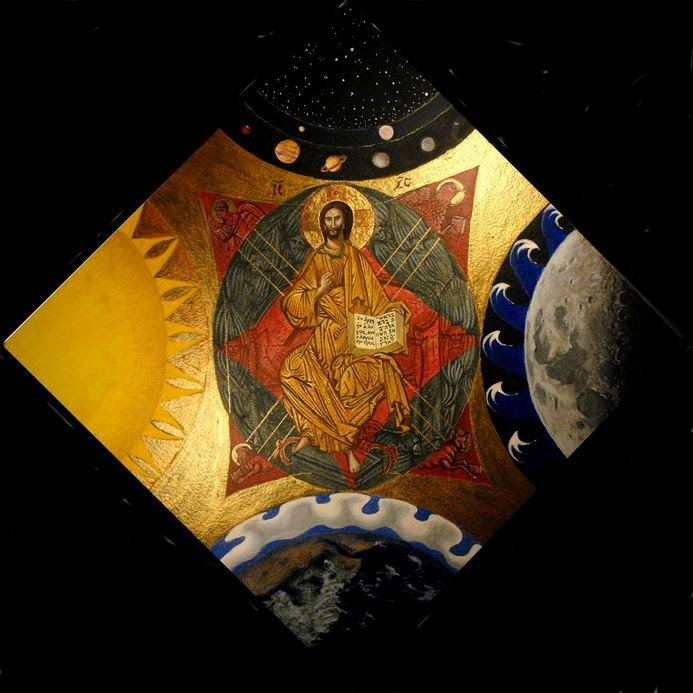
![]() Iconography by Tobias Haller BSG WORSHIP AND PRAISE OF THE DIVINE has taken many forms through time and space. Much of it has been verbal, but the words of prayer and liturgy have often been accompanied by a humble sense of their inadequacy to comprehend the incomprehensible greatness of God. At the same time, suspicion of (and even harsh antagonism toward) visual representations of the Divine have often starved the eye to favor the ear, neglecting the truth expounded by Saint Gregory the Great that imagery offers a path to understanding for those unskilled in words--and when it comes to the ultimate quest of faith seeking better understanding of God we all lack sufficient skill. IT IS LIKELY BEST TO ALLOW the verbal and the visual to serve hand in hand and side by side, as they have done for most of religious history apart from those times in which austere iconoclasm dominated the religious sphere. A more tolerant attitude to the visual allows each of these modes of expression to fulfill the goals best suited to the minds and hearts of those who worship. After all, at the heart of our Eucharistic worship, all of the words eventually serve to consecrate and sanctify those very tangible and physical elements of bread and wine, taken and consumed as a sacramental participation in the life of the Incarnate God. SO IT IS THAT ART (and the arts) are servants in the human quest for engagement with the Divine. In this present call, visual artists in all media at their disposal are encouraged to "incarnate" their visions in dialogue with the texts of the Eucharistic liturgies of the Book of Common Prayer--perhaps inspiring a "Gallery of Common Vision" to stand side by side with those venerable words: the beauty of holiness mirrored in the holiness of beauty, the union of the Good, the True, and the Beautiful as a pointer towards the ineffable and inexpressible that is beyond our grasp--but as close as every breath we take. - Tobias Stanislas Haller BSG, Curator
Tobias Stanislas Haller BSG retired after 16 years as Vicar of St. James Fordham (Bronx, NY). While in New York he served diocesan leadership, at General Convention, and on the Anglican Communion Indaba Reference Group. Now living in Baltimore, he continues to supply and is an associate at Church of the Advent. He is a member of the Brotherhood of Saint Gregory, and a Commander of the Order of St. John. He is an iconographer, visual artist, and musician. His publications include The Episcopal Handbook Revised (Church Publishing 2015), and Preparing for a Wedding in the Episcopal Church (Church Publishing 2017). His next, Re-membering God: Human Hope and Divine Desire is on Church Publishing's spring list; it includes chapters on liturgy, art, music, and architecture as human articulations of this quest.
Criteria for Artist Entry Current members of The ECVA Artist Registry are invited to submit images of works in 2D and 3D, video and film. Member artists are encouraged to submit up to 2 works for this exhibition. The exhibition curator will make selections from entries received: submission of an entry to this exhibition is not a guarantee of inclusion in this exhibition. To learn more about The ECVA Artist Registry, to join, or to renew membership, visit The Artist Registry at ECVA. For each submission: Send a digital image that is 72 dpi, and is 600px on the longest side, and is under 1MB, and is in JPG, TIF, or PNG format, and, Name your image file this way: your name and artwork title, and, For video/film works, in addition to a still shot (poster image) from your video, include a link to your video at your Vimeo or YouTubeRed account; videos from YouTubeStandard accounts will not be considered, and Submit an artist statement for each entry and one artist bio, together about 300 words. If a work has been collaboratively executed, please submit a group artists' statement and group, and, Include your preferred email address and your contact phone number that the curator can use to contact you with questions. Send your submission by email to entry@ecva.org. Questions? Contact Joy Jennings, ECVA Exhibitions, jjennings@ecva.org |
| EPISCOPAL CHURCH & VISUAL ARTS COPYRIGHT POLICY “It is the policy of Episcopal Church & Visual Arts, Inc. that all rights in copyright shall remain with the creator." |
Christmas 1 • Holy Covenant Episcopal Church, Baltimore
When the fullness of time had come, God sent his Son, born of a woman, born under the law, in order to redeem those who were under the law, so that we might receive adoption as children.One occasionally hears of somebody called a “self-made” man or woman. You may be familiar with Horatio Alger and his tales of rags to riches; or perhaps Madame C. J. Walker and the story of how she built up a cosmetic firm by the sweat of her brow and the work of her hands. Perhaps it is some poor immigrant who managed to scrape together the money to start a small business, and the business grew and prospered and he or she ended up a millionaire. And while not wanting to diminish admiration for such a person’s industry, inventiveness, skill and hard work — such a person is not self-made.
Words are not what they represent. That is the whole point of the gracious untruth of metaphor — not actually true but pointing to some truth — that is true of all language. Words are like actors playing a part, whether they strut and fret their hour on the stage, or move the hearts and minds of those who behold to share the emotion or the idea the author intends. But actors are not the character they portray, except in those rare instances when billed as Himself or Herself. They are playing a part, a role that points away from themselves towards a character, historically real or fantastically fictional. Bad actors are the ones who constantly remind you who they are. Acting, like metaphor, is deception that tells a truth.
The form of that deception is the issue at hand. There was a time when it was considered normal for an actor playing Othello to “black up” for the part, though even by the time Laurence Olivier did so it was challenged as unnecessary. In our time we barely blink at Adams, Burr, and Hamilton portrayed by Latino, African-American, or Asian actors — tacit permission being given for the members of formerly appropriated cultures to have some payback, and to raise our consciousness to the fact that these secondary characteristics are not at the heart of the characters portrayed. Perhaps a time will come when actors will once again be free to emulate these secondary characteristics without fear of offense.
It is the same with our language about God and humanity: we are now in a time where people are acutely aware of how jarring it sounds to speak of God only in masculine terms, and to insist that man includes women — sometimes jarringly so as in the old definition, “Man is a mammal having large external breasts for nursing its young.” Perhaps after a time of exposure to the wealth of expansive language that can point us in a Godward direction, we will once again be free to speak of God as “King” without particularly calling the usual gender of kings to mind.
All of these words, like actors, serve until they retire gracefully from the stage; as all must. The time will come when words of prophecy will fall silent, and tongues will cease. We will some day, as Prospero did, deeper than ever plummet sounded, drown our books — even the Book of Common Prayer and the Bible — for we will be in the presence of the Word, before whom all other words, and we ourselves, must bow.
—Tobias Stanislas Haller BSG
Mount Calvary, Camp Hill PA • Feb 24 2018Anyone who knew Brother Luke Anthony knows that he liked to eat. I knew Luke Anthony for almost forty years, and shared many a meal with him during that time, in many different settings. In part because of this familiarity, I noticed one of the first signs that he might be dealing with a serious illness late last December. He was with a group of us Gregorians at Lin’s Buffet, one of his favorite restaurants. But not only did Luke not make his normal second trip to the buffet, he didn’t finish what was on his plate from the first trip. Now, Lin’s Buffet was Brother Luke’s idea of something close to paradise. Whenever he talked about going there for lunch, he would get a gleam of anticipation in his eye, such as a mystic might when speaking of heaven. And Luke Anthony got that same look in his eye when he spoke of the Holy Eucharist — another feast that meant so much to him. So I am confident that Luke’s choice of the Old Testament passage from Isaiah has something to do with a vision of heaven as a bit like Lin’s Buffet; as Isaiah says, God’s provision of “a feast of rich food” for all peoples, a truly international buffet.
The Funeral of Br Luke Anthony Nowicki BSG
Tobias Stanislas Haller BSG
Death has been swallowed up in victory.+
Word has it that the topic of Prayer Book Revision is back on the front burner for The Episcopal Church's decision makers. I do not wish to intrude myself in the debates, but I would like to suggest that the revision process be fully informed by changes in the world that might have some impact on the usefulness of the liturgical texts for the next several decades. It may well be worth considering including some or all of the following new forms of prayer and worship, just to keep up with the times:
The biblical texts portray God as Father because God is the creative source of all life. In the era in which the biblical texts were composed, the male was believed to be the active, creative contributor to human (and animal) reproduction; the female was understood to be passive, contributing the substance from which the creative force shaped offspring. So while biblical authors may well have conceived of God as male, they did so not on the basis of revelation, but due to their misunderstanding of the reproductive process. Pinning theology to this misunderstanding of biology is as pointless as pinning our understanding of the universe to a mistaken cosmology.
Tobias Stanislas Haller BSG
I think a great learning for our time will come in exploration of the question: What is acceptable but profoundly wrong in our own time and culture? — just as acceptable as were slavery to the founding fathers and sexual harrassment to the bosses in their corner offices, and just as profoundly wrong; wrong then and wrong now.
But what other things in our present culture are equally bad, but equally accepted?
Systemic racism is just one such thing, still too acceptable by some. And systemic sexism, enacted into practice by unequal pay and unfair policies, feeds and nourishes a culture in which women still are second class citizens.
But what else is in there, at the roots of our culture, accepted, but rotten at the root? What wrongs are so accepted that no one but the victim notices, and keeps silent because “that’s just the way things are.” The Psalmist had it right, “Who can tell how often he offends? Cleanse me from my secret faults....”
—Tobias Stanislas Haller BSG
The Lord is my shepherd; he's really great; the best. I don't need anything... takes me to the best places, golfing — the greens are beautiful, really good. Nice lake. Takes great care of the highways, really good care... sign with his name on it, so he gets the credit. Great job! Even out in Death Valley... I was there once. Really hot, but heat doesn't bother me. He sent his whole staff, we had a good meeting. Very good meeting. Nice lunch, even with Chuck and Nancy there. Losers. But we’re doing great things. Really good things, always.
—TSH
I’m sure I'm not the only one who has noticed that in an era where hard-core porn is accessible to fingertip reach on ubiquitous screens, and things appear on network TV that in earlier years would have been subject to prosecution even if displayed in private smoke-filled back rooms, there is a simultaneous call for an almost Victorian propriety in the workplace, in which an off-color joke or a misplaced hand on an unwilling shoulder might be cause for dismissal. I find the tut-tutting of commentators expressing horror and disgust at the Al Franken photo to be incongruous given the language and attitudes expressed on, say, the Celebrity Roasts on basic cable channels, where crowds applaud the most vulgur obscenities about both women and men, issued with the proviso of “no disrespect.” To say nothing of the incongruity of the incumbent in the White House joining in the tut-tutting.
Perhaps Yeats was right after all, and the center cannot hold, but we are entering the widening gyre where prudery and license spin, and the moral compass cannot find true North.
Tobias Stanislas Haller BSG
“a clear-sighted companion.... If you are passionate about the vitality of today’s church, I encourage you to accompany him on his mystagogical excursion into the liturgical landscape. You will rediscover a familiar place rife with fresh provisions planted by the God who longs to feed our deepest hungers and hopes.” —Jay Koyle, chair, Faith, Worship and Ministry of The Anglican Church of Canada
Your words are yours but I reserve the right to cite them or refer to them in other contexts
I will not post comments that are irrelevant or offensive.Note that Blogger limits comments to 4,096 characters.