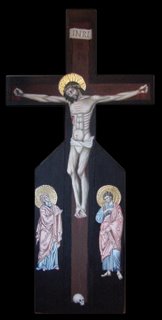
August 19, 2006

Finally, A Conference

I am happy to see word of the planned meeting of our Primate and Primate-Elect and official representation from the Anglican Communion with a small group of American bishops, including both via media Lee and Alternative Oversight petitioner Iker. The Anglican Communion Office confirms that this meeting is taking place with the approval of the Archbishop of Canterbury, unlike the Texas gathering to which I referred earlier, and for which the Archbishop's approval — while claimed — has not been explicitly confirmed.

It seems to me that, like it or not, any kind of Alternative Primatial Oversight will have to involve change or adaptation in the legal structures of the Episcopal Church — whether that means the creation of a new non-geographical Province X, a “flying bishops” scheme, or some other mechanism. I know similar ideas have been tabled and rejected in the past; but that does not mean that they cannot be reconsidered — as we saw at General Convention, reconsideration might be considered an Anglican conceptual art-form. Such reconsideration is to be preferred to the improvisational free-form ecclesiology that Anglicans have been engaging in of late.

Any official changes will require the official participation of the acknowledged authorities: and whether the dissidents like it or not, the Presiding Bishop is the Presiding Bishop, the General Convention is the General Convention, and it is high time for the Archbishop to work to engage the dissidents with the authorities whose consent will be required for any legitimate (i.e., licit) adaptations to accommodate the dissent.

I am distressed that some of my sisters and brothers of the liberal wing have begun bewailing this meeting before it begins, predicting anything from a sellout to a rout. On the contrary, I am hopeful that this meeting may produce some positive and concrete results toward a real settlement, because the people capable of actually accomplishing this are to be participants. This is not backchannel diplomacy, but perhaps a real treaty discussion at last.

Major changes will take time, however — the creation of a new Province will require another General Convention, if that is the road that is to be followed. But temporary measures can and should be put into place in such a way as to preserve the interests of God’s people on whatever side of the current controversy they find themselves.

Continental Congress

To return to a theme I’ve played a number of times over the last months, it is high time for all who profess themselves Christians to recognize the wisdom of Donne’s imagery about islands and promontories. He was talking about death — but I prefer to apply the image to life. No church is an island — even the so-called “national” churches are merely promontories and peninsulas. When we look across the gulf that separates, it is good to be reminded it is a gulf, not an ocean, and that at the headland of the continent we are united at our roots.

What, after all, is a “national church” in this day, in which Erastianism is a fading memory for Christianity even while it becomes the desideratum for militant Islam? Geography is less significant for us than it was in the days when few traveled, and few spoke any language other than their own. Even the Eastern Orthodox will acknowledge (ruefully) the anomaly of multiple overlapping jurisdictions in much of the world.

But the Christian, through baptism, is born into a citizenship that is not of this world — born again into a citizenship that cannot be lost, marked with an indelible passport stamped on the forehead in the shape of a cross. We are citizens of the world to come, and aliens in this one, wherever we are.

—Tobias S Haller BSG


August 12, 2006

Peter, Paul, and the Church

Those of us who follow the discipline of the Daily Office will soon be coming to the point in Acts of the Apostles at which it gets agreed that Peter should minister the Gospel to some while Paul and his associates will minister the same Gospel to others — others who will be held to a different standard of conduct, since they are not Jews but Gentiles. The wisdom of this move was credited by the Apostles to the Holy Spirit.

It appears to me that we have here a model for how to handle disputes in the church. It is not necessary, classical Anglican formularies tell us, that rites and ceremonies be in all places the same; nor would it seem, given the Apostles’ debate and decision, in even weightier matters of the Law, that an absolute uniformity be observed, so long as the heart of the Gospel is preserved.

To use Alisdair MacIntyre’s telling imagery, What deep truths from the narrative of our past, in which the practice of obedience has formed us, will enable us to meet future commitments in such a way that we “make of human life a unity”? What, exactly, are the obligations put upon us by the Gospel, if not those Christ enumerated in the Summary of the Law? And how, in keeping them, do we find ourselves, even if discontinuous on the practice of other virtues — even virtues held by some to be grave and important — how do we find ourselves still able to remain united in spite of these discontinuities?

And can we? This is the challenge that faced the church of Acts: and as the Epistles show, it failed — splintered over glossolalia and circumcision and a handful of other trivial discords that the churches’ warring members allowed to divide them — until the hammer of martyrdom in the Empire’s hand awoke them to a consciousness that there were more serious things in life — and in the life to come.

So can we be a church united in Christ while still some of us are “Pauline” and others “Petrine”? Does the unity of the church depend on choosing between Paul, or Cephas, or Apollos? Upon this set of rules or another? Or upon Christ, who summarized the Law under the rubric of Love, and in whom we are one not by our own virtue, but by virtue of our Baptism, and who has chosen us as much as we have chosen him?

— Tobias S Haller BSG


August 5, 2006

Transfiguration

“Some standing here shall not taste death until
they see the Son of God in glory come.”
So Jesus prophesied. He soon chose some
of his disciples, climbed a lonely hill.
Did they suspect that that would be the day
when glory would come down within a cloud,
surround, embrace them all, and speak aloud,
“This is my Son. Hear what he has to say.”?
They saw; they heard, but did not understand
what goal the high Eternal Counsel planned.
Ahead lay cross and crown, the lifting up,
the agony, the bloody, bitter cup.
But Peter did not comprehend these truths.
Instead, he said, “Lord, let us build three booths.”

Tobias Stanislas Haller BSG, July 1990


August 4, 2006

Canterburial Insertions Unhelpful

I am distressed that the Archbishop of Canterbury appears to be participating in the Texan Consultation by proxy. This continues a pattern of meetings with various parties disaffected to one degree or other, and his somewhat patronizing acknowledgment that the Anglican Communion Network consists of Episcopalians (which they took as a bit more of an endorsement than I imagine he intended; but then, his intent is difficult to read at times.) It must be acknowledged that +Rowan's acts have been less meddlesome than those of his retired immediate predecessor, but it is nonetheless bothersome in that he seems to be ignoring the standards of polity I referred to in my previous post.

Rather, the Archbishop should, by Lambeth's own standards, deal directly with the duly and synodically elected leaders of the (at present) sole legitimate constituent member of the Anglican Communion (per the Constitution of the Anglican Consultative Council) on our shores, The Episcopal Church -- not with conventicles or special interest groups, however exalted their membership, or however much the special interests of these groups might coincide with his own views, or the purported views of the "majority of the Anglican Communion."

It might be argued that the "embassy" of Bishop Langrish to meet with the House of Bishops was +Rowan's attempt at proper channeling; and that the "failure" of this mission (i.e., B033's alleged inadequacy) opens the door for this subsequent move. However, such a move remains — and I don't know how to say this delicately — subversive. It leads me to ask, "Archbishop, what part of the word 'No' don't you understand?" The Episcopal Church has made its position clear; no less ambiguously though with greater charity than, say, Nigeria.

In the best possible light, this may be an instance of behind the scenes diplomacy; the problem being that it is not behind the scenes but trumpeted on the Internet. Perhaps the good offices of Bishop Wimberly may provide some room for mediation. But I remain concerned that such ad hoc backchannel efforts have not, in the past, proven beneficial in the long run, and may simply distract us from the difficult task ahead.

— Tobias S Haller

Lambeth Speaks on General Convention

The proposed gathering of "Windsor" bishops in Texas appears, in its rejection of General Convention's official act in adopting B033, and as an effort to bypass the General Convention as the collective and authoritative "voice" of the Episcopal Church in Communion matters, once again to be ignoring a principle laid out by Lambeth from the very beginning:

"The Provincial Synod -- or, as it is called in New Zealand, the General Synod, and in the United States the General Convention -- is formed, whenever it does not exist already by law and usage, through the voluntary association of Dioceses for united legislation and common action. The Provincial Synod not only provides a method for securing unity amongst the Dioceses which are thus associated, but also forms the link between these Dioceses and other Churches of the Anglican Communion.... It is the office of the Provincial Synod, generally, to exercise, within the limits of the Province, powers in regard to Provincial questions similar to those which the Diocesan Synod exercises, within the Diocese, in regard to Diocesan questions. As to the relation between these two Synods, your Committee are of opinion, that the Diocese is bound to accept positive enactments of a Provincial Synod in which it is duly represented, and that no Diocesan regulations have force, if contrary to the decisions of a higher Synod; but that, in order to prevent any collision or misunderstanding, the spheres of action of the several Synods should be defined on the following principle, viz., That the Provincial Synod should deal with questions of common interest to the whole Province, and with those which affect the communion of the Dioceses with one another and with the rest of the Church; whilst the Diocesan Synod should be left free to dispose of matters of local interest, and to manage the affairs of the Diocese." -- Committee Report A of the Lambeth Conference of 1867
The findings of this committee were ratified in Resolution 4, which reads:
"That, in the opinion of this Conference, Unity in Faith and Discipline will be best maintained among our several branches of the Anglican Communion by due and canonical subordination of the Synods of the several branches to the higher authority of a Synod or Synods above them."
This does not, by the way, contrary to the assertions of some, refer to Lambeth itself, which was never conceived of as a canonical or synodical body, but as the invitation letter to the first Conference explicitly declared,
"Such a meeting would not be competent to make declarations or lay down definitions on points of doctrine." -- Letter of Invitation from the Archbishop of Canterbury, 22 February 1867
— Tobias S Haller

August 1, 2006

The Split [Still] In Our Future [?]

I wrote the following in October of 2004, in a note to the now famous House of Bishops/Deputies List. I am posting it here at this point as a “check” on how things have fared in relation to my sense at the time, just prior to the publication of the Windsor Report. I do so in part in response to the continued expressed hopes — and I have myself expressed them, most recently in an essay in Episcopal Life — that the Communion might still find a way to hold together in spite of the many tensions and disagreements we face.

The final question still stands.

The Split in our Future

Given the recent statement ("Drawing the Line") from the Anglican Communion Institute and the comments and actions of Archbishop Akinola, it appears to me that a split in the Anglican Communion is almost certainly assured. Neither Akinola nor ACI will be content with any form of Communion in which the Episcopal Church (and one assumes the Canadian as well) are allowed to be at the table in any meaningful sense of the word. A "parallel jurisdiction" in which parishes and perhaps dioceses of the "Network" would be recognized in addition to the Episcopal Church (assuming such an arrangement could be worked out) will not be satisfactory to ACI. Akinola and others have openly opined on a new "center of unity" apart from Canterbury, should he not comply with their demands for the discipline and exile of the Episcopal and Canadian Churches. Akinola has been explicit in his rejection of participation in any synod or conference in which those who consented to Bishop Robinson's election and consecration are seated, and to date has been true to his word.

I will make no prognostication on the contents of the Windsor Report, nor Canterbury's response to it, but it appears that we will either see a temporary split in the Anglican Communion (if the American and Canadian churches are exiled from full participation in the "instruments of unity" until they have undone what others believe they ought not to have done) or a permanent schism (consisting of perhaps most, but not all, of what is called the "Global South" and a number of sympathetic parishes, and perhaps dioceses, scattered through the rest of the present Communion) if those concerned do not find the solution Canterbury eventually adopts to be acceptable.

Am I misreading the signs of the times?

— Tobias S Haller BSG (October 2004)


July 30, 2006

Growth in a Godward Direction

From a sermon on Ephesians 4
The Letter to the Ephesians tells us what it means to grow up — to be no longer a child blown about by every wind of doctrine, but being firm in the truth that God has provided us in the person of Christ. The wonderful thing about growing in unity in Christ is that it isn’t about uniformity: the various members of the church are completely united but individually gifted: as they grow they diversify!

This is what lies behind Paul’s baptismal language — beginning with unity, passing through universality, and ending with diversity: there is one body and one Spirit, one call, one hope, one Lord, one faith, one baptism, one God and Father — of all — who is above all and through all and in all. But to each — to each — he gave grace according to the measure of Christ’s gift: and each individual’s gift is different yet works together for the unity of the body.

There is a biological reality to this movement from one to all to each: every human being starts as one single cell, a fertilized egg. As it divides into additional cells they specialize under the direction of that amazing DNA molecule that is identical in all the cells but directs each in its own way — this one becomes a nerve, another a blood cell, another skin, another bone. If all of the cells were the same, we would not and could not be what we are: we would be like the Blob — a giant amoeba that can only digest. But instead the body grows with differentiation — different cells equally part of the one body, all directed by the same DNA, but each doing different things for the good of the whole body, knit together in every ligament and joint, each part working together as one. Maturity requires differentiation as much as it requires unity.

So part of maturity means being an individual — as a psychologist would say, being individuated — not being tossed about by what other people say or think or feel, but having one's own identity. To be mature is to have one’s own sense of self, and the ability to exercise one’s own gifts but not to keep them for oneself alone, but to use them to the benefit of the good of the larger body, and its growth towards the end that God intends. Rabbi Hillel, who was the teacher of Saint Paul’s teacher Gamaliel, once said something along these lines: “If I am not for myself, who will be? But if I am only for myself, what am I? And if not now, when?” Each individual will have the maturity to stand for him or herself — but not to stand for him or herself alone, but in unity with all — and this happens in the now that is given to us anew each day. Perhaps Paul learned this lesson from his spiritual grandfather Rabbi Hillel.

For what is important in all of this is the direction of the growth: it is not growth away from God or from others, but growth into Christ, and for the good of the whole church.

There is obviously a lesson for us in all of this as we deal with our differences in the Anglican Communion — for differences there are. The church grows through diversity, united in Christ, preaching one Lord, but with each of its many members in the body making their unique contribution to its well-being. To use the biological language once again, ontogeny recapitulates ecclesiology: the process of differentiation and growth from one through all to each is what makes us who we are as individuals and as the church.

So let us learn to celebrate our differences as part of God's gift, rather than seeing them only as wounds in the body; perhaps they are not wounds at all, but the marks of difference that empower mission in ways we might not be able to serve if we were all alike.

Tobias S Haller BSG


July 23, 2006

What if...

For Christ is our peace; in his flesh he has made both groups into one and has broken down the dividing wall, that is, the hostility between us. He has abolished the law with its commandments and ordinances, that he might create in himself one new humanity in place of the two, thus making peace, and might reconcile both groups to God in one body through the cross, thus putting to death that hostility through it. — Ephesians 2:14-16
What if we were to practice what we proclaim: that we are one in Christ by virtue of our baptism?

What if we realized that what divides us are the rules we set in place to define us?

What if we set aside the commandments that divided us, the ordinances that determine who is in and who is out, the law that makes outlaws of us all?

What if we accepted Christ as our peace, as he accepted us, and went without covenants and treaties to bind us together, but trusted only in the Cross?

What if we truly practiced what we proclaimed?

— Tobias S Haller BSG


July 17, 2006

It’s Not Easy Being Pope

“Mortal, I have set you as a watchman to the house of Israel.” Note that Ezekiel, the one the Lord sent to preach the word, is called “a watchman.” A watchman or sentinel takes a post on the highest point, in order to see whoever may be coming from a distance. Similarly, anyone appointed watchman to a congregation should live a “higher” life so as to keep all things in sight.

As I say these words, I realize I am reproaching myself. For I do not preach as I ought, nor does my personal example accord with these principles that I’m preaching even now. I can’t deny my guilt, for I’ve become lethargic and negligent in my work; though perhaps by recognizing my failure I’ll win some sympathy and pardon from the judge. Before I started this work, while living in a religious community, I was able to refrain from talking about idle topics and to devote my mind devotedly to prayer. Since taking up this new pastoral position, I have been unable to concentrate on prayer, because I’m so distracted by my responsibilities.

For example, I have to consider questions about churches and communities and make assessments about people’s lives and acts. One minute I’m involved with a public policy issue, and the next minute I have to worry over outside threats to the well-being of the church under my care. I have to accept a public role in political matters in order to support good government. I have to bear patiently with law-breakers, and then confront them with an attitude of charity.

I am split and torn to pieces by the variety of weighty things on my mind. When I try to concentrate and pull myself together to preach, I feel inadequate to that sacred task. I am often compelled by the nature of my position to associate with worldly people, and sometimes I become casual in my speech; because if I spoke my conscience dictates with all formality, I know some of them would simply drop me and that I could never influence them towards the goal I desire for them. So I endure their aimless chatter in patience. Then, because I am weak myself I am drawn gradually into idle chitchat — and I find myself saying the kind of thing that before I didn’t even want to listen to! I’ve come to relish wallowing where once I would have been ashamed to stray by accident.

What kind of a watchman am I? Far from the heights to which I aspire, I am constrained by my weakness. And yet — the one who created me and redeemed me and all humanity can give me, even in my unworthiness, some grace to glimpse the whole of life, and the skill and ability to speak of what I see. So it is for the love of God that I do not spare myself in preaching.

— Gregory the Great, from a sermon on the Book of Ezekiel


July 11, 2006

Does Communion Require Authority?

I have followed the writings of the ACI and its members for some time. It appears in general they seem to wish there were a "judicatory" of some sort at a level above the individual churches of the Communion. I recall language of "superior synods" from some years ago, for example, from either Dr Radner or Dr Seitz. This has remained a theme in the ACI work.

What must be admitted -- or at least should be admitted, and +Rowan for one admits it though he may rue it, or not (on alternate days of the week) -- is that at present no such synod or judicatory exists. There is no central authority in the Anglican Communion to which all of the provinces must submit. There are, on the contrary, provincial authorities to which dissatisfied members refuse to submit, appealing to the notional superior synod that is as of yet to be called into being.

What is now under discussion is whether such a judicatory should be established. Some (particularly those malcontented with their own or others' inferior synods' decisions) say yes, others no. It is no good trying to argue that there is a natural progression towards such centralization. There is nothing "natural" about it. It takes a good deal of work, if indeed it is work we want to undertake. Nor is such a political structure inherently more "Christian" -- it may actually be less so to the extent that it relies on "authority" after the manner of the kings of the Gentiles, rather than the richly organic body that Paul seems to favor, in which all are identically blessed, but each is uniquely gifted. (Ephesians 4)

At present some who have made the loudest noises about what they regard as infractions in our common (unadjudicated) life, have also made it abundantly clear that they consider themselves omnicompetent to make such judgments regardless of any other adjudication. I speak of Nigeria, as the prime exemplar of this. This province has indicated it is interested in fellowship of any kind only with those with whom, in its sole determination, it agrees.

There is also a great deal of speculation concerning the possible Anglican Covenant, and much of it assumes that the Covenant will be written in a certain way, so as to create a level of superior authority capable of saying who is no longer a valid member. But I can think of a Covenant that is based not on authority but on trust, not on power but on commitment; in short, more in keeping with the Gospel, that might say things like, "No member or members shall judge the actions of any other member or members."

Wouldn't that be novel.

Tobias S Haller BSG

July 7, 2006

Bondage and Discipline

The most recent comment from Canterbury seems to express a fervent (or wistful) hope rather than to offer a real possibility. +Rowan appears to want a stronger Communion in which everyone signs off on something to which they all agree to be bound. But clearly the problem is that no such document yet exists -- and is unlikely to come into existence if the people composing it are the ones who can't agree in the first place! Or at best, this is merely a way to ratify the divisions.

For Rowan is unwilling to step in as the strong-man and simply lay down the law of what he thinks the Covenant should be -- even in draft form. He seems to hope that a solution will emerge from the primeval soup of discord, but I sense that his "solution" will prove merely to be a label on the problem -- a handy name for the disease rather than a cure. If this is Samuel waiting for David to get back from the sheepfold, I'm afraid he will have a long wait.

We have been cycling in rings of paradoxes since the Windsor Report: a collegial-minded leader at the head of a fractious collegium, one which alternately insists on the rights of the individual members ("What touches all must be affirmed by all") but then wants to impose limits on who is in and who is out if they assert those rights; that calls for dialogue but invites withdrawal from the consultation; and so on. I've noted all of this before.

As for any Covenant that might emerge from the present cast of characters: If it is strong enough to bind, few will be willing to be bound -- as it is the very ones calling for such bondage and discipline who also most vehemently insist on being the definers of the limits: the Church of Nigeria (Anglican Communion), for example, has made their position abundantly clear.

So this is little more than an ecclesiastical tautology: those who will agree will agree, and those who don't won't. If everyone just gives in to the lowest common dominator, well, then we might have peace, but at what price? What does it profit any of us to gain a Whole-World-Church at the cost of our ability to minister effectively where we actually are?

What I believe could survive -- if we would get off the Utopian kick for a new model -- is precisely the same old messy mix that Anglicanism has always been: or at least since Colenso and the very first Lambeth Conference, admittedly more since 1988 and 2003: a collection of historically related churches, with bilateral rather than universal mutual communion, impaired here and there because of gender or sexuality, but willing to cooperate on mission.

Can even that survive? You will note that it is also the Global South that has introduced problems with the latter: in the Ugandan rejection of any support even for the corporal works of mercy if they come from the tainted hands of North American Episcopalians. I ask again: who is causing the tear in our church's fabric?

So, it is time for an honest, rather than a wishful, appraisal of the situation. It is either, to my mind, a "weak" communion that is strong on mission, or a hobbled and divided -- and I dare say split -- communion in which the institution is secure and the mission flounders.

WWJD?

Tobias S Haller BSG

July 6, 2006

Whence and whither

I've argued for a long time that the Anglican Communion is neither a federation (which would require some sort of written Articles) nor a world-church (which would require a single hierarchy) but much more in the tradition of the Eastern churches: a communion. (Fr J Robert Wright's essay in the pre-GC Anglican Theological Review reflected this observation as well.)

As I see it, the pressure now is between those who say they want a Communion but are actually pushing for either a Federation or a World-Church. The idea of a fellowship of "national" churches bound by a common tradition and mutual respect and geared for mission seems to have fallen by the wayside under the pressure for more centralized authority or a fractious club concerned mostly with its membership rather than its mission.

The idea of mutual submission, and embracing the Cross of self-denial is wonderful. But it only works if everyone agrees: the emphasis must be on the mutuality as much as the submission. Otherwise we simply become, or create, a structure of domination: precisely what Jesus warned against when he told the apostles that they were not to exercise authority after the manner of the kings of the gentiles. I'm reminded of the quote attributed to Mahatma Gandhi, who when asked what he thought of Christianity, is said to have responded, "A wonderful idea; why doesn't someone try it." With the present state of affairs, those who laid down their ecclesiastical arms, so to speak, would simply become the victims of the lowest common dominator.

Could we not still function as a loose network united by historical ties, common (or at least related) liturgies, and engagement in mission?

A good idea; why doesn't someone try it.

—Tobias S Haller BSG

July 4, 2006

Dear Rowan, No Thanks

Word has now come from the Nigerian Synod that should be abundantly clear to the Archbishop of Canterbury. This is, if I'm not mistaken, the third strike.

In this communiqué the Church of Nigeria (Anglican Communion) gives reality to its new name, and new significance to the parentheses. The Church of Nigeria is to be the ultimate arbiter of the Anglican Communion. The Lambeth Conference is described as risking having outlived its usefulness, and an alternative all-Anglican all-Bishops conference, in the "age-long tradition" (well, at least from 1867) of decennial gatherings will take its place, under the careful organizational oversight of this new regime — if things don't go the way the Nigerian pontificators think they should.

Archbishop Rowan, what part of this do you not understand? Who, exactly, is tearing the fabric of the Communion at this point? Who are the "super-apostles" who puff themselves up, trumpeting their delight in recognition by Time and declaring other parts of the body to be "cancerous lumps" worthy of excision? These pronouncements from Nigeria are more than unhelpful. It is time to recognize the nature of pride, and real "unilateral" action against other members of the church when it is proposed or taken. This is not the spirit of interdependence, but something else entirely.

&mdash Tobias S Haller BSG

Excerpts from the statement:

1. CONGRATULATIONS

Synod notes with satisfaction the efforts of the Primate of the Church of Nigeria (Anglican Communion), His Grace, The Most Rev. Peter J. Akinola, in giving the Church of Nigeria, (CAPA and Global South) a purposeful and effective leadership. It further expresses its approval of his actions and pronouncements against errors of revisionist ideologies. With much delight and enthusiasm, Synod received his citing by TIME Magazine as one of the 100 persons that shaped the World in 2005, and encouraged him not to relent in his efforts in exercising his ministry.

2. THE ANGLICAN COVENANT

Synod is satisfied with the move by the Global South to continue with its veritable project of defending the faith committed to us against present onslaught from ECUSA, Canada, England and their allies. The need therefore, to redefine and/or re-determine those who are truly Anglicans becomes urgent, imperative and compelling. Synod therefore empowers the leadership of the Church of Nigeria (Anglican Communion) to give assent to the Anglican Covenant.

3. THE LAMBETH CONFERENCE

The Lambeth Conference which is one of the accepted organs of unity in the Anglican Communion is due for another meeting in 2008. The Synod, after reviewing some recent major events in the Communion, especially the effects of the ?revisionists? theology?, which is now making wave in America, Canada and England, observed with dismay the inability of the Church in the afore­mentioned areas to see reason for repentance from the harm and stress they have caused this communion since 1988 culminating in the consecration of Gene Robinson, a practicing homosexual in 2003 as a bishop in ECUSA. Synod also regrets the inability of the See of Canterbury to prevent further impairment of the unity of the Church. It therefore, believes strongly that the moral justification for the proposed Lambeth Conference of 2008 is questionable in view of the fact that by promoting teachings and practices that are alien and inimical to the historic formularies of the Church, the Bishops of ECUSA, Canada and parts of Britain have abandoned the Biblical faith of our fathers.

4. GLOBAL SOUTH CONFERENCE

Synod underlines the need for maintaining the age-long tradition of a ten-yearly Conference of Bishops in the Anglican Communion for discussing issues affecting the Church. It therefore calls on the leadership of the Global South and Council of Anglican Provinces in Africa (CAPA) to do everything necessary to put in place a Conference of all Anglican Bishops to hold in 2008 should all efforts to get the apostles of ?revisionist agenda? to repent and retrace their steps fail.


June 30, 2006

Unity and Truth

Unity without truth may be mere conspiracy.
"Truth" without unity leads only to divisions and factions.
But unity in pilgrimage towards the truth we only know in part:
this is the path the church is called to walk,
following the One who leads us into Truth.

—Tobias S Haller BSG

June 28, 2006

A Theatrickal Masque

I'm wondering if instead of a Lambeth Conference it might not be worth staging a pageant or theatrical production. One play to which I've alluded below comes to mind: King Lear. I think +Rowan would be admirably typecast -- he certainly has the "look" -- though he might prefer to spell the title character's name by the older mythological "Llyr"! He was the king, you will remember, who decided to divide his kingdom among his children, giving the best bits to the ones who flattered him the most.

Cordelia will, of course, be the first role for our new Presiding Bishop: the daughter who truly loves but will not dissemble just to please, and must suffer the consequences of disenfranchisement. In this she stands in for the whole Episcopal Church, it seems, or 90 percent of it, anyway.

The Fool who tells the truth but to whom no one listens as the tragedy unfolds? Bishop Robinson, I think you've got a part to play: Shakespeare's fools are the wisest but also the saddest, and Lear's fool most of all. Of course, you may not be invited to the show. If so, I nominate Desmond Tutu for a special farewell performance of a part he's played not just in the church, but in the world.

The other daughters will have to be played in drag, in the tradition of Shakespeare's time. A number of US bishops seem to be vying for the roles of the sisters who butter up and then betray their father, so auditions will be held. (The star has casting approval.) So too for their husbands. Perhaps an Australian accent might be good there; with a touch of Southern Cone.

Then there's Edmund and Edgar (Akinola and Ndungane?) and a host of other characters.

It could be a very interesting production. Perhaps even instructive.

Feeling somewhat of a Fool myself (and I actually did play the role once years back in a very odd musical version of the play) I remain,

Perplexed at the haste with which people seem to be moving in widening gyres,
Tobias+

June 27, 2006

Canterbury's Latest Thoughts

Not bad; not bad at all. Finally a response that begins to make a good bit of sense, and lays out some clear paths for the future. Thank you, +++Rowan.

I, for one, could live with the "second track" solution; maybe even prefer it! After all, what does it really mean in practice to be "second class" in this new Communion: not going to Lambeth, maybe not being part of ACC (which takes a vote of 2/3ds of the primates -- including us and Canada and SA and Mexico etc.) So let's say that's what happens; as my CPE supervisor would say, "And.....?"

In one sense, Lambeth and the ACC and $2 gets you on the subway. We're talking about two weeks of meetings every 3 or 10 years! In the interim is all the good stuff of MISSION, which is what the church is FOR! What a novel idea. As Lear put it, we can be God's spies, and stop worrying about who's in and who's out, and all the intrigue and gilded butterflies of the ecclesiastical "court." And maybe spend more time on the real work of the church.

And that's my point, as I made it at the Convention when I spoke in favor of the process leading to a Covenant: the problem with the contemporary church is we're thinking about ministers instead of ministry: all this focus on personal qualities and manner of life instead of whether they do what Jesus said to do.

Jesus seems to have been completely indifferent to the "manner of life" of those he called to serve, and those who served him -- as long as they served! (Remember the woman who washed his feet with her tears, and Simon's pious reaction?) You know, Jesus never mentions personal holiness at all; it's part of the purity code he rejected. He talked about prophetic righteousness and not judging others. Hmmm... could sure use more of that in the Anglican Communion!

The only downside to Rowan's reflection is his still being mired with this particular sticky matter: "The Church's One Obsession" with its own structure, its being rather than its doing; the tendency to exalt form over function. But I'm hopeful the two-track solution might actually be liberating for us all!

So let's embrace an imperfect communion based on mission instead of a pure one based on the lifestyles of the missionaries!

June 26, 2006

What should have happened

a Swiftian catena

The General Convention should have listened to the clear directions of the Primates and repented and repudiated all that had been done to offend.

The Episcopal Church should have ignored the tradition of national church polity and remained as a missionary arm of the Church of England even after the Revolution.

The Church of England should have listened to the pope and never separated from Rome.

The Eastern Orthodox should have done the same and submitted to Rome so as not to sever communion.

The martyrs should have followed Saint Paul’s advice to obey those in civil authority.

Saint Paul, in the interest of not tearing the fabric of the early church, should have acceded to the circumcision party instead of trusting to his own private interpretation of Scripture.

The Jerusalem Council should have ignored the anecdotal evidence of Paul and Barnabas — which could only serve to make Law-abiding Jewish converts uneasy.

Saul should have ignored his personal “experience” on the road to Damascus and followed his orders from the Sanhedrin.

The other apostles should have ignored Peter’s “dream” and stuck to the letter of the Law.

Jesus should have heeded Peter’s advice and turned back from Jerusalem.

He might also have considered more seriously the various options presented to him in the Wilderness Report.

Joseph should have ignored the “personal revelation” he received — again in a dream, no less — and acted in accordance with the Law, and when he found Mary to be with child by someone other than himself, had her stoned to death, and her unborn child with her.

Then we wouldn’t be having all these problems with the Anglican Communion.

—Tobias S Haller BSG


June 25, 2006

Our New Primate: God Bless Her!

An announcement at Saint James Fordham • June 25 2006
Last Sunday was Father’s Day, but it was also the day upon which the gathered bishops of the Episcopal Church — numbering almost 200 — elected the first woman Presiding Bishop of the Episcopal Church — the first woman primate of the Anglican Communion, ready to take her place alongside the leaders of the other thirty-seven independent provincial churches of the Communion.

We have indeed come a long way from the days in which Saint Paul said it was not proper for a woman to speak in church or to teach, but that she should learn in all submission. It is evident that although Saint Paul was doubtless guided by the Holy Spirit in much that he said, he was also limited — as he admitted — as a man of his own time by the culture of his own time. Even today there are human cultures that do not allow a role of leadership to women. But divine order overturns human limitations.

In his better moments, Saint Paul knew this: that woman’s submission was not part of God’s original will for human beings; that indeed when God created man and woman he created them as equals. Adam himself recognized this fact when he greeted Eve by saying, “This at last is one like me: bone of my bone and flesh of my flesh.” Eve was meant by God to stand at Adam’s side, from which she was taken — not cringe under his feet! It was only the fall that led to her submission and subjugation to the husband from whom she came, just as Adam was forced into subjugation to the earth from which he came: to toil at it with a sweaty brow until he would return whence he came.

But as Saint Paul also recognized, in his better moments: in the redeemed life in Christ, the effects of the fall are reversed: the world is leveled out, and there is no more domination or subjugation, but rather mutual love, as God’s curse is reversed by God’s grace. As Paul wrote to the Galatians, in Christ there is no more slave or free, no more male and female. These differences have lost their importance, and more importantly, their power to enslave.

It is true that Paul found it hard to give up the cultural beliefs in which he was immersed like a fish in water. He approved of slavery — even though we now consider that for one person to own another as a piece of property is not acceptable in God’s sight. So too Paul tolerated the subjugation of women, and would not allow them to teach or hold authority.

Fortunately, Paul knew that his vision was limited, clouded as it was by his own cultural limitations, and he admitted to his partial knowledge in struggling to see the truth through a glass darkly. But even more importantly, Paul’s limitations in this regard are more than offset by our Lord Jesus Christ himself, who made no such distinctions: who in fact allowed women to be the first apostles of his resurrection, the first to bear the word that he had risen from the grave — to be apostles to the apostles.

And so it is we welcome Katharine Jefferts Schori as the first woman Presiding Bishop, Chief Pastor and Primate of the Episcopal Church — and perhaps we should, as Anglicans, be reminded that the supreme governor on earth of the Church of England is also a woman: Queen Elizabeth the Second; and that our Anglican tradition came into its own under the loving and careful direction of Queen Elizabeth the First. So perhaps Bishop Katharine might well echo the famous words of Elizabeth the First as she prepared for battle against foreign invasion, when she said: “I know I have the body of a weak and feeble woman, but I have the heart and stomach of a king, and a king of England, too!”

God bless Bishop Katharine Jefferts Schori, and may she guide this church in the light of the Gospel.

• Tobias S Haller BSG

Note: my congregation consists largely of West Indian and West African members, many of whom come from parts of the Anglican Communion that do not ordain women even to the priesthood, let alone the episcopate, and many of whose cultures still regularly subject women to a secondary status. I can report that this somewhat extended announcement was very well received!

Parliamentary Procedures

An article in the on-line Living Church describes the various actions surrounding A161 and the more Windsor-complian substitute. In so doing it somewhat confuses the procedural challenge that I offered after the chair ruled the second resolve of the substitute was in order. My constitutional objection was to the language of the second resolbe: "Resolved that the 75th GC effect a moratorium on the authorizing of all public rites of blessing of same sex unions (WR 144)," which is not the language reported in the TLC article: "that this General Convention not proceed to develop or authorize Rites for the Blessing of same-sex unions at this time." That language would have been in order, as it referred to the General Convention choosing not to do something. But that is not the language the substitute proposed.

My point, eventually upheld by the chair, is that the GC cannot "effect a moratorium" on such matters by resolution, since this is a Constitutional issue: Article X and the BCP itself give bishops the right to authorize liturgies not provided for in the BCP. Had the language of the substitute used the word "recommend" rather than "effect" it would have been entirely in order.

—Tobias S Haller BSG

June 24, 2006

Resolution Redivivus

A thought came to mind in relation to the language I used in a response to a reporter about A161 -- since widely quoted -- that the resolution had died. Little did I know it would come back in another form on the following day! Whether this was a resurrection or a case of someone having neglected a stake through the heart, it is clear that this was a sentiment that would not rest easy in a legislative grave.

But this also brings back memories of an earlier time. It seems to me that in GC2006.B033 we are essentially dealing with a resolution (and situation) not unlike GC1979.A053, except this time only consent to bishops is addressed. Like that resolution, this one is recommendatory: not because the Convention is unable to adopt binding language, but because it can only do so by amending the canons and constitution, as was pointed out in the objection to the substitute that used the Windsor language of "effect a moratorium." (Had this substitute used the word "recommend" where it used "effect" it would have been entirely in order.) As in 1979, a number of bishops have already made clear what is well within their right: they are not bound by this resolution.

The reason for this, of course, is the other principle embodied in the Windsor Report, about which I've written before: what touches all must be decided by all. It is at present within the right of any diocesan bishop or standing committee to consent (or withhold consent) to an election of a bishop, for reasons which need not be specified. The General Convention can recommend concerning this right, but not restrict it, short of expressly adding an impediment to the canons. (This was attempted in resolution D067, which I don't believe ever made it to the floor.)

My sense is that in the coming weeks and months we will see this matter put to the test: given a candidate's many qualities apart from his or her "manner of life," and the high regard in which the decisions of electing dioceses are held, whether the church will be willing to withhold consent in order to please the dissident within our church and the arrogant* without it.

--Tobias S Haller BSG


* I use the word arrogant in the somewhat archaic sense, of those who assume powers they do not have. Such as telling other provinces what to do.

Fear, Folly, & Disorder

Fear cloaked as courage, victimization masked as sacrifice, and disorderly expediency: these are the qualities that typified the dysfunction of the closing day of the General Convention meeting in Columbus.

Fear of fear itself

Our leaders spoke of not giving into our fears. But what were the fears they hoped we might set to one side? The only fears of which I was aware on the last day of the General Convention were fears we did not set to one side: fear that the Anglican Communion might split, or fear that we as a province might be excluded from the conversation. It seems very possible that in spite of the good intention, our action on the last day of Convention will not prevent the Communion from splitting, and though we may have provided Canterbury with the minimum to allow an invitation to the Anglican conversation pit, we no longer have anything to say.

How much better to have let our Yes be Yes or our No, No. How much better it would have been to tell those who accuse us of imperialism — within our church or in other provinces — that we have no wish or will to impose our views upon anyone, and are willing to take whatever steps are necessary to assure them of this willingness, including placing our future as part of the Communion in their hands. How much better to be excluded to the margins (or even off the page) for doing what we believe to be right: for Christ would be with us in our exclusion to the edge or over it, as he was always more comfortable in the company of those deemed sinners than in the synagogues of the ones who thought themselves righteous.

The sacrifice of the few for the many

I wasn’t a Girardian before this General Convention; but I have to admit I saw the Girardian principle of scapegoat-making in full play: as a few were selected to be the offering that would relieve the anxiety of the many. In the course of debate, a number of persons spoke of the sacrifice being made in the first-person plural; however, it was evident that very few of them were making any personal sacrifice at all. And while it is always permissible to sacrifice oneself, it is never so to sacrifice someone else.

As the day wore on I began to appreciate what it feels like to be the Sudetenland, as a little piece of paper marked B-033 offered the false promise of peace in our time. It is already evident this blemished sacrifice has been rejected by the augurs.

Disorderly Houses

On the last day of Convention, disorder plagued both Houses. The deputies had on the day before considered and rejected a resolution urging the church to refrain from ordaining any bishop, or blessing any relationships, that might provoke anxiety. The deputies also heard a substitute imposing moratoria à la Windsor — unconstitutional because the General Convention cannot abridge the rights and responsibilities of the various organs of the church except by amendment of the Constitution and Canons. I am happy to have pressed the point on the liturgical question, on the basis of Article X of the Constitution and the Book of Common Prayer, which gives bishops the right to authorize liturgies not provided for in the BCP; the President received my objection in good spirit and after further consultation ruled against consideration. The original resolution was rejected by a wide margin, and a motion to reconsider it similarly failed. So far the normal orderly procedures of the House.

It was on the following day that pressure began to be exerted, with the calling of a joint session in which the Presiding Bishop appealed to both Houses to pull the Episcopal fat from the Anglican fire. The Bishops departed to their chamber and adopted B-033, substantially the same as the first resolve that failed in the Deputies: calling on the various organs of the church to refrain from consenting to a bishop whose manner of life might add to the tension in the church. (We all know what that means, and to whom it refers, I assume.) In order for the Bishops to take up this matter, it was necessary for them to suspend their Rule XVIII, which forbids new legislation after the second day of Convention, and even more strongly on the final day of the session. I assume the Bishops took this necessary step prior to adopting their Resolution B-033.

In any case, this resolution was then sent to the Deputies, who had to suspend their Rule 28 governing the consideration of a matter once settled, and should likely have suspended Rule 31.b.7 on the reconsideration of a reconsideration without material change. (The Parliamentarian ruled that as the matter of B-033 did not include the resolve about rites that it was materially different.) After the vote on the second reconsideration passed, debate was engaged, into which was inserted an address by the Presiding Bishop-elect, concerning fear, swords and shields, and conjoined twins. I fear this action will cost her ministry more deeply than we can even begin to estimate at this point, and that B003 may not turn out to be so much a gift as a burden.

I remain concerned when such a scramble at accommodation combines with a helter-skelter setting aside of rules of order — rules not designed for their own sake, but to prevent this very sort of coercive (or, if you prefer) persuasive exercise of power: to protect the rights of the assembly and its many members. One of the things that could well be said of GC2003 — whether one agreed with its decisions or not — was that all canonical rules and regulations were followed scrupulously. The same, quite simply, cannot be said of GC2006: rules were not followed, but suspended.

After all is said and done, I do know one thing: Jesus is my friend. I thought the Episcopal Church was my friend, too — really. And B033 is not how you treat your friends.

In conclusion

Can good come of this? Yes, I do believe, in God’s good time and with God’s good grace. But expediency often shows itself to be inexpedient in the long run. Perhaps an icon for the Episcopal Church at this point might be the electronic voting system adopted for this General Convention. It was hoped that it would simplify and expedite our process. In fact it took up far more of our precious time together than was wise of us to expend, leaving us stumbling over ourselves in the closing hours of what I cannot call debate, but simply haste. When the means by which we do things (the institution of the church) becomes more important than, and draws resources from, the things we are called to do (the mission of the church) — well, we have made the error of Babel: as if the point was that we be united, that we not be scattered to bring the message to the world’s ends. The “unity” of Babel is the antithesis of the Gospel. Pray that God may restore the gift of distinctiveness that shatters the false unity of accommodation.

—Tobias S Haller BSG


June 8, 2006

About that bus...

As I feared, and referred to in responses to comments on the preceding post, my analogy has been misunderstood.

By "back of the bus" I did not, repeat not, mean to imply returning to a time of repression and injustice. I firmly oppose the suggested moratoria on ordination and same-sex blessings, and will not vote for their adoption. I support full and open inclusion of gays and lesbians in all orders of ministry, and favor the adoption of same-sex blessings. As a practical reality, reflecting the Anglican tradition of reception, and in order to promote broader acceptance over time, I believe such rites should be authorized on a diocese by diocese basis. This is what I meant by "local option" in the essay in Episcopal Life.

So what did I mean by the "back of the bus"?

I meant the situation in which we find ourselves at present: being out of favor with a large portion (about one-third as I reckon) of the Anglican Communion. The consequences of our not adopting the Windsor Report (whatever that means) may lead to our bishops not being invited to Lambeth, for example. So it is the "Anglican bus" as a whole I'm talking about, not the status of gays and lesbians, women, or disadvantaged people. Some have suggested that the whole Episcopal Church is to be placed in the back of the bus, so to speak, if we do not enact the moratoria. (Others have suggested we'll be thrown off the bus entirely, and some have even called for that explicitly, though I think it very unlikely given the super-majority of the Primates that would be needed to accomplish such a division in the Communion).

So it is in this respect that I am willing to "suffer wrong for doing right." I don't think that's "good" -- I wish following the gospel had no negative consequences -- I just think it is a sad fact of where the sorry-assed Anglican Communion is right now. I know it will change, and I will work for that change with every fiber of my being. But I believe the way to do that is the constant patient witness of enduring unmerited punishment.

Hope this clears up the misunderstanding.

— Tobias S Haller BSG

June 1, 2006

Comprehension

I've had a short essay published in the June issue of Episcopal Life, dealing with the current issues. It is called A comprehensive view...

An additional thought came to mind early this morning, in relation to the civil rights movement. Now, let me say right up front that I make this analogy not because of "rights" but because of "civil." There is no "right" to be ordained -- though there is a right for the church to ordain those whom the church discerns are called. But back to the "civil" part. What we are talking about is how we can live as a civitas: a civilized society in which differences are comprehended under the Sign of Love, not Judgment.

Anyway, I was thinking about the matter of the back of the bus. To put it bluntly, I am willing to stay on the back of the Anglican Bus. I am willing to accept the reality that my ministrations as a priest would not be acceptable in parts of the Anglican Communion, even in some parts of the Episcopal Church. But as long as I get where I need to go, the back of the bus works for me; for I trust that the day will come when those in the front will be willing to say, at last, "Come up higher." I am willing to "take the lowest seat."

The problem at present is that I get the feeling that some in the front of the bus don't want me on the bus at all. They'd rather I walk. What I ask of them is a willingness to let me stay on the bus. I am not asking them to leave; I am only asking them to let me stay. Because I believe the bus is going where we all want to go.

In short, my compromise is to say, Let us live with this imperfect agreement on these matters of rites and ceremonies, while relying on the perfect unity that comes in, with, and through the blessing of Christ. Let Christ be the focus of our unity and our goal -- not our own treaties and contracts.

Tobias S Haller BSG

May 26, 2006

Tearing the Fabric

One of the assertions common these days is that the actions of North American Anglicans have somehow obscured the underlying reality of our communion in God the Holy Trinity. (Primates’ Dromantine Statement 2005.12). This assertion also sometimes takes the form of an accusation that we have torn the fabric of the communion. (Primates’ meeting 2003)

Whether obscured or torn, it seems to me that two very different kinds of communion are being spoken of here. One is the pragmatic ecclesiastical communion that we talk about in ecumenical relationships, the sure and certain sign of which is mutual acceptance of ministers. On this ground, let’s face it, the Anglican Communion is not just impaired, but divided, by the lack of agreement on the ordination of women to the priesthood and episcopate, pace the historical fiction of the Windsor Report.

But I would submit that the communion referred to in the Dromantine statement, however “obscured” is not capable of being torn, for it does not lie in our power to tear it. The communion we share in God the Holy Trinity does not come about by our doing, except to the extent we participate in and carry out the mandate to baptize all nations. Once baptized, there is no human power that can unbaptize. One can depart from the ecclesiastical institution — but however far we flee, be it to the heights or to the depths, we cannot escape our incorporation into God.

It seems to me that the concern with tearing the fabric of the communion — preserving the shreds of the partial unity we seem to enjoy in the manifestly divided church— is perhaps misplaced, as a part of our general fixation on the institution. It struck me in the early hours of this morning that a similar concern about tearing fabric took place in another context. To what extent are the powers that broker the future of our Anglican Communion like the soldiers haggling over the seamless garment, casting lots to see who will end up in possession, while the Lord of Glory hangs naked and crucified, spilling his blood for the world, and praying forgiveness for those who know not what they do?

—Tobias S Haller BSG


May 22, 2006

Doing The Lambeth Walk, In Circles

The Lambeth Commission has issued its "consultation paper" on how to move Towards an Anglican Covenant. I've read through the document, which is, of course, not a Covenant, but an additional call to outline the parameters for the possible development of a Covenant. (As such, it is even less practical than the Windsor Report, which at least offered a concrete model that few were willing to accept.)

I would like to suggest that we already have an Anglican Covenant, and it resides in the Constitution of the Anglican Consultative Council, and any more than that is only perceived as needed at this time because of the unwillingness of some in the Communion to accept that there is disagreement on a fairly narrow range of particular issues.

The Anglican Consultative Council is officially recognized in the Canons of the Episcopal Church (I.4.2) and we should by all means resume our seats as part of it.

—Tobias S Haller BSG

May 21, 2006

Two of them were walking

I've just finished realizing the orchestration of Symphonic Poem 2 -- my first in many years, written for James on his birthday. This one is built up around the themes of the walk to Emmaus, and is called "Two of them were walking into the country." It isn't strictly programmatic, but rather reflects the themes of sorrow and joy, concealment and revelation, the paschal mystery and the recognition in broken bread, "and he vanished from their sight."

The piece was written using Finale composition software and realized with the Garritan Personal Orchestra. Enjoy! (You'll need software capable of playing mp3, and a highspeed connection for best effect...)

—Tobias

May 16, 2006

Drama Queen

I'm getting very weary of the histrionics from Ambridge. Before the terrorist bomb (read, nominees in California), there was the relatively mild imagery of the Titanic and the Carpathia (read, General Convention and the rest of the Communion).

Now it's the SA and the Creature from the Black Lagoon. I begin to wonder about Dean Zahl's rationality at this point. Seriously. Is he literally seeing monsters where none exist? It is astounding to find in one short essay such a raft of argumentum ad misericordiam combined with the relatively more recent argumentum ad Nazium. Certainly he is prosecuting a "Cause" here which was settled 2000 years ago on the hill of Calvary, and which does not need his sense of persecution and threat to complete what is lacking in the suffering of Christ. That Paul can, from the relative comfort and security of his Deanship, portray himself as persecuted — while gay and lesbian people are threatened with prison sentences merely for associating in public or speaking out for civil rights (threats supported by his Nigerian ally +Peter); while gay and lesbian people are beaten to death or executed, by true believers nursed on the toxic teaching of homophobia cloaked under the vestments of religious faith, Christian or Muslim — almost beggars imagination.

But I have a good word for Dean Z. Paul, the strife is o'er. The proof of your faith will lie not in the extent of your purity, or the depths of your sense of persecution, but in how you love your sisters and brothers.

—Tobias S Haller BSG

May 14, 2006

Ekklesiastes: The Bible and the Church

I've just posted my sermon for today (Easter 5) over at my sermon blog. It's called The Bible and the Church and may be of some interest in light of present discussions concerning Scriptural authority. It concludes:

Ultimately, as Philip showed the Ethiopian, the heart of the Scripture lies in how it points to Christ. He is the living Word of God to whom the written Word of God — the Scripture — leads us in the Way into the Truth, and the Scripture is useful to us only to the extent that it performs that task, a task for which we are assured it is, as the Anglican tradition puts it, sufficient. For its ultimate purpose is to bring us to the new Life of faith — as it did the Ethiopian, who, when once on his Way the Truth was opened to him by the Spirit’s guidance and Philip’s teaching, immediately asked to be baptized into the new Life, to become himself the newest member of Christ’s body, the church.

Most of the tension in the present life of the Anglican Communion would vanish in a flash as sudden as Philip’s disappearance if we would simply take Jesus the Word of God at his word! The Scripture is not hard to understand in this respect, though we find it hard to put it into practice. He has told us mortals what is asked of us — it is amply stated in John’s teaching to us today in both epistle and gospel: the commandment of God is to believe in Christ and to love one another. Got that?

When Jesus summarized the law in his commandment to love God and neighbor, when he taught us to love our neighbors as ourselves and to do unto others as we would be done by, he meant what he said, and he gave us both a task and a promise. Those in Christ who love their sisters and brothers in this way — doing for them as they would be done by — have observed God’s commandment. All the rest is commentary.

My sisters and brothers, as I prepare for the General Convention this summer, where I will serve as a deputy from this diocese, along with three other priests, four lay persons, and the three bishops who serve New York, this is what I will keep in mind and heart. The Scripture is sufficient to salvation, for it has told me the truth that is so simple a little child can sing it: Jesus loves me, this I know, for the Bible tells me so. This simple truth is my armor against doubt, against judgment, against those who seek division and domination, against bigotry and ignorance, against pride and power, against all who would diminish human dignity or deny human worth.

So, as Christ taught us in his Word, “Let us love one another, not in word or speech but in truth,” neither condemned by our hearts nor dismayed by those who would demean us or deny us. God is love, beloved sisters and brothers, and we follow his commandments when we love him and each other.Against this the Scripture records neither law nor prophet, but rather the voice of the Lord himself to affirm us in our faith in the power of the Spirit, now and to the end of the ages.+


April 8, 2006

Adam Found the Tree of Life


For many years I searched to find this place. The way
was watched by angels armed with swords;
and yet in seeking it I felt the Lord’s
love guiding me. With hope and fear, by grace
I made my way — I’m sure it was God’s will.
It was the Tree of Knowledge God forbade.
Its bitter fruit our innocence unmade;
had we kept faith we’d be in Eden still.
But this, the Tree of Life, was only lost
because we fell. In Paradise once more,
I looked upon the Tree, and what it bore.
The Tree had brought forth fruit, but at what cost!
I saw a wonder hanging from that Tree;
a man was nailed to it; he looked like me.

Tobias Stanislas Haller BSG
1988


April 3, 2006

Who’s In — Who’s Out

The first Lambeth Conference was assembled in response to a request from the Canadian episcopate, addressed originally to the Canterbury Convocation, who then passed it along to the Archbishop. He in turn was quite clear in his invitation that he had no interest in assembling a doctrinal or legislative commission, but rather wished to share in Christian and episcopal fellowship.

There seems to be some confusion between "being in Communion with the Church of England" and "being a member of the Anglican Communion." The former, which is definitively determined (in the case of doubt) by the Archbishops of Canterbury and York, is the more expansive of the two: that is, there are any number of churches that are in communion with the Church of England which are not part of the Anglican Communion. I refer those interested to page 206 of the current Canons of the Church of England (2005).

Membership in the Anglican Communion itself is not defined by the Archbishop of Canterbury, but at present by the Anglican Consultative Council, which is a duly established entity with its own constitution, capable of deciding who is or isn't part of it by amendment of its schedule of members.

It does appear that being in communion with Canterbury could be seen as a prerequisite for membership in the more narrowly defined Anglican Communion. But what I am suggesting is that it might be possible for TEC (and the "founding member" the Church of Canada) to remain in communion with the Church of England even if for some reason temporarily removed or suspended from the Anglican Communion by a two-thirds majority vote of all of the Primates (in accordance with the ACC constitution).

This might, in fact, be a way to address some of the current concerns of other members of the Anglican Communion while retaining our historic relationship with Canterbury.

Tobias S Haller BSG

April 1, 2006

The Lay of the Land

Results are in on the pseudo-survey conducted by a new group aptly named "LEAC" (I'm not sure if it should be pronounced "leak" or "leach" -- or perhaps "leech") -- Lay Episcopalians for the Anglican Communion. The "survey" went to all bishops (not just those who actually had the right to consent to Gene Robinson's election, and to many who were not even present at GC 2003. Only 27% of those solicited responded. (You can read more about this extremely flawed "survey" at Thinking Anglicans.

I would suggest that this survey, flawed as it is, didn't even really produce the results the surveyors hoped for. First of all, the report refers to a "reversal" but doesn't indicate the percentage of those who changed their vote (if they had one in the first place: this was asked on the first two questions, each in two parts, on the survey form, but no result for the "B" section of each question is shown in this article.) How many of the 56% actually represent a change in voting?

More importantly, note the response to the crucial third question:

"Survey respondents split almost evenly on the third question, assessing relative loyalty to ECUSA and the Anglican Communion, with 46.25 % desiring to stay with ECUSA regardless of whether it remains in the Anglican Communion. Solidarity with the Anglican Communion would come first in such a showdown for 45% and 8.75% chose not to answer that question. This division could be a serious ECUSA political concern for the presiding bishop as he leads his church into a critical period through mid-June?s General Convention and beyond."

In short, there was no overwhelming support, even among the tiny proportion of respondents, for choosing continued participation in the "Anglican Communion" over continued participation in The Episcopal Church even if no longer part of that "fellowship." Perhaps the predominantly lay surveyors forgot that clergy take an oath as part of their ordination vows, and that oath is to "the doctrine, discipline and worship of The Episcopal Church" -- not to some ill-defined "Anglican Communion."

March 31, 2006

Non-Hunting Dogs of Ecclesiastical War

Dr Andrew Goddard takes up Bishop Langrish's comments to our House of Bishops and highlights this argument:

The Bishop proceeds to define precisely the difficult features of the New Hampshire consent and consecration (and hence any similar future consecration). These are two-fold in that such actions amount to:
-'consecrating a Bishop - presumably with intent to create a bishop for the church catholic - without seeking the assent of that wider church catholic (and this is about more than consultation)'
-'ordaining to the episcopate someone (and I make a general rather than a personal point here) who was in a relationship not liturgically sanctioned by the church, and to that extent at least irregular'

It is unfortunate that folks like Langrish and Goddard frame their arguments in ways that simply beg for rebuttal.

For example, are they unaware that the "liturgical sanction" of marriage in the church is not, according to the church's own teaching, what "makes" the marriage? Marriage, in the time of the church's foundation, was a civil phenomenon. The church did eventually get around to imparting its peculiar blessing on this secular institution, but never required the nuptial blessing for "regularity" until the Council of Trent! Quite simply, those of the apostles who were married (such as Peter) did not have the benefit of "Christian marriage" because it didn't exist.

(I leave to one side the observation that for most of its history, and throughout its broadest extent, being in the married state at all was a bar to the episcopate, period. Hmmmm.)

But back to church sanction: The Episcopal Church meeting in General Convention in 2000 recognized (in large part in response to Lambeth 1998.1.10) that persons living in same-sex relationships, while in tension with the historic teaching of the church, and absent any authorized ecclesiastical recogntion, nonetheless were to be given "the prayerful support, encouragement, and pastoral care necessary to live faithfully by" principles of "fidelity, monogamy, mutual affection and respect, careful, honest communication, and the holy love which enables those in such relationships to see in each other the image of God."

Moreover, the 2003 General Convention, drawing upon this resolution, recognized that indeed there is liturgical recognition being given to such relationships, albeit without provincial authority, and that those who do so are acting within the bounds of the church's common life.

Of course, Goddard would like to play a game of Whack-A-Mole with this, because the "liturgical" objection is simply a smoke-screen for his real opposition to any recognition of same-sex relationships, to say nothing of electing bishops who are living in such relationships. This is also known as the famous Catch XXII (Vicesimus Secundus).

Finally, as to bishops for the "church catholic" -- has either Dr. Goddard or +Exeter checked in with the Vatican lately to see if they are considered to be ordained in the "church catholic"? Failing such broad recognition, what are we to say of the fact that the Church of England and a number of other Anglican provinces would not recognize (at this point) a woman in the episcopate as authorized to function as such?

This dog will not only not hunt, but I am not entirely convinced it is a dog.

— Tobias S Haller BSG

March 23, 2006

Annunciation and Response


She knelt beside the neatly planted rows
of cummin, dill, and mint. The clear March sky
was bright; a flock of birds flew high.
She pinched a leaf;
                    then, suddenly, she froze —
a voice had spoken. There was no one there.
It spoke a second time; she looked around.
“How can this be?” she asked the vacant air.
Once more it spoke, yet there was not a sound.
She paused again; her answer in her mind.

In thirty years and three, her words would find
an echo: “Not my will, but thine be done,”
said in another garden by her son,
while three friends slept.
                           So here none heard her words —
except an angel, a high flight of birds,
and three neat rows of cummin, mint, and dill:
“Be it to me according to thy will.”

April 7, 1989
Tobias Stanislas Haller BSG


March 11, 2006

The Origin of Species
and the Descent of Man

Claims for a new species of persecution
have recently appeared.

It is one thing to be persecuted
because of what one believes.

It is another to be persecuted
because of what others believe.

Now, it seems,
one can claim to be persecuted
because of what one believes
others should believe.

—Tobias S Haller BSG

March 9, 2006

Still Anglican After All These Years

To read some of the conservative blogs out there, one would think that the Episcopal Church was already no longer a member of the Anglican Communion. Certainly the bonds of affection have been markedly weakened, and in a few cases actually disconnected by our overseas partners' letting go of their end, so to speak.

But the Episcopal Church still seems to be on Canterbury's mailing list. The letter that went to all 38 primates about Lambeth, came to +Second Avenue as well as +Abuja.

More important than Lambeth, however, is the Anglican Consultative Council. This is the sole constitutionally established "instrument" of the Communion. And according to its constitution, it will take a vote of 2/3 of the present member provinces' Primates (including the US) to "expel" the US from the Anglican Consultative Council by amending its roster of membership. As I count it, there are fewer than 1/3 willing to take that step, perhaps less than 1/4. Others may read the situation differently, but for all the noise from the "Global South" I do not think it amounts to 2/3 of the Primates.

Of course, things may change after GC2006. But for the time being, we are as Anglican as apple pie; or should I say, Jamaican meat pattie (a favorite at my parish coffee hour!).

Meditations on the Way of the Cross


by Tobias Stanislas Haller, BSG

V. We will glory in the cross of our Lord Jesus Christ:
R. In whom is our salvation, our life and resurrection.

Let us pray. (Silence)

Assist us mercifully with your help, O Lord God of our salvation, that we may enter with joy upon the contemplation of those mighty acts, whereby you have given us life and immortality; through Jesus Christ our Lord. Amen

First Station

Jesus is condemned to death

V. God did not spare his own Son:
R. But delivered him up for us all.

The Lord who set his hand upon the deep,
who stretched the compass on the heavens’ face,
who planned the universe and gave it life,
here, now, is trapped — the victim of a plot.
The judge is judged, and shares a sinner’s fate,
while Pilate, at the warning of his wife,
evades his guilt with water and a towel,
delivering up the one who would deliver
the world that owed him all of its existence.
The very ones who call out for his death —
that he deserves to die — owe him their breath.
Let us pray. (Silence)

Almighty God, whose most dear Son went not up to joy but first he suffered pain, and entered not into glory before he was crucified: Mercifully grant that we, walking in the way of the cross, may find it none other than the way of life and peace; through Jesus Christ your Son our Lord. Amen

Second Station

Jesus takes up his Cross

V. The Lord has laid on him the iniquity of us all:
R. For the transgression of my people was he stricken.

The eternal word now mutely keeps his peace
and opens not his mouth. The worthy one,
held worthless now, takes up his heavy cross.
The one who bore the weight of all the worlds
now wearily takes up a cross of wood.
The Lamb of God who takes away our sins,
in meekness his last pilgrimage begins.
Let us pray. (Silence)

Almighty God, whose beloved Son willingly endured the agony and shame of the cross for our redemption: Give us courage to take up our cross and follow him; who lives and reigns for ever and ever. Amen.

Third Station

Jesus falls the first time

V. Surely he has borne our griefs:
R. And carried our sorrows.

A star shot from its place in heaven and fell
down to the depths of the abyss. Was Christ’s
descent less terrible, his humble stooping down?
Yet humbly he had washed the apostles’ feet,
so now he falls to wash away our sin.
Can we do less than kneel here and adore
the one who all our sin and anguish bore?
Let us pray. (Silence)

O God, you know us to be set in the midst of so many and great dangers, that by reason of the frailty of our nature we cannot always stand upright: Grant us such strength and protection as may support us in all dangers, and carry us through all temptations; through JesusChrist our Lord. Amen

Fourth Station

Jesus meets his afflicted mother

V. A sword will pierce your own soul also:
R. And fill your heart with bitter pain.

A mother’s pain! to see her own child die —
tragic reversal, when age sees youth undone.
The heart that stored such hope, such promised joy
now breaks to see the ruin of that hope.
Yet breaking, that heart’s hope finds its release
and brings the world the promise of its peace.
Let us pray. (Silence)

O God, who willed that in the passion of your Son a sword of grief should pierce the soul of the Blessed Virgin Mary his mother: Mercifully grant that your Church, having shared with her in his passion, may be made worthy to share in the joys of his resurrection; who lives and reigns for ever and ever. Amen

Fifth Station

The Cross is laid on Simon of Cyrene

V. Whoever does not bear his own cross and come after me:
R. Cannot be my disciple.

Simon didn’t know who Jesus was;
just that he’d better do as he was told:
take up that cross and carry it a while.
What unknown hands lift crosses from our backs?
Who serves us? And what strangers do we serve?
Whom do we serve, if not our Lord himself,
who told us that as we each do unto
the least of them we do it unto him?
To follow him we must take up that cross —
to save our lives our lives must suffer loss.
Let us pray. (Silence)

Heavenly Father, whose blessed Son came not to be served but to serve: Bless all who, following in his steps, give themselves to the service of others; that with wisdom, patience, and courage, they may minister in his Name to the suffering, the friendless, and the needy; for the love of him who laid down his life for us, your Son our Savior Jesus Christ. Amen

Sixth Station

A woman wipes the face of Jesus

V. Restore us, O Lord God of hosts:
R. Show the light of your countenance, and we shall be saved.

He came to show us all that we could be,
to stand displayed a perfect man, that we
might have a model for our lives. Instead
we turned away; and worse, we cursed and mocked
his beauty, so much greater than our own.
Yet all our hurts and harms could not deface
the inner glory of his perfect soul,
and his wounds only served to make us whole.
Let us pray. (Silence)

O God, who before the passion of your only-begotten Son revealed his glory upon the holy mountain: Grant to us that we, beholding by faith the light of his countenance, may be strengthened to bear our cross, and be changed into his likeness from glory to glory; through Jesus Christ our Lord. Amen

Seventh Station

Jesus falls a second time

V. But as for me, I am a worm and no man:
R. Scorned by all and despised by the people.

How can he bear that weight? How can he bear
the gathered sorrows of a billion souls?
How bear these sins, since he is innocent?
It is no wonder he should fall, beneath
the heavy weight of all this unearned guilt.
All we like sheep are scattered, wandering, lost;
we set the price; and he has paid the cost.
Let us pray. (Silence)

Almighty and everliving God, in your tender love for the human race you sent your Son our Savior Jesus Christ to take upon him our nature, and to suffer death upon the cross, giving us the example of his great humility: Mercifully grant that we may walk in the way of his suffering, and also share in his resurrection; who lives and reigns for ever and ever. Amen

Eighth Station

Jesus meets the women of Jerusalem

V. Those who sowed with tears:
R. Will reap with songs of joy.

What tears are these? Whence comes this grievous moan?
Is it for him, or for the loss of hope?
If this is how the world will treat its Lord,
what hope is there for anyone? For us?
If green wood burns so easily, what flames
will ravage those whose hearts and souls are dry?
It seems for our own sins we’d better cry.
Let us pray. (Silence)

Teach your Church, O Lord, to mourn the sins of which it is guilty, and to repent and forsake them; that, by your pardoning grace, the results of our iniquities may not be visited upon our children and our children’s children; through Jesus Christ our Lord. Amen

Ninth Station

Jesus falls a third time

V. He was led like a lamb to the slaughter:
R. And like a sheep that before its shearers is mute, so he opened not his mouth.

Where is the light? The candles have gone out!
There is no hope, no way to see the way;
the one we hoped would lead us has collapsed.
Yet in his fall, this third bone-weary fall,
his voice cries out, Remember me, O Lord;
and God, who hears the fallen, will not fail.
Up from the depths and darkness without light,
he calls on our behalf through our long night,
his prayer ascending God’s high throne unto:
Father, forgive; they know not what they do.
Let us pray. (Silence)

O God, by the passion of your blessed Son you made an instrument of shameful death to be for us the means of life: Grant us so to glory in the cross of Christ, that we may gladly suffer shame and loss for the sake of your Son our Savior Jesus Christ. Amen

Tenth Station

Jesus is stripped of his garments

V. They gave me gall to eat:
R. And when I was thirsty they gave me vinegar to drink.

The night before, he’d spoken of his blood,
and blessed the cup of wine, removed his robe
and kneeling, washed their feet; and later, in
the garden kneeled again, and asked his God
to let the cup of bitterness pass by.
All comes together here: wine, blood and gall.
The garments are removed, the veil undone:
We see the naked glory of the Son.
Let us pray. (Silence)

Lord God, whose blessed Son our Savior gave his body to be whipped and his face to be spit upon: Give us grace to accept joyfully the sufferings of the present time, confident of the glory that shall be revealed; through Jesus Christ our Lord. Amen

Eleventh Station

Jesus is nailed to the Cross

V. They pierce my hands and my feet:
R. They stare and gloat over me.

The carpenter of Nazareth is brought
at last to Skull Hill’s bloody, dismal mound.
Between two criminals, hemmed in by sin,
the sinless one is nailed upon the cross.
How many times had he with his own hands
wielded the hammer, pegging wooden frames,
or driven nails. He’d made good yokes, good yokes
for oxen at the plough, or at the cart.
Yet here he is undone with his own art.
Let us pray. (Silence)

Lord Jesus Christ, you stretched out your arms of love on the hard wood of the cross that everyone might come within the reach of your saving embrace: So clothe us in your Spirit that we, reaching forth our hands in love, may bring those who do not know you to the knowledge and love of you; for the honor of your Name. Amen

Twelfth Station

Jesus dies on the Cross

V. Christ for us became obedient unto death:
R. Even death on a cross.

What legacy is this, what parting gift?
A mother loses one son, gains another,
as John, belov’d disciple, gains a mother.
The end has come; time for one bitter taste
of vinegar on a sponge, a gasping breath,
the words of commendation, and of death.
Let us pray. (Silence)

O God, who for our redemption gave your only-begotten Son to the death of the cross, and by his glorious resurrection delivered us from the power of our enemy: Grant us so to die daily to sin, that we may evermore live with him in the joy of his resurrection; who lives and reigns now and for ever. Amen

Thirteenth Station

The body of Jesus is placed in the arms of his mother

V. Her tears run down her cheeks:
R. And she has none to comfort her.

Long, long ago, an angel called her bless’d
and full of grace. Did Gabriel know the course
her life would take, the life of her womb’s fruit,
the Son of God — that it would come to this?
And did he know as well that this was not
the end, that there was more — far more — to come?
Yet Mary’s grief is not relieved in this,
as on his wounded brow she plants a kiss.
Let us pray. (Silence)

Lord Jesus Christ, by your death you took away the sting of death: Grant to us your servants so to follow in faith where you have led the way, that we may at length fall asleep peacefully in you and wake up in your likeness; for your tender mercies’ sake. Amen

Fourteenth Station

Jesus is laid in the tomb

V. You will not abandon me to the grave:
R. Nor let your holy One see corruption.

His foster father was named Joseph, too;
in death, he takes another Joseph’s tomb.
He had no earthly father of his own,
nor would he have a grave but as a gift.
His birthplace was a stable let on loan,
his burial in a tomb another built.
And all this was to free us from our guilt.
The Way is ended, now the tomb is sealed —
our eyes have seen the love of God revealed.
Let us pray. (Silence)

O God, your blessed Son was laid in a tomb in a garden, and rested on the Sabbath day: Grant that we who have been buried with him in the waters of baptism may find our perfect rest in his eternal and glorious kingdom; where he lives and reigns for ever and ever. Amen

To Christ our Lord who loves us, and washed us in his own blood, and made us a kingdom of priests to serve his God and Father, to him be glory and dominion for ever and ever. Amen.

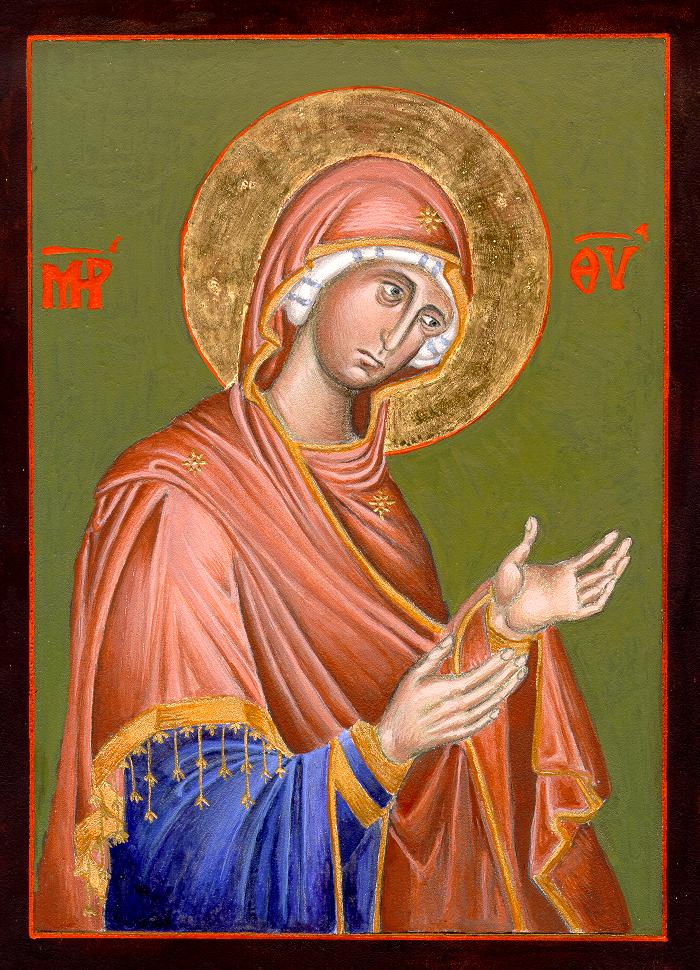
March 6, 2006

Listening, Acceptance, and Approval

In a recent interview with David Frost, Archbishop Rowan Williams observed:

I think, to find ways, as long as possible, of getting these two sides to make sense of themselves to each. The biggest problem is people don’t listen very much. That’s, you know, that’s human nature, and the Church is no exception. And so long as people are still trying to - so long as people are aware that they’ve enough in common to disagree, rather than just to tear it all up, so long as that’s true, it’s worth working at. Now the point may come where people say well we no longer have enough in common and we may reach that point - I don’t know. Meanwhile, my first priority is to try and keep the conversation going, to say do you understand why this matters.
It seems to me that the Archbishop says two things here: one false, and one true — and they are related. The false part is the accusation that “people don’t listen.” I think people have in fact listened very carefully; and that after listening we still disagree. +Rowan is betraying his liberal optimism here: if only you will understand me, you will agree with me. But arguments are not always persuasive, and a failure to agree need not indicate a failure to understand. An old priest friend of mine once told me of a conversation with his senior warden, who finally said to him, in exasperation, “Father, you aren’t listening to what I’m saying!” The priest responded, “George, I hear you perfectly. But I disagree.”

Where the Archbishop is “spot on” is in the question of how we deal with the disagreement. This is where we can choose to act in a gospel fashion, or not. Do we have enough in common to hold the church together in spite of strong disagreement about the rightness of same-sex relationships, and, whether right or wrong, how important is this particular aspect of a person’s life in terms of ordained ministry? Can those who disapprove accept the full participation of those of whom they disapprove in the church — in all orders of ministry? — that is the question for the “reasserters.” The question for the “reappraisers” is not (or ought not to be) Will you stop doing this? but Can you live with this lack of full approval — is acceptance enough? In short, can we maintain our unity in spite of a difference of opinion: even if it means various impairments in the communion, and juggling of episcopal oversight to accomplish it?

Ultimately, we have no control over others accepting us, only over who we accept. The Gospel way, for me, is the way of acceptance, not of “being accepted” — in fact, Jesus promises rejection in the short run for those who follow him. And it seems this is precisely what we are seeing: churches that are welcoming and accepting are getting a tongue lashing for not being restrictive enough. And if we criticize those calling for restriction for being restrictive — they say we don't “accept” them!

What can we do in response? I say, keep preaching the Gospel! And remain open and welcoming even to those who disagree — that is crucial, I think. I can say, “I hear what you are saying, but I disagree with you; but you are welcome to worship with me — if you want to.”

Acceptance in this sense need not mean approval — on either side. Rather we should acknowledge that we are all to some extent in error, but “accept one another as Christ accepted us” — with all our imperfections, and not as a sign of approval, but as an act of salvation.

—Tobias S Haller BSG


March 3, 2006

California Dreamin’

Some, including most “reasserters” — and even a few who in general support the ordination of gay and lesbian clergy, but have gotten antsy about our place in “the Communion” — have reacted negatively to the posted slate of candidates for Bishop of California, because it includes two people whose “lifestyles” create a stumbling block to unity in the church — something bishops are supposed to “safeguard.” Some have gone so far as to suggest that these two candidates are only there because of their sexuality. Others have gone further and implied their presence is primarily to “thumb our nose” at “the Communion.” This strikes me as a very myopic view, or at best a cynical one. I’ve know Robert Taylor for years, from before he was ordained. His name has been circulated as a likely episcopal candidate long before even GC2003 — so his presence on the California slate is no calculated surprise move.

Let me be frank. It is certainly true that out gay and lesbian bishops are a stumbling block to some Anglicans. The election of another such bishop may indeed lead to some of the provinces of the Anglican Communion severing their ties with the Episcopal Church (how many in addition to those who have already done so remains to be seen.) That would be their choice. I do not believe “the Communion” is going to vote us off the island in this case, as I do not feel that a majority of provinces feel that strongly about the matter; and if I am mistaken, and they do, it will still be their choice to do so. It would not be the first time that a part of the Body has suffered exclusion because it did what it thought was right.

But as to stumbling blocks: The cross was a stumbling block to Jews and a folly to Greeks. Jesus’ “lifestyle” was a scandal (that is, a stumbling block) to his contemporaries, shocked and appalled as they were at his fellowship with sinners — eating with them, and even letting them touch him. This led to deep and serious divisions in the religious community of his day; only a small minority of whom came eventually to join his movement. So Jesus did not come to bring unity, at least not at first, and certainly not as expected — but division. There had to be, as Saint Paul said later (1 Cor 11:19), a certain amount of partisan division and factions (Paul used the word heresy) so that what was truly genuine might be made manifest.

For true unity does not emerge from compromise, but crucifixion. The grain of wheat does not grow unless it perishes. It is through the Paschal mystery, and only thus, that the unity of the church emerges and is preserved.

You may recall that “the last temptation of Christ” was to appease those who crucified him: to deny himself and his mission, to compromise and come down from the cross, and settle down in the acceptable lifestyle of a first-century Jewish male. He did not do so. He remained the scandalous stumbling block, the great division, the wound that healed the world. I am called to follow Christ, and proclaim the unity for which he died: not the cozy fellowship of our little Anglican tea-party, as nice as that is and as loath as I am to see it split — but the unity of all who bear the likeness of God in Christ — the unity which he purchased on the cross and which no human action, whether mine or the Diocese of California, or the Primate of Nigeria, or the Archbishop of Canterbury can in any way destroy. That is the only unity worth standing for, for it is the only unity that will endure the end of days and the gates of hell. The one who was the stumbling block gave us his word, and I, for one, trust him.

— Tobias S Haller BSG