February 11, 2013

No To the Papacy

a review of Habemus Papam released in the US as We Have A Pope, a film by Nanni Moretti, 2011.
I watched and enjoyed this film some weeks ago on Netflix. Actually I enjoyed it so much that I watched it twice. Little did I know at the time how timely it might become. For this unassuming little film is about a man who resigns from the papacy — or I should say, puts the College of Cardinals into confusion and captivity by being elected, accepting the office, but then, in a crisis of conscience, refusing to be presented on the balcony — leaving them in the quandary of having a duly elected pope who refuses to be announced as such.

The film is billed as both a comedy and drama, and indeed that is what it is; there are any number of satirical pokes at institutions as various as the church and the press — including a delightfully gaffe-prone TV journalist who keeps making announcements that he must immediately correct. But the take-away for me is the poignancy of many of the characterizations; particularly that of the reluctant pope himself, beautifully crafted by Michel Piccoli. He captures both the gentleness and irascibility to which pastors who are also men of power are given, in a carefully graded blend of nostalgia for paths not taken, anger both at his own incompetence and at the misplaced help of others, and a sense of loss and dismay and incapacity. One might observe the director intended a commentary on the church itself; if that is the case, Piccoli serves well to portray it.

The cast is uniformly excellent in both large and small roles. I would take particular note of the director himself, who plays an atheist psychoanalyst made a prisoner of the Vatican, and who has delightful and meaningful encounters with the large (and convincing) cast of Cardinals who are similarly locked up until their dilemma can be resolved. Jerzy Stuhr as Il Portavoce, the Vatican press secretary, is a wonderful example of someone tasked with something inconceivable, yet managing to use all his wiles to cover the obvious embarrassment. This includes finding a Swiss Guard to hang out in the papal apartments and give the impression that all is well (the almost nonspeaking role of a man thrust into an inconceivable position is played with great charm by Gianluca Gobbi.)

I’ll stop there lest I give away too many spoilers, as there are many twists and turns in the plot — suffice it to say the film is well worth seeing, amusing and moving at turns, funny and poignant. But at this point, timely. Whether it is a parable of a church that has lost its way I will leave to you to decide, but it does raise some questions — now more than ever.

Tobias Stanislas Haller BSG


February 8, 2013

Liturgical Note

It is helpful to note that the 1662 BCP marriage service, while making reference to the "cause" of procreation in its opening exhortation, when it comes to the couple actually marrying, directs that the collect bidding that the couple "may both be fruitful in procreation of children" "shall be omitted, where the Woman is past child-bearing."

Thus the 1662 liturgy explicitly recognizes that while procreation is a "cause" for the creation of the institution of marriage, it need not be a reason for the particular marriage of a all real couples. This represents a healthy movement from idealism to realism.

The first American BCP was even more realistic, and omitted any reference to procreation, focusing entirely on the couple. It wasn't until 1928 that an optional prayer for "the gift and heritage of children" appeared in the Episcopal liturgy. And, to my mind to its detriment, a revised version of the 1662 preface on the "causes" of the institution crept back into our liturgy with the 1979 book.

Make of this what you will, but the liturgical history clearly demonstrates that capacity for procreation has not been a limiting factor in Anglican marriage for centuries.

Tobias Stanislas Haller BSG

February 7, 2013

Thought for 02.07.13

Why is it that the people who want to insist that Adam and Eve present us with the sole, divinely ordained pattern for human marriage, do not similarly insist that all follow the sole, divinely ordained diet God specified for human nutrition (Genesis 1:29)?

TSH

February 5, 2013

What for?

As England’s Parliament debates same-sex marriage, one issue often raised is the notion that marriage has a purpose; that being, it is claimed, to provide for inheritance and progeny. But as is surely obvious, heritability and offspring are not of the esse of marriage, but of the bene esse. They represent possibilities which, even if not realized, do not in any way lessen the reality of the marriage itself.

The “reason” given for marriage in Genesis 2 is not procreation, but loneliness. The “reason” for marriage given in 1 Corinthians is not children, but as a remedy for fornication. And clearly these two things — companionship and conjunction — are matters for the couple, and between them; that is, they subsist in the marriage itself. Marriage is a phenomenon that finds its essential reality in the relationship of the couple, not in any epiphenomena or results that spring from that relationship. Marriage is not a means to some extrinsic end, but a thing of value in and of itself.

This is a philosophical issue, as well as a legal one and religious one. And if someone were to point me to Genesis 1 to claim that it shows that marriage is about procreation, given the command to be fruitful and multiply, I would have to ask why birds and fish do not “marry” — given that they receive an identical command.

No, marriage is about the couple and their bond and covenant. It is not a bond and covenant — or contract — to produce children, since that might well not happen, and the marriage is not void if no children are produced. It is a bond and covenant to remain faithful to the spouse, just as the marriage vows spell out in detail, with no reference to offspring: loving and cherishing, having and holding, honoring and comforting, and above all, forsaking all others in an exclusive life-long relationship. This is why adultery is a threat to marital union even if no offspring is produced — the fault of adultery, like the good of marriage, does not lie in the results, but in the acts themselves.

Tobias Stanislas Haller BSG

I wish I'd seen it earlier, but two English thinkers have published a report that well summarizes the position I am addressing here. The fact that they see marriage in teleological terms is precisely the problem. The notion that "conjugal marriage connects the bond between men and women to a future beyond themselves, both in respect of children and the needs of wider society" obviously was not true of the primal marriage described in Genesis 2 -- as there was no "wider society." In addition, of course, the authors are hard pressed to give a novel definition even to the word conjugal — which refers solely to the couple and their relationship!

TSH

February 1, 2013

C of E Continues Hand-Wringing

In their latest shot across the bow of Parliament those speaking for the Church of England have made yet another anxious contribution full of concerns, unanswered questions, and uncertainty.

Two of the "unanswered questions" concern consummation and adultery. Why? Under English law, consummation and adultery can only take place in a mixed-sex context. (That does not mean the pariticpants must be heterosexual; it is certainly true that numbers of gay and lesbian persons are capable of heterosexual sex!)

But as to the C of E, it is not that the question has not been answered, but that the tremulous and anxious church-spokespersons seem not to like that answer. In both cases this is only an issue when one is seeking either to annul a marriage (due to failure or refusal to consummate) or end a marriage because of adultery. But nothing has changed under the new law: Under present English law, a woman cannot sue her husband for divorce with adultery as the ground (or as the English say, the "fact") if he has an affair with another man — but she can sue for divorce on the fact of "unreasonable conduct." This will remain the case with same-sex marriage legalized: a person who has an affair with a person of the opposite sex is committing adultery under the legal definition; if with a person of the same sex, it could constitute unreasonable behavior — and an "innocent party" who finds that either situation render continuing the marriage intolerable, can sue for divorce. In short — nothing has changed.

So in the long run this anxiety is merely displaced; it is just the church making an issue out of the few scraps of straw available to them. It doesn't make a very convincing straw-man, as it has nothing to do with marriage other than its termination.

Tobias Stanislas Haller BSG

January 30, 2013

Lead, Follow or Get Out of the Way

I am trying simply to verify a fact: do shepherds "lead" from in front, or "shepherd"* (i.e., "guide and direct") from behind or the midst of the flock? Scripture (Isaiah 40:11) seems to say that a shepherd can "lead" nursing ewes by carrying a lamb — which makes sense — but I suspect that simply walking in front of sheep and expecting them to follow is a bit optimistic! The intertubes provide no reliable evidence one way or t'other, offering completely conflicting opinions with great confidence. Any real shepherd care to comment?
Tobias Stanislas Haller BSG

* the English word "lead" in relation to a flock is often used for the Hebrew or Greek "shepherd" as a verb. I think in English when one says one is "shepherding," for example, a project, it does not mean walking in front of it and "leading" it, but rather tending to it and moving it along. Hence my question.

January 23, 2013

Thought for 1.23.13

Political fundamentalists read the Constitution in the same way that religious fundamentalists read the Bible: without context. While claiming to be faithful and literal, their understanding often wanders very far both from the text and its original intent.

Tobias Stanislas Haller BSG
Thinking particularly of those who imagine a militia was designed to attack the government rather than to serve it...

January 17, 2013

Unequal Measures

Reading Martin Kuhrt's response to Steve Chalke reminds me of the basic problem I have with the dyed-in-the-wool (and apparently wool-over-the-eyes) hermeneutic of the conservative evangelical movement. The main problem lies in the fact that they apply a very loose and freewheeling reading to the Scripture, a "reading" which actually wanders very far from what the text says, all under the cover of being particularly faithful to it.

Thus they go on and on (joining conservative catholics) about Genesis 1 and 2 revealing a divine plan for all sexual behavior, even though, as the text makes abundantly clear, it is speaking of two individuals (how after all could the man be "alone" if there were others?). They continue to misread Jesus' words on this text as some kind of pronouncement on complementarity when it is in fact a dissuasion from divorce, again in reference to the pair becoming a unit. It is particularly ironic that at least some conservative evangelicals have swallowed the pill of remarriage after divorce (the actual substance of Jesus' teaching) by means of the very "progressive" reading of Scripture and church history that they reject when applied to same-sex marriage.

The hermeneutic that Kuhrt seems to call for, in his rejection of a "progressive" hermeneutic (such as that which Augustine advocated in Of Christian Doctrine -- that all Scripture must be interpreted in the light of the Great Commandment to love God and neighbor; and which it is also fair to observe is the general hermeneutic applied through most of Christendom, at least to other texts) would ultimately require approval of slavery, condemnation of the consumption of unkoshered meat, and an end to the modern investment banking system, at the very least. In short, the conservative evangelicals either lack the conviction of their alleged hermeneutic or they are simply hypocrites. In either case it is the employment of unequal weights and measures.

Tobias Stanislas Haller BSG

January 15, 2013

On the Ranking of Rights

Thinking Anglicans has a very thorough round-up of reports (including the full statement of the court) concerning the European Court of Human Rights decision on some alleged infringements of religious rights on the part of employers.

The principle upon which the court bases its decision should come as no surprise to those familiar with human rights, that is: that one's exercise of a right should not constitute an infringement of another's exercise of a right — whether the same right or a different one. In particular, it is abundantly clear that the right to one's religious beliefs and practices does not include the right to deny others a public accommodation or service simply on the basis of one’s religious objection to the manner of life or behavior of that other person — including his or her own religious beliefs.

The court found that the employer who said an employee could not wear a cross because it conflicted with brand identity had indeed infringed upon her rights; but in the case of an employee who was offered an alternative way to express her religion because the means she chose to express it constituted a possible hazard (offered a pin instead of a cross on a necklace), the court found that the offer was reasonable. The other two cases involved people whose employers required them to provide services to mixed-sex and same-sex couples alike, and the court ruled that their refusal on the basis religious objection infringed upon the rights of those to whom they wished to deny service.

This decision, taken as a whole, provides a good balance in addressing the hierarchy of rights. If we accept one legal definition of a right as not simply a freedom to carry out a given activity, but as placing an obligation upon others (whether individuals or society as a whole) it is perhaps easier to see the issue in terms of a ranking of obligations: those who provide public accommodations are obliged to provide them without discrimination; employers are obliged to protect their customers and clients, and provide services without discriminating; a religious believer who feels an obligation to profess his or her faith through the wearing of some visible symbol, or to profess a given belief, has a right to do so unless it conflicts with some other duty which they are also obliged to carry out in reference to someone else.

It is earnestly to be hoped that a similar clarity of thought can be applied to the issue of the provision of health insurance.

Tobias Stanislas Haller BSG

People, Look East

Tobias Stanislas Haller BSG

This article appeared in somewhat different form in The Anglican Catholic, Volume XV (Summer 2003), and in the newsletter of Saint Paul's Church, K Street, The Epistle.

One of the more contentious issues of liturgical reform in the last third of the last century concerned the position and posture of the priest and people in relation to the altar. Many exponents of the Liturgical Movement, both in the Roman and Anglican communions, encouraged the erection of free-standing altars in new churches (the ravages of World War II in France and Germany gave ample opportunity for this) and the relocation of altars (or where impractical, their supplementation through installation of new altars). Historical and liturgical arguments were invoked in favor of the move towards free-standing altars and celebration in which the priest and people faced each other over and across them. It was commonly asserted that this was a recovery of ancient tradition, which fostered a greater sense of the church as a gathered community empowered for mission. In this paper I will join a number of historians and liturgists who are finding it prudent to reexamine these claims.

History reexamined

The part of this literal “liturgical movement” connected with the furniture had a sound historical basis: altars had, for the most part, been freestanding, based on the scant evidence of the earliest house churches, to the well-documented basilicas, and on through the renaissance — and the placement of the altar as a massive sideboard against the eastern wall of the apse was a fairly late development. Note, however, that even these high altars of the baroque era, though they appear to be up against the wall due to the elaboration of gradine and reredos, almost without exception have passageways behind them to allow the circumambulation required by rubric at their dedication. (Anson 1948, 76.) (This technical compliance with the rubric reminds one of the creasing of hosts with the edge of the paten which conscientious anglo-catholic clergy used to do in deference to the “lesser fraction” rubric, saving the complete breaking of the bread for the point at which they knew it to be proper!) So at least as far as historical precedent for the position of the altar goes, the leaders of the Liturgical Movement had some foundation.

Along with the restoration of the freestanding altar, the celebration of the eucharist with the priest facing the people (technically called “versus populum,” henceforth “VP”) was also encouraged, in the earnest belief that this was the ancient position for the celebrant, whether bishop or priest. However, even during the height of the Liturgical Movement and the Vatican II reform cautionary voices were raised. Few scholars felt the freestanding altar required or implied a VP Eucharist, and the primary impetus appears to have been the enthusiasm generated in the excitement of rearranging the furniture. A calm and careful look at the historical evidence since the heady days of the 60s and 70s has led many to reexamine and rethink the matter.

What the evidence shows is that, with very few exceptions, the celebrant at the eucharist rarely faced the congregation across the altar, at least during the eucharistic prayer. It appears that the position of the bishop’s chair behind the altar in the early basilica may have been the source of the confusion. Since the bishop faced the people during the liturgy of the word it was wrongly assumed that he continued to do so at the prayers or at the liturgy of the table. However, the early church was not concerned about whether the bishop faced the people or not, but about the direction all worshipers faced for prayer. Prayer, above all the eucharistic prayer, was addressed, not to the assembly, but to God. The traditional direction for prayer was towards the east, towards the rising of the sun that symbolized the coming of Christ. This meant that in churches that were “oriented” with the apse in the east, the bishop would come around the altar and join the congregation, leading their prayer as they all faced east together.

In the city of Rome, however, basilicas were often if not always “portal oriented” — that is, their entry door faced east, and the altar was in the western end. In this case the bishop was already facing east for prayer, and the congregation would join him, not turning their backs on him but turning to face east with him, leaving the altar behind them. This may seem odd to us, but in this early period the medieval concern with “seeing the consecration” had not yet evolved. Indeed, in the Eastern Orthodox tradition, visibility was never a primary issue, as the whole people of God, clergy and laity, were quite happy to pray together and in the same direction whether they could see each other or not. (Jungmann 137f; Bouyer 175) As Louis Bouyer notes:

The notion that the arrangement of the Roman basilica is ideal for a Christian church because it enables priests and faithful to face each other during the celebration of Mass is really a misconstruction. It is certainly the last thing which the early Christians would have considered, and is actually contrary to the way in which the sacred functions were carried out in connection with this arrangement. (175)

There is no need here to rehearse the process by which the basilican freestanding altar evolved into the magnificent sideboard of the middle ages, though Jungmann suggests (138) that the impracticality of the people turning away from the altar (in the Roman portal-oriented layout) led to the development of “altar orientation,” the eventual notion of a “liturgical east,” the movement of the altar deeper into the apse, and the adoption of the “eastward position” (EP) in which the celebrant turns to join and lead the people, in facing the same way together with them.

It is fair to say that this practical change was accompanied, but not driven, by an emerging theology of sacrifice. It was largely in reaction to this theology of sacrifice, and a desire to introduce a resemblance to the “Lord’s Supper” that the Reformers transformed the altar into a table around which the assembly gathered — though here too their intent had little historical authority, even if the eucharist had ever been conceived of simply as a recreation of the Last Supper. For in a classical banquet all those partaking, host and guests alike, sat or reclined on the same side of the table or tables— an image preserved in countless (even late) representations of the Last Supper. (Ratzinger 78)

Many of the newly designed freestanding altars of the Roman Catholic tradition in the middle of the last century still required an EP celebration. A number of photographs of these grand but now rather dated “modern” liturgical spaces (even in texts such as Hammond’s, that argue for VP) reveal the limitations upon the VP posture, due to the tabernacle and candlesticks still present on the mensa. It was only with Vatican II that the Roman Catholic Church, by banishing the tabernacle and candlesticks (admittedly late additions) from the altar, made VP celebration almost universally possible, though as some Roman Catholic liturgists are now emphasizing (as they reconsider the wisdom of this change), the rubrics do not require this posture. It has also been pointed out that even at Saint Peter’s, where the pope has stood opposite the people since the basilica was constructed, it was not in order to face them: indeed, in the long period from the Baroque until Vatican II in which tabernacles reigned, the celebrating pope could no more see the people than they him.

On this side of the Tiber (and the Atlantic), our own Book of Common Prayer rubrics still expect the EP posture, and the rubric at the end of the dialogue leading to the preface states, “Then, facing the holy Table, the Celebrant proceeds...” (BCP 361, etc. Note, however, that this rubric has uncountably disappeared from the Spanish version of our Prayer Book!) Bonnell Spencer, writing in 1965, noted that the rationale for the introduction of VP in the Roman church provided a means of improved visual participation in a church which at that time conducted much of its liturgy in a low voice and the Latin language, but that the Anglican tradition had less need of such visual rearrangements because it had long since dealt with the verbal accessibility of its liturgy. Joint prayer of the people and priest together, he noted, “is a far superior form of corporate participation than merely watching the celebrant.” (161)

Yet, in spite of the specious foundation for the historical argument for VP, i.e., that it represents a recovery of the ancient tradition of the church, this has become the dominant Roman Catholic liturgical fashion, and is now prevalent among Anglicans.

There are times when historical justification is less significant than present need — tradition should inform, but not bind the church in its efforts to serve. However, while we need not be dominated by our history, we should at least be well informed concerning it, particularly if we are going to argue from it. Liturgists in particular seem to fall prey to a kind of historical nostalgia, whether for the apostolic, patristic, or some other golden era. But it is no good picking up one feature of some past liturgical customary (always assuming that scholars and fashion-setters have it right— which it seems many didn’t with VP) and simply patching it onto our contemporary situation. New wineskins really are needed for new wine, and there has been a lot of water under the Milvian Bridge.

Communion and Community

So, is there a compelling rationale for VP — or a return to EP — on some other basis than the historical. When making liturgical changes (whether one sees them as a recovery or a development) it is important to consider the whole context of the world as it is today, and what different meanings a gesture from the fourth century may have for us, and what effects. We really ought to be saying what we intend.

My conclusion is that while VP has its place in certain limited and specialized environments (closed communities such as convents or schools, or informal private gatherings) it raises a number of practical and pastoral problems, and what is worse, has had and will continue to have deleterious effects on the parish, the wider church, and its understanding of ministry.

Far from encouraging a growth in the sense of community, as texts from the Liturgical and Parish Communion Movements too numerous to list insist, the dominance of VP has sometimes led on the contrary to a new and more insidious form of clericalism. How so?

Take, for example, Peter Hammond’s critique of EP and his insistence that VP not only will bring about greater liturgical participation, but spur the laity on to apostolic mission in the world. (Note as well his acknowledgment that the foundation for VP is ideological rather than historical, or as he says “missionary rather than antiquarian.”)

Preoccupations which have already brought about a widespread restoration of the ancient ceremonies connected with the offertory, and the celebration of the eucharist versus populum have all been missionary rather than antiquarian. So long as the layman in church remains a passive spectator of something done on his behalf by professional actors, it is likely that he will be equally passive in regard to what is done out of church. (168)

Just think about the logical and historical problems with this assertion. The historical assumption concerning the VP itself has been addressed above. Here it is more important to note that the church’s great missionary efforts in previous ages managed to survive without the benefit of VP quite nicely, and many laity, Roman and Anglican alike, have gone forth from churches with baroque or gothic furnishings and truly antique ceremonial, nourished with a sense of mission and outreach, of which I have not noted an incredible resurgence since the adoption of VP as a virtual norm. One need only cite Jesuit mission and Jesuit architecture to see the fallacy in Hammond’s assertion.

More problematical is the second sentence in Hammond’s analysis. I have actually been a professional actor, having appeared on Broadway and off for a period of fifteen years before I entered full-time church work, and the one thing professional actors are above all eager to avoid is turning away from the audience. While it is certainly true that some priests who used the EP may from time to time have thought of themselves as performers, and some congregants who worshiped in their churches may also have felt themselves reduced to spectator status, that clearly has nothing to do with the professional theater, and any actors who habitually “upstaged” themselves would soon find themselves out of work! Actors quite normally face their audiences, and while there is one time in the liturgy where a certain element of performance craft is not out of place — the sermon — in general any semblance of “performing” should be restrained.

Sadly, and contrary to Hammond’s assertion, VP enforces the “performance” mode, most particularly in the eucharistic celebration, where the celebrant becomes a kind of ecclesiastical Julia Child confecting the eucharist, or worse, acting out the Last Supper (the Reformers have had their way after all!). How many times have we had to endure clergy “stretching out their arms upon the cross” or similarly pantomiming the surmised actions of Christ at the table in the upper room? Far from avoiding performance mode, the VP has virtually set it in stone, as the altar becomes a barrier as substantial as any rood screen, and as definitive and divisive of the liturgical space as any proscenium is of the theatrical. This has burdened many clergy with the task (in many cases far beyond their talents) of performing for, rather than praying with their congregation. It is, in short, a less subtle and more demanding form of clericalism. As Bonnell Spencer pointed out, “Far from being eliminated, the idea that the priest is celebrating for the people is made more explicit. They can watch him do it.” (162) Of course, this model of the priest as alter Christus par excellence fits quite nicely into the Roman Catholic conceptualization of church hierarchy, as an essentially papal model of eucharistic celebration became the norm for every parish (as the suggestions in the General Instructions on the Roman Missal of the 1960s came more and more to be interpreted as rules in the 1990s). If one wishes to emphasize hierarchy there are few more effective ways of doing it than dividing the people from the celebrant. For the Roman hierarchy, it is also a way to emphasize the all-male priesthood. Note this 1993 instruction from the Congregation for Divine Worship and Discipline of the Sacraments:

The celebration of the Eucharist versus populum requires of the priest a greater and more sincere expression of his ministerial conscience: his gestures, his prayer, his facial expression must reveal to the assembly in a more direct way the principal actor, the Lord Jesus. One does not improvise this; one acquires it with some technique. Only a profound sense of the proper priestly identity in spiritu et veritate is able to attain this. (12:1)

In my experience, clergy more often attain to the level of talent show MCs or nightclub performers; the burden of being a performer is more than most can bear. I will address below at greater length the even greater burden of “revealing to the assembly in a more direct way... the Lord Jesus.”

Another problem with VP is the confusion of exactly to whom the various parts of the eucharistic prayer are addressed. EP made it very easy to distinguish those portions of the prayer addressed to the assembly from those in which the presiding minister turned to lead the assembly in addressing God, normally symbolized (or at least given liturgical focus) through the cross above and to the east of the altar. With VP, the celebrant finds him or herself either looking into thin air, a rose window, lowering the eyes to concentrate on the altar book or the chalice and paten, or looking at the congregation (thereby giving the impression that the eucharistic prayer is addressed to them). And what does the congregation have to look at? Again, the smiling or somber priest must naturally become the focus of attention. After all, isn’t it rude not to look at someone who appears to be speaking to you? The liturgy comes to be more and more about the celebrant.

On the mission and ministry front, the widespread adoption of VP has led, not to greater lay involvement in church mission either for Romans or for Anglicans, but to a proliferation of lay participation in roles on the “other side of the rail” even in broad and low churches, and greater lay involvement in “speaking roles” for the Roman Catholics. (The anglo-catholic parish always had lots of things for people to do “on the altar.”) How many times have you heard “participation” limited to being a reader, an acolyte, a chalice administrant, or intercessor, all of them formerly ministries not of the laity but of the “minor orders,” and many of them once the reserve of the deacon (and of the many forces working against a revived and flourishing diaconate in our time this is one of the most insidious)? Often greater lay participation on the “other side of the footlights” (facing the congregation) has precisely the opposite effect, as in the dismal failure of the Roman Catholic ministry of “song leader” — which sometimes has the effect of rendering congregations completely silent as they are “led” by someone who appears to them to be more of a nightclub performer than a cantor.

Ultimately, no amount of such “participation” will have an impact on what people do in the world unless while assembled in church they have been fed with the bread from heaven and transformed in their hearts to become what they behold. Theater on a proscenium stage, or a three-quarter thrust, or in the round, will always have its actors and its spectators, and if what you think you are doing in church is theater, then it really doesn’t matter which way you face.

Turning one’s back for leadership

The contemptuous way in which the ideologues of last century’s VP movement commonly described EP, as the priest “turning his back on the people” (Lowrie 158), also indicates the essentially clericalist focus of their concerns. No one ever suggested that the people in the front pews had turned their backs on the people behind them. It is the priest who matters, and who he or she is facing. But though it may be true that many clergy who have used the EP think in terms of who they are turning from, I think many more rightly focus on whom they are turning toward as they join their congregations to face the same direction together. Liturgy is primarily an essentially plural enterprise in which the many focus on the One in holiness and adoration, and that mutual focus draws them together. If the priest usurps the focus by becoming the actor, or the people become the focus for the priest who has nothing else to look at, the center of worship becomes the worshipers themselves.

VP and EP simply represent two very different models for the church, one focused inward primarily on itself and its concerns, the other looking outward and onward; one emphasizing the gathered community, the other the transcendent presence of God. What we have in these two models is, in short, the circle or the procession. Both have their place, but there is a clear question as to which better truly builds community. As mentioned above, there are situations in which the circular arrangement for the eucharist makes a good deal of sense: a permanently or situationally closed community (a convent or school). But in these cases the strong sense of community already exists; in fact, the stronger this sort of community, the harder it is for an outsider to feel welcome — it is very hard to break into a circle, but it is wonderfully easy to slip in at the end of a procession. Community is far more easily built by adding a sense of common direction and mission, rather than focusing on the membership itself. This is particularly true when the VP is circular in name only, for example, when a gothic church’s high altar is moved forward by about a third or less, with the celebrant on one side and the congregation on the other. This has all of the weaknesses of both models, to my way of thinking, and I will reflect at greater length below on how this setup, far from creating an aura of equality, is even more clericalizing in its effects than the most distant high altar of the old tradition.

Let me also note at this point that I have seen and experienced worship in modern churches that embrace the circular model with far greater success: balancing the aspects of leadership of and membership in the body, without losing a sense of direction. For example, Saint Matthew and Saint Timothy’s in New York, while providing an intimate and almost womb-like gathering place for the assembly (entered via a long corridor that echoes the sacred caves and catacombs of antiquity), manages to preserve a marvelous sense of the transcendent, as the central altar is bathed in light from the atrium above, and the liturgical direction becomes up. The priest in this case is clearly leading the liturgy, but is also clearly a member of the circle, directing the attention of the whole assembly with word and gesture but also joining with them in raising their hearts on high together.

That sense of a community joined in a common direction is at the heart of the liturgy. C.S. Lewis once described the difference between friendship and love as a matter of focus: that lovers look at each other, and friends stand side by side looking towards some common goal. Clearly, the church is called to be a loving community, but isn’t the church’s love based at least in part on the sense of God as the ultimate lover, towards whom all our attention ultimately turns, and from whom we gain our life and power to love others, most especially those not already part of our inner circle? If we become fixated on each other in the liturgical assembly, rather then turning our attention to God, where will we get the emotional and spiritual energy to carry our love for God out into the world, instead of spending it all on ourselves?

And if the priest must become the “stand in” for Christ, does that not place upon him (or her) an intolerable need both to “deliver” and to receive the displaced love of the whole congregation, rather than leading and guiding that love towards the transcendent One who is before us, beyond us, above us and yet at the same time with us? Seeking to reveal Christ through one’s own “gestures, prayer and facial expression” (as the Congregation on Divine Worship recommended) strikes me as the cult of the personality verging on idolatry: and any priest who succeeded in doing so would likely be a great danger to his (so the Roman Catholics would have it) flock and to himself. I am reminded of that wonderful short story from Ray Bradbury’s Martian Chronicles in which a shape-shifting Martian becomes the object of the inmost need of each person he encounters (including a priest, who sees him as the crucified Christ). Ultimately the conflicting needs of the people destroy the poor empathetic alien. Is there any connection between what I have said here and the cases of clerical misconduct and burnout that seem to have become so common? I wonder.

I am more secure in saying that the processional form for the liturgy provides a responsible and at the same time less debilitating model for leadership and mission. First of all, there is a clear sense of direction, implying motion, or at least an expectancy of motion, a sense of a yet-to-be-realized eschaton, reminding us that even our Eucharist is a type and shadow of the glory that shall be, and not its full accomplishment. Secondly, the goal and focus is not within the community, but beyond it. And thirdly, and perhaps most importantly, the priest is the leader but not the goal.

Finally, to mention the deacon again: how much more powerful is the dismissal as a sending forth in a particular direction, than as the mere dispersal of a circle. I have more than once heard the traditional oblong church model described dismissively as an “airplane.” Well, at least airplanes go somewhere.

So where do we go from here?

Now, I realize in all of this that I risk being catalogued as the worst kind of retrograde reactionary. And I admit that I am a bit uncomfortable to find that I share any opinion at all with Josef Cardinal Ratzinger. (I was quite amazed when his Splendor of the Liturgy appeared, decrying the great “mistakes” of Vatican II, in which I can only say I felt as if he’d been reading my mind, if not my journal notes!)

But I am heartened to find that my thoughts on this matter were presaged by the likes of Fathers Bonnell Spencer and Josef Jungmann, and today are echoed by numerous younger clergy and laity. Moreover, my practical experience has also shown me that a balanced eucharistic liturgy, with elements of the liturgy of the word (particularly the readings and the sermon) executed in an engaging, lively, and personable manner, coupled with a liturgy of the table that brings with it notes of transcendence, solemnity, and purpose, has provided the congregations which I have served with a real sense of renewal. In both parishes I have served my predecessors had abandoned the old “high altar” and introduced freestanding altars, and in both I made the decision to abandon this liturgical novelty in favor of the manner of worship which has been predominant for most of Christian history — not because of the historical reality, but because people are hungry for transcendence in a world that so aggressively confronts them or performs for them, rather than accompanying them and leading them.

Simply rearranging the furniture is not an answer to church growth or mission in itself. Nor is simply changing the posture of the clergy in relation to the laity. What the church needs now is a complete attitude adjustment and recovery of what it means to worship the One who is the object of our prayer, and the source of our life. Let us mean what we say, do what we intend, and become what we behold.

Sources

Anson, Peter F. Churches: Their Plan and Furnishing. (Milwaukee: The Bruce Publishing Company, 1948)

Anson, Peter F. Fashions in Church Furnishings: 1840-1940. Second edition. (London: Studio Vista Ltd, 1965)

Bouyer, Louis. Rite & Man: Natural Sacredness and Christian Liturgy. (Notre Dame, Ind.:University of Notre Dame Press, 1963).

Congregation for Divine Worship and Discipline of the Sacraments. “Praying Ad Orientem Versus,” in Notitiae 332, Vol. 29, No. 5, May 1993, pp. 245-249.

Gamber, Klaus. Reform of the Roman Liturgy : Its Problems and Background. (Roman Catholic Books, 1993).

Hammond, Peter. Liturgy and Architecture. (New York: Columbia University Press, 1961).

Jungmann, Josef A., S.J. The Early Liturgy. (Notre Dame, Ind.: University of Notre Dame Press,

Lowrie, Walter. Action in the Liturgy. (New York: Philosophical Library, 1953).

Ratzinger, Josef. Spirit of the Liturgy. (San Francisco: Ignatius Press, 2000)/

Spencer, Bonnell, OHC. Sacrifice of Thanksgiving. (West Park, N.Y.: Holy Cross Publications,

January 12, 2013

On Reading the Psalms as Cranmer Intended

My community joins a number of others in reading the Psalter as part of the Daily Office in Cranmer's 30-day cycle (indicated in headings in the Book of Common Prayer.) This produces some odd dissonances from time to time, but the overall effect is powerful. One is somewhat down at the sea in ships, being cast high or low, then in a quiet eddy, sometimes a bit queasy, then by turns thrilled, occasionally becalmed then narrowly escaping the maelstrom of anger and the funnel of hatred, only to sail into a safe harbor of Hallelujah's as the cycle comes to a close.

Tobias Stanislas Haller BSG

December 31, 2012

Christmas Special

The "must see and glad I saw it" of this Christmas season was the Call the Midwife Christmas Special --- apparently a last-minute decision on the part of PBS, as it didn't appear in the program guide. I only caught word of it because of a promo on the day itself. The new series ended its run for this season earlier this year, so the Christmas special came as something of a surprise.

And not only a surprise, but a delight. This is a wonderful tale of redemption, forgiveness, closure, thanksgiving for changing times, and the sufficiency of grace: good themes any Christmas. Keep an eye out for a rebroadcast, and keep a hanky handy. Wonderful performances by the standout cast.

Tobias Stanislas Haller BSG

December 22, 2012

Papal Fallibility

Pope Benedict XVI has chosen to make use of his Christmas message to do a bit of theology concerning human nature. In doing so he reveals a fundamental failure to grasp the meaning of the Incarnation.

...People dispute the idea that they have a nature, given to them by their bodily identity, that serves as a defining element of the human being.... They deny their nature and decide that it is not something previously given to them, but that they make it for themselves.... The manipulation of nature, which we deplore today where our environment is concerned, now becomes man's fundamental choice where he himself is concerned...
This rather misses the mark, as the whole point of the Incarnation taking place in the manner it did — via the work of the Holy Spirit and the Virgin Mary, without any participation of a human male — was to reveal the secondary quality of maleness and femaleness: Jesus derived his entire human nature from the Virgin Mary (or so says the Definition of Chalcedon). Although Jesus is male, his humanity derives entirely from a female. So the "human nature" is in itself genderless, although each particular human being has, by virtue of genetics and epigenetic factors, a sexual or gender reality expressed anatomically, psychologically,  emotionally, and socially. But as with all qualities of a person, sex is not essential to the nature: it is a characteristic particular to the individual, like height, or eye or hair color, or any of the other variable factors that individual human beings have. We even have a very clear sense of the genetic factors that produce this particular characteristic quality of the person. The quality does not make them human; their humanity gives expression to the quality.

The Pope takes what can only be described as a hard-line determinist position, pure sexism in its most precise form: anatomy fixes identity. In addition to the discontinuity of this position with the doctrine of the Incarnation, this also tends, like its cousin racism (also based on "given" characteristics), to dehumanize the human person, and reduce the concept of the person to the level of the animal nature; it puts all the weight of identity on the very aspect which the doctrine of the Incarnation shows us should not be given any weight at all, for as St. Paul so famously observed, "in Christ there is no more male and female."

Categorical difficulties
Which brings me to Genesis. One of the ongoing problems with the traditional Christian view of sex and sexuality lies in the reading of Genesis 1:27 ("male and female he created them") as referring to categories of people; that is, reading the words male and female as adjectives. However, in Hebrew, they are nouns — and would likely be better translated as "a male and a female, he created them." Although the Greek translation (LXX) elides them into adjective form, the Aramaic retains the noun form, and in one of the Aramaic versions adds specific details about the couple.

It appears from the contemporary evidence that Jesus and other Jews of the Second Temple era read and understood the text in this way, as referring to a couple. The Damascus Document of the Dead Sea Scrolls (Geniza A Col. 4:19-21), for example, uses the verse from Genesis in support of its argument in favor of monogamy. The same is true of a section of a Zadokite Document (7:1-7) that is usually classed with the Old Testament pseudepigrapha or apocrypha. (It seems to me to be from the same source as the Qumran text.)

And Jesus himself, when he cites this text in his critique of divorce and remarriage (Matt 19:4-6) is also clearly referencing not some alleged complementarity that makes male and female fit together, but rather the simpler and more obvious notion that a couple join together to form a unity: he even quotes (paraphrasing the Hebrew, as do the LXX and Targumim, by adding "two") another portion of Genesis (2:24). He then nails the matter home by his own gloss, "So they are no longer two, but one flesh."

So this isn't about categories, but about the mystery of how two become one — which is, of course exactly how St. Paul deals with it in Ephesians, which is also about how two become one — the two of Jew and Gentile (2:15) in one body as well as the two of husband and wife in one flesh.

So could we please have no more of this nonsense about categorical qualities being determinative about who and what people are, at their most basic level as human beings? People are fully dimensioned with many qualities and characteristics, and indeed free — with the freedom given by their Creator — to become all that God intends for them. The Scripture may begin with Genesis, but it ends with the Revelation of the new humanity, which transcends the merely earthly categories and qualities that each of us possess. It is not our substance or our genes that matter: but our actions of love and service to one another.

Tobias Stanislas Haller BSG

ps: Let's try a mental exercise. Surely a part of the imperative of bodily identity as male and female should be "ordered" towards what male and female exist for: sexual reproduction. So any person who fails to live out this aspect of his or her natural identity is in some way "constructing" an identity at odds with their biological destiny. So the "celibate lifestyle" is contrary to human nature.

UPDATE: You can read the full text of the address courtesy of Whispers in the Loggia. As I suspected, Benedict reads Gen 1:27 as referring to categories, not people. He's done it before, and will do it again...

December 20, 2012

Grace's Cost

Grace is not cheap. It is free. It comes as a gift, unearned, unasked for, unexpected and most of all undeserved.

He was the gift that gave it. 
He gave that gift to save us. 
That gift was costly to himself alone,
All for our sake and our salvatiòn. 
Deo Gratias.

Tobias Stanislas Haller BSG
Eve of St Thomas 2012

December 19, 2012

It's In the Cards

tsh as dr grün
Once upon a time I felt flattered to be asked to produce ID in order to order a drink or buy a bottle of spirits, wine or beer; it is now not so flattering not to be asked for ID in order to obtain a senior citizen discount...

Tobias Stanislas Haller BSG

December 16, 2012

The Unheeded Warning

In spite of how obvious it is that people should deal fairly with one another, they don’t: a sermon for Advent 3c

Advent 3c • SJF • Tobias Stanislas Haller BSG
With many other exhortations, John the Baptist proclaimed the good news to the people.

Our gospel passage this morning ends with the assurance that John the Baptist proclaimed “good news” to the people. In light of recent events, we sure could all use some good news. I have to say I am heart-broken, right now, as I know many are, at the terrible tragedy that took place last week in Connecticut. But our other Scripture readings sound like good news, no doubt about it. The prophet Zephaniah urges daughter Zion and Israel to shout out and rejoice, and to make thanksgiving for the redemption of the Lord and God who is coming to rescue and restore that kingdom and that hope. God will restore their fortunes, the prophet promises; God will give them the victory of a triumphant warrior; God will rejoice over them with gladness and renew them in love, exulting over them with loud singing as on a day of festival. Fling out the banners and light the fireworks; strike up the brass band and start the parade!

Those sentiments are echoed in the First Song of Isaiah that we used as our psalmody this morning — words full of assurance that God the Savior is at work and that God’s work is trustworthy and solid. If there were a theological “Angie’s List,” this would let us know that God gets an A-triple-plus rating — God is someone you can count on.

Saint Paul continues the celebration in his Letter to the Philippians, beginning with that word that gives this Sunday its name, “Rejoice Sunday,” or as it is known in Latin, Gaudete. What we heard as our second lesson today would have been the first words you heard on this Sunday in the Western church right on up into modern times: not only an assurance of reasons to rejoice, but a command to rejoice. We follow that tradition by using these rose-colored vestments on this day — lightening up from the somber purple of the Advent season to a brighter and more cheerful hue.

+ + +

By this time these warm-up acts have got us ready for a celebration in the gospel. But what are the first words we hear from John the Baptist: “You brood of vipers! Who warned you to flee from the wrath to come?” It seems the parade has come to a screeching halt. As if a gunman has broken into a classroom and opened fire. As if the pink of the vestments were not a celebration of life but about breast cancer awareness, awareness of that terrible disease that strikes so many; it’s as if someone in the brass band has hit a very sour note, or even worse, that a sniper has opened fire on the band, and all of the instruments have fallen silent. The towering figure of John the Baptist points with his gnarled hand at the crowds who have come out to hear him preach — like the ghost of Christmas yet to come. And if the crowd wanted something other than fire and brimstone, they are in for a surprise, for he calls them, a “brood of vipers.” And yet the Gospel goes on to say he encouraged the people with such good news. I don’t know about you, but being called a viper is not the best news I’d like to hear.

So let us look more closely at what follows that initial stern rebuke. There is good news, thank goodness. For after this powerful condemnation and threats of axes and fruitless trees being chopped down and thrown into the fire, when it gets down to brass tacks and the fate of the crowd — no doubt shivering in their sandals by that point at the prospect of what is about to be demanded of them — when the terrified crowd gets up the courage to ask what they can do to be saved, what does John tell them?

“Whoever has two coats must share with whoever has none, and whoever has food must do likewise. You tax collectors just collect the tax, and you soldiers don’t blackmail or abuse people!”

Well, if you had been there then, wouldn’t you breathe a sigh of relief at those words? After his verbal introduction and assault, John does not ask the people to do anything at all extraordinary — he doesn’t ask them to live like him out in the wilderness dressed like one of the prophets of old with a hairy mantle and a leather belt, living off locusts and wild honey. He tells them to go home and get back to work and do their jobs and live lives of honesty and fairness.

And this is really where the good news comes in — for certainly it is good news, as Zephaniah and Isaiah and Paul assure us: that salvation is not something we have to do on our own for ourselves, but something that is done for us by one who is mighty to save. For surely, as Isaiah says, it is God who saves us, and we can trust in him and not be afraid.

And on top of that, John the Baptist, after that initial stern language, gives us the good news that what is asked of us is not impossible — but is really only fair and just and right: to share our resources with those who do not have — our clothing with the naked and our food with the hungry — and to do the work we have to do with honesty and without taking advantage of or abusing anyone else.

And that, my friends, is the good news — that we have been saved by God, and that what God asks of us is to love God and our neighbor.

+ + +

And wouldn’t it be lovely if people actually did. If it’s really that simple, why did the prophets have to keep proclaiming it? Why did John the Baptist have to shout at the people and greet them as a brood of vipers? Why did he have to warn them of the coming destruction and the fruitless trees and the great bonfire at the end of time, the threshing floor and the unquenchable fire that will burn up all the worthless chaff and deadwood of unproductive lives?

You know why — because in spite of how obvious it is that people should deal fairly with one another, they don’t. Even without the awful example of last week’s shooting, ringing in our ears, impossible to avoid as you turn on any television station at all, we know that people do not do as they ought to do. In spite of the fact that everything works so much better when everyone follows the simple rules of courtesy and fairness and generosity — just common sense — people still try to take advantage — just watch the exit ramp on any crowded highway: someone will have to create a lane of his or her own, or find a creative way to nose in at the head of the line causing everyone else to be slower. In spite of the calls for spare coats to be dropped off at the library or police station for distribution to the poor and cold, the dawning day of the Lord’s Day will find plenty of closets full of clothing that people haven’t worn in years. To my own shame I realized as I wrote these very words that there was more in my closet at home than really needed to be there; and I took that unworn second coat up to the library on Eames Place and dropped it off; how about you?

If nothing else, let this reading today be a reminder to us — to all of us — of a simple command: to check that closet when you get home and find the coat you no longer wear and bring it to the library or the precinct so it can be given to someone who will actually wear it.

We are not asked to do the impossible, my friends. We are asked to do something so easy it would be a crying shame for us to fail to do so. It would be a shame to end up crying in shame when the ax is laid to the root of the trees and every tree that does not bear good fruit is cut down and thrown into the fire. That’s good news, if we are prepared to hear it, and hearing it, act upon it. God gives us the warning; may he give us the strength to do as he commands.+


December 15, 2012

Rachel Weeps

A voice is heard in Ramah, weeping and wailing.
Rachel cries for her children and will not be consoled,
because they are not.
Rest eternal grant unto them, O Lord, and let light perpetual shine upon them.
A voice is heard in Ramah, weeping and wailing.
Rachel cries for her children and will not be consoled,
because they are not.

From Requiem for Children, 1980
Tobias Stanislas Haller BSG


MP3 File

December 12, 2012

Thought for 12.12.12

Unity is not a value to be held in spite of diversity. It is a value we hold because of diversity. If we were all the same we would not need such a value.

Tobias Stanislas Haller BSG

Being Institutionalized

Sir Tony Baldry is reported as saying, "For the Church of England, the uniqueness of marriage is that it embodies the distinctiveness of men and women, so removing that complementarity from the definition of marriage is to lose any social institution where sexual difference is explicitly acknowledged."

To imply that sexual difference is essential to marriage is just a circular argument for "only mixed-sex couples can marry." To say that removing sexual difference from marriage means we have to remove it from all other social institutions is to the point, though. I mean, haven't we? Shouldn't we? Is it just that marriage is the last bastion of the social shrine of sexual difference? To what end?

Tobias Stanislas Haller BSG
h/t Thinking Anglicans

December 11, 2012

Sirens and Asparagus

It is now reported that the English Parliament, while edging towards approval of same-sex marriage, is responding to appeals by at least some in the Church of England, to make it part of the law that the Church of England (and that of Wales) be explicitly prohibited from performing such marriages.

Needless to say present law of the Church of England (and Wales) does not allow for same-sex marriages, although there has been occasional movement in that direction. It appears that some fear that if something is not forbidden it will become mandatory.

This particular "lock" or "lockout" forbidding England and Wales to perform same-sex marriages even if their governing bodies decide to do so seems a bit like our American "fiscal cliff" -- a law put in place to prevent a body from doing what it very well knows it might one day choose to do, but is unwilling to do or fearful of doing.

The fact that there seems to be a need for such an external restraint is testimony to the lack of resolve -- and the pressure for change -- within these institutions, and a sad sign of a kind of double-minded immaturity and unwillingness to deal with reality.

Odysseus bound to the mast comes to mind, knowing he has no power to resist the sirens' song, but wanting to hear it all the same, while his deaf crew row with wax-filled ears.

Of course, it also reminds me of Alice: "I'm so glad I don't like asparagus, for if I did I should have to eat it, and I can't bear it."

Is it any wonder the Church of England -- coming to resemble both of these -- lacks credibility?

Tobias Stanislas Haller BSG

December 5, 2012

Jumping the Gun?

There is a press report that the Presiding Bishop has accepted Mark Lawrence's renunciation of ministry in The Episcopal Church.

While I believe that Mark Lawrence has abandoned the communion of The Episcopal Church, I do not think he has renounced his ministry, at least in the manner laid out by Canon III.12.7, which requires a written declaration to the Presiding Bishop expressing a “desire to be removed.”

I think that rather than jumping the gun, and taking actions and speeches as if they met the formal requirements of the Canon, the process of dealing with the abandonment should have been followed to the letter. Lawrence's November 17 speech — and other actions — obviously do not constitute "a good faith retraction" of those things that led to the charge of abandonment, which is what he could have done in the 60-day period to reverse course. But continuing on the same course does not transform abandonment into renunciation under either the letter or spirit of the law.

Haste is not our friend.

Tobias Stanislas Haller BSG

UPDATE: An additional problem is that “renunciation of the Doctrine, Discipline or Worship of the Church” — which constitutes abandonment under Title IV — is not the same thing as “renunciation of the Ordained Ministry” under Title III. I think it is clear that Lawrence has done the former, but it is not at all clear he has done the latter — in the form set out in the Canon, that is, by a written statement to that effect. There has been no canonically formal, “You can't fire me, I quit.”

December 4, 2012

Unmasking

The term "Mutual Responsibility" popped up in the late 60s in Anglican circles as a way to describe how the Communion ought to work together, and it has been part of our cultural DNA ever since, right up to and including the Proposed but Not Yet Widely Adopted Anglican Covenant.  I would like to suggest that this supposedly foundational principle be unmasked for what it actually is: not a creative bit of gene therapy, but an alien virus that is ultimately harmful to the Body Ecclesiastic.

It seems to me, that beneath the mask of the high-sounding terminology works the reality of former colonialists wanting to make their former colonies (and themselves) not to feel so bad about the past and present, and pretend that "we're all equal" while knowing full well that "some are more equal than others" in terms of resources. This in part derives from the colonists' romantic (and envious) view of the emerging churches ("they have such a vibrant faith") in comparison with their own staid and stolid churches, that they feel have grown lukewarm.

Some might say I am being cynical; but this seems to cover the evidence a bit more completely than otherwise. After all, why is it that this notion emerged precisely in the era of post-colonialism if not as a part of that very movement. Who can deny that we've seen the sad results of both colonialism and post-colonialism in the secular states over the last two generations; and why should anyone assume that the church is immune from the same malady?

To test the waters, one might well ask, How can one truly be "mutually" responsible? To what extent does this "responsibility" shift from acknowledging one's own faults to the larger body, to the larger body picking out the perceived faults in the individual members — or one or two self-righteous members deciding that they can pick out the faults of everyone else? "Motes and beams" come to mind. Mutual responsibility may just end up as codependency.*

Paul, in his Letter to the Galatians, seems to have been well aware of the phenomenon of one part of the church deciding what was best for another part of the church, and the tension between missionaries and those missioned. And he neatly outlined the dilemma of "mutual responsibility" in the last chapter of that document: the tension between "bearing one another's burdens" (6:2) and "all must carry their own loads." (6:5).

The answer, it seems to me, is not so much  to stress the "mutual" as the "responsibility." People ought to take responsibility for their own actions, engaging in vigorous self-critique before daring to engage in other-critique. As Paul also says, we are called to freedom, not to self-indulgence. "The whole law is summed up in a single commandment, 'You shall love your neighbor as yourself.' If, however, you bite and devour one another, take care that you are not consumed by one another." (5:13-15) If we want anything mutual let it be mutual charity and forgiveness, coupled with responsibility to the one who actually is our judge. Not autonomy, nor neither heteronomy — but theonomy, with the knowledge that God, and God alone, is both our Judge and our Advocate.

Tobias Stanislas Haller BSG

*From Wikipedia:

Codependency (or codependence, interdependency ) is defined as a psychological condition or a relationship in which a person is controlled or manipulated by another who is affected with a pathological condition (as in an addiction to alcohol or heroin); and in broader terms, it refers to the dependence on the needs of or control of another. It also often involves placing a lower priority on one's own needs, while being excessively preoccupied with the needs of others. Codependency can occur in any type of relationship, including family, work, friendship, and also romantic, peer or community relationships. Codependency may also be characterized by denial, low self-esteem, excessive compliance, or control patterns. Narcissists are considered to be natural magnets for the codependent.
Does that sound familiar?

TSH

November 28, 2012

Lincoln as Grand Opera

a review of Lincoln by Steven Spielberg

Steven Spielberg’s Lincoln is a film that will likely stand the test of time: a splendid script, well acted and well filmed, with a weighty subject and important themes. But beyond that it has the stamp of art about it; ironically, in my opinion, less the cinematic than the operatic. This is a film of arias, duets, trios, and choruses; a film that relishes the richness of language, indeed about people who relished the richness of language and were not afraid to speak in long sentences with polysyllabic cadences and periods that clunked down at the end to make a point with no misunderstanding possible: the ponderous solemnity of sober speech as well as the rollicking ribaldry of pungent insult. These were people suckled on the twin teats of Shakespeare and Cranmer, and the film shows off their language to good effect.

The actors are all up to the performance of these roles; Daniel Day-Lewis is the leading tenor hero alternately performing the comic aria and the solemn recitative. Sally Field portrays the complex female lead, a sorely tried and trying woman with the humility of Hyacinth Bucket, the rhetoric of Foghorn Leghorn, and the emotional stability of Bill the Cat. Her verbal duel with the baritone, Tommy Lee Jones as Congressman Stevens, is an acid-etched example of the most polite and politic vitriol, razors sheathed with smiles. Jones chews the rich language placed in his mouth like a fine malt, and clearly enjoys every nuanced syllable. The operatic analogy cannot pass without notice of David Strathairn’s Seward, the standard baritone “best friend” of the leading tenor, loyal to the end.

A dramatic high point in the film is the duet between Mr. and Mrs. Lincoln caught in the dilemma created by their son Robert’s desire to serve in the military. They are each in their own world, talking past each other simultaneously — the high-minded idealism of the president crashing in a restless wave of words against the impassioned anchored anguish of a mother already bereft of two sons and unwilling to lose a third. At the end of the scene, the defeated woman collapses like Violetta into her crinolines in a visible gesture of resignation and grief as powerful and evocative as the plunge of a white satin Hindenburg.

Not since Orson Welles have we seen such exercises in fugal dialogue as in this scene and another in which young Thomas Lincoln, also known as Tad (because he looked like a tadpole when he was a baby), prattles on while the adult conversation continues around him. Gulliver McGrath is splendid in the role, and provides what I found one of the most moving, and historically accurate, moments, reacting to the news of his father’s death; for he was also at the theater the night Lincoln was shot — in a different theater, watching an Arabian adventure unfold on the stage. Spielberg’s choice not to show the assassination but to allow us to hear of it as little Tad did, indeed as most of the nation did, secondhand, is a wonderful example of his artist’s delicacy — the cinematic equivalent of a mot juste, not unlike the red coat in Schindler’s List, a film also echoed in Robert’s following a barrow of amputated limbs to see them summarily disposed of in a lime pit. Even were it not for the high-flying language, this would not be a film for children.

Another reason this film will endure is the strong political message it sends, a timely one at that. It is a political world that is also a deeply personal world — this was before corporations were thought of as people. It reminds us that the body politic is made up of individual people. It moves from the writhing, entangled bodies of the opening battle scene, a sea of blue and gray — and red — to the political battle of Congress, and the unique individual people who make it up, each and every vote counting. These too are people who in the day of decision ventured much; one might even say that decision-making is at the heart of what this film is about — a theme not at all foreign to Spielberg’s best and most serious work, echoing the powerful sentiment of Hillel and Private Ryan both, concerning the worth of each individual life. We see decisions played out not only by Lincoln and his wife and son, but the cast of Congressmen, some bought and sold, set at a price as were the slave children whose images young Tad pondered, others throwing caution to the wind as they cast a vote they know will cost them dearly. Michael Stuhlbarg, as George Yeaman, is particularly moving as he finds his voice.

If I were to fault the director on any point of this film it would have to be the ending. I had thought it might end with that long-lens shot of Lincoln walking down the hallway — after all we know how the story ends. But then we would have missed the superbly handled presentation of the assassination itself, reported by messenger as in the best Greek tragic tradition. And then I thought it might have ended with those famous words, “Now he belongs to the ages.” Instead the director gives us Lincoln in a flame, an effect all too much like a Victorian faery photograph, or Lincoln as the Ghost of Christmas Past, and a snippet from an admittedly great speech. But it seems a false step to end in this way — and is a step away from the operatic form which had served so well up to that point. What, after all could be more operatic than the leading character lying dead surrounded by the other principal players, as the curtain falls on the closing chords?
 
Some will no doubt accuse me of quibbling at this point; and I will not say that this minor flaw undoes all that went before. Far from it; but in a film that is so nearly perfect a small flaw is all the more irking, particularly as it comes at the end.

This is a film that will last, and bear repeated viewings.

Tobias Stanislas Haller BSG


November 20, 2012

Why No

I will venture to suggest that the bulk of those voting against the draft measure to approve the ordination of women to the episcopate in the General Synod of the Church of England fall into three categories:

1 & 2. Evangelicals or Anglo-Catholics firmly opposed to the idea of women bishops on the ground that a woman is incapable of holding such an office; or

3. Progressives who felt that the compromise resolution would mean that any women called to the episcopate would be equally compromised in their ministry, by the ability of the parish to request alternative episcopal oversight — which request was to be “respected.”

So it seems that the moderate middle failed to carry the day, and England will have to wait a bit longer for women to come to the office of bishop there. It was a narrow defeat, by a handful of votes in one order, but a defeat nonetheless.

Maybe next time...

Tobias Stanislas Haller BSG
h/t Thinking Anglicans

November 14, 2012

Introducing

This is Sir Bootz, a shelter cat from Pets Alive Westchester, added to the rectory population yesterday. He is a fine clerical fellow, right at home on my keyboard, in fact blocking the screen at this very moment. He has a very sweet disposition, and is fascinated by my typing on the keyboard... Perhaps I can put him to work?

Tobias Stanislas Haller BSG

November 11, 2012

Veterans (more)


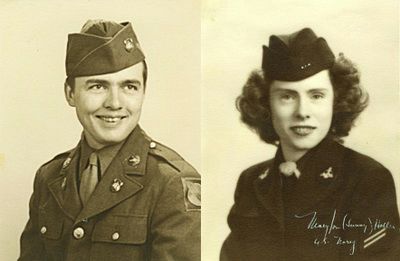
O.K., two more pictures of my Mom and Dad in uniform. First, my mother with some of her WAVE classmates, in a spectacularly un-feminist pose — and yes, that's her in the front of the line! Then my Dad up a tree, in uniform. Have no idea where this was taken.

Blessed Veterans Day to all....

Tobias Stanislas Haller BSG

Veterans

This is my father and mother, William and Mary Haller, both in uniform (Army and Navy respectively). They met during, and I suppose it fair to say, because of, the Second World War. They were together as a married couple for almost fifty years. Both are interred in the “Patriots’ Hill” section of the suburban cemetery dedicated to Veterans, not too terribly far from where my siblings and I grew up. On this Veterans Day (Armistice Day, or by whatever name you choose to know it) I give special thanks for my Mom and Dad, who served their country in wartime, and loved it in peacetime.

Tobias Stanislas Haller BSG

November 7, 2012

Note to Pundits

To all of the pundits who predicted the election of Governor Romney by more than 300 electoral votes: There is no need to acknowledge your error, explain how or why you were mistaken, or express regrets or apologies. Reality is what it is, and has a way of taking care of itself without your input. It might be as well to remember this:

If a prophet speaks in the name of the LORD but the thing does not take place or prove true, it is a word that the LORD has not spoken. The prophet has spoken it presumptuously; do not be frightened by it.Deuteronomy 18:22

So I do have to wonder why the error-prone talking heads are still nattering away on the airwaves and intertubes, and why anyone would listen to them for any other reason than to assuage their own disappointment by listening to the echoes of their ideology. Perhaps that is reason in itself. Misery loves company, the old saying has it.

Meanwhile, it is time for the country to pick itself up, dust itself off, and get to work. The Republican members of Congress should realize that obstruction will not be long tolerated, and for most of you the next election is in two years. It is time to lead, follow, or get out of the way.

Mr. President, you have our attention. 

Tobias Stanislas Haller BSG

UPDATE: See this graphic from the inimitable folks at Slate.com. It is a graphic display of who among the pundits did well or poorly in their estimations. The fact that Conservative pundits were more "off" than the moderates or liberals testifies to the stupifying effects of their ideology.

tsh

November 3, 2012

Comprehensive Reform

for the Feast of Richard Hooker: a sermon by Tobias Stanislas Haller BSG from 2004, Church of the Intercession, New York

GRANT that we may maintain that middle way, not as a compromise for the sake of peace, but as a comprehension for the sake of truth. — The Collect for the feast of Richard Hooker
There once was a vicar in an English country church of whom his congregation said, “Our Vicar is like God — he is invisible on weekdays and incomprehensible on Sundays.” I hope that I will not in my reflections today prove to be the latter.

Incomprehensible is a synonym for “impossible to understand.” Such understanding can be pictured almost in a physical sense: for to understand is to stand under, as a table stands under what is placed upon it, and so must be larger and more stable than what it holds in order to sustain or support it. To comprehend in this sense is to hold the object of knowledge on the table of ones mind.

Which is why God is incomprehensible. We cannot comprehend God because however hard we try, we cannot wrap our finite minds around the infinite God; God will not fit on the table of the human mind, however rasa our tabula, however much room we make on it, however many leaves we add, because, as the old hymn says, God is broader than its measure.

And the same goes for Truth, if we are speaking of Truth With A Capital T — not just some true things, but the whole ball of wax, the Truth as a full and complete description of All That Is — for the description must be at least as complex as what it describes. Try, for example, to describe a zipper to someone who has never seen one. And when we get to natural zippers like the string of DNA that holds us all together and builds us up at the most fundamental level, the description will take volumes — the printed listing of the human genome, a single transcribed copy of just one DNA zipper, of which we each carry trillions of the real thing in our bodies, would take 200 volumes the size of the Manhattan phone book.

To make matters worse, the truth about what is — even as it is spoken — adds to the sum of what is. If we were to write down even a mere tally of all that is, without further comment or explanation, truly the universe itself would not be large enough to contain all the books that might be written. For the books themselves would add to the substance of the world, and with every word we wrote we would be adding to the subject of our enterprise, and the bibliographers and catalogers would soon have to take up their work. As the wise man said, “Of the making of books there is no end.”

Indeed, the only way to comprehend the Truth, in this fullest sense of the word, and as appears to be the aim laid out in the Collect for this feast of Richard Hooker, is to be outside of all that is. And since only God is outside of all that is, as God is the cause of all being and becoming, so only the mind of God can truly comprehend all Truth.

We get glimpses of this outside-in structure of reality in the visions of the saints and poets — in Byzantine icons and in Dante, and in William Blake too. Perhaps it is most vividly captured in that wonderful vision God imparted to Blessed Julian of Norwich: a God’s-eye-view of the universe, as she saw in the palm of her hand a tiny thing no bigger than a hazelnut, so frail it looked as if it would cease to be in a moment. And God told her, It is all that is, and it endures because God loves it. As Blake would later write,
To see a world in a grain of sand,
And a heaven in a wild flower,
Hold infinity in the palm of your hand,
And eternity in an hour.
That is the God’s-eye-view that only the odd mystic glimpses.Now, in spite of the visions of the saints and poets — who are careful not to mistake these momentary experiences of God’s view of the world for their own accomplishment — most of us are wise enough to know our limits. As Hooker himself put it, “The true properties and operations of [God] are to know that which is not possible for created natures to comprehend; to be simply the highest cause of all things.” (5.53.1)

Yet in spite of this, some in the church from time to time do appear to think they have come into possession of the Truth, which usually turns out to be something far more prosaic and far less visionary — a set of right doctrines, or more commonly, right behaviors. And most of us have the good sense to realize that even this limited claim is a bit presumptuous. We have learned from the hard experience of the church’s history that what you don’t know can hurt you; and that often the church is at its most errant precisely when it claims to be most certain. It is rash for any in the church to claim the ability to see in a glass brightly: especially when the church’s rear-view mirror consistently warns us that objects are nearer than they appear — and we travel at our peril if we imagine that our view through the looking glass is either infallible or complete. Indeed, as we take that backward glance on the ecclesiastical autobahn, we see that behind us HeilsgeschichteStrasse — Sacred Story Street — is littered with the wrecks of time over which God towers in divine incomprehensibility.

Just ask Galileo, Richard Hooker’s contemporary, who set about the task of trying to record a few true things about the world, things evident to the senses, or at least to the senses aided and abetted by the telescope. He suffered the fate of being told that what was wasn’t, or at least wasn’t what he saw it was. Threatened with torture, he recanted and submitted to those who refused to know the truth of what is, so insistent were they on what they thought ought to be.

+++

Those on our side of the Tiber, the Anglicans, by Hooker’s day had learned their lesson the hard way. There had been enough burnings and tortures and beheadings on the scepter’d isle over mutually exclusive doctrines to satisfy the lust for certainty at least for a season. So a “settlement” to continuing vexatious matters emerged from the serendipitous arrival of a monarch like Elizabeth and a scholar like Hooker.

Now, Elizabeth, as a monarch, was probably more interested in compromise for the sake of peace than in comprehension for the sake of truth. She did not wish, as she said, to make windows into men’s souls. She knew that if she refrained from peeping into her advisors’ heads, she could benefit from the wisdom they would share around the privy council table, rather than having to commit those selfsame heads to the block and pike. As long as private opinion on divisive matters was kept in the privy closet, as long as one didn’t ask or didn’t tell, a form of peace could be maintained. Thus what Napoleon would later call the nation of shopkeepers kept the peace by means of compromise, the peaceful coexistence that falls a good deal short of true communion and community, but at least keeps heads on shoulders.

But as our collect reminds us, Hooker aimed higher. His Middle Way was not primarily a matter of compromise, but of comprehension. And the genius of comprehension lies in the breadth of its embrace, and in its confession of and willingness to live with an inevitable degree of error and ignorance. Hooker confesses that since we cannot know all things, and sometimes err in the things we think we know, we must allow room for all things, to make the table not infinitely broad (which is beyond our capacity) but broad enough to hold both the unforeseen and unexpected guest, as well as the uninvited and errant guest who shows up at the wrong party. Who knows, until the master comes, who really belongs there after all?

Hooker directs us to avoid the need for final answers on all but the minimally sufficient, and sufficiently salvific claims of the Gospel, secure truths at the heart of what it means to be Christian: centered on the existence of God, and the incarnation, death and resurrection of Jesus Christ —the eternal Gospel without which there really wouldn’t be any point in continuing the discussion, but beyond which all else is more or less provisional. As he said concerning baptismal faith: “Belief consisteth not so much in knowledge as in acknowledgment of all things that heavenly wisdom revealeth; the affection of faith is above her reach, her love to Godward above the comprehension which she hath of God.”(5.63.1)

So the final answers and the definitive positions on everything and anything, so beloved both by Calvinists and Papists, would give way in Hooker’s view to a more rational willingness to withhold and reserve final judgment on all but a very few core doctrines, to realize that mutually exclusive opinions on other matters cannot both be true — and in the long run neither might be true, and the real truth might lie somewhere else altogether. To cast the net broadly, to make the table wider; to expand the breadth of charity to include all possibilities on matters for which clear and final evidence is yet to be shown: this is Hooker’s rational and charitable mission, a willingness to treat our knowledge as sufficient, rather than complete, and certain, in certain matters, only of its own uncertainty; and above all to trust that all such knowledge and love are securely centered in the depths of God, where the Spirit moves and searches, and where alone wisdom is to be found.

For when one is truly in the communion of the Church, truly united with the other members of the body — which can only truly be a body when all the members are lovingly comprehended in it in spite of differing opinions on secondary matters — Deus ibi est: God is there. Next to this transcendent unity-in-communion all other modified and restricted uses of that word, even the one called “Anglican,” must surely pale in comparison. In the truly comprehensive communion of the whole Body of the Church, the blessed company of all faithful people, we are in God, and God is in us.

+++

And it is in this that we come to the grand reversal, the inside-out of God. Now, generally speaking, reversible garments are notable principally for being unattractive whichever way you wear them. But the inside-outness of God is quite another matter. Here we enter the amazing world — the real world, I might add — in which the inside is bigger than the outside — as observation shows us is true of most church buildings. God’s universe, it turns out, is more like those Byzantine icons or M.C. Escher lithographs than most people are willing to allow. This truth is summed up nowhere so well as in that Johannine avalanche of prepositions and pronouns from today’s gospel.

Jesus starts first from the expected greatness of God: “As you, Father, are in me and I am in you, may they also be in us” — so we are nested in God, resting in the palm of God’s hand like Thumbelina, safe in our hazelnut cradle.

But then comes the surprising reversal: Jesus prays, “I in them and you in me, that they may become completely one,” and suddenly we — made one in the mystical and holy communion of the Body of the Church, the Body of Christ, the temple to which God comes and deigns to be our guest — suddenly we hold Christ within us as he holds the Father within him, nested like a set of Russian dolls with God the Father in the innermost secret room of the human heart, the holy of holies, the privy chamber and closet of good council, and the human image and likeness become the frame to hold the true divine reality behind all that is, among us and within us always.

+++

And in this and this alone is the comprehension of the Truth, the whole Truth, and nothing but the Truth. I said earlier that God will not fit upon our mental tables; but there is one table on which God will fit, indeed, upon which God will fit in a few minutes. It’s right there in the sanctuary. In a few moments, the universe will turn inside out, the heavens will open and God will descend and condescend to be among us and with us, the Spirit will descend upon us and upon these gifts, and we will hold God in the palms our hands, and place God to our lips and, like Mary, become God’s earthly sanctuary. We in him and he in us, will become what we behold, and hold what we become.

Sanctified in this Truth, comprehended in this Body, fed with this food, may we be now and ever one, in the knowledge and the love of God, and the peace of God which passes understanding.

This is a repeat posting, but I think it worth repeating.