May 26, 2006

Tearing the Fabric

One of the assertions common these days is that the actions of North American Anglicans have somehow obscured the underlying reality of our communion in God the Holy Trinity. (Primates’ Dromantine Statement 2005.12). This assertion also sometimes takes the form of an accusation that we have torn the fabric of the communion. (Primates’ meeting 2003)

Whether obscured or torn, it seems to me that two very different kinds of communion are being spoken of here. One is the pragmatic ecclesiastical communion that we talk about in ecumenical relationships, the sure and certain sign of which is mutual acceptance of ministers. On this ground, let’s face it, the Anglican Communion is not just impaired, but divided, by the lack of agreement on the ordination of women to the priesthood and episcopate, pace the historical fiction of the Windsor Report.

But I would submit that the communion referred to in the Dromantine statement, however “obscured” is not capable of being torn, for it does not lie in our power to tear it. The communion we share in God the Holy Trinity does not come about by our doing, except to the extent we participate in and carry out the mandate to baptize all nations. Once baptized, there is no human power that can unbaptize. One can depart from the ecclesiastical institution — but however far we flee, be it to the heights or to the depths, we cannot escape our incorporation into God.

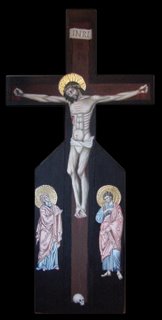
It seems to me that the concern with tearing the fabric of the communion — preserving the shreds of the partial unity we seem to enjoy in the manifestly divided church— is perhaps misplaced, as a part of our general fixation on the institution. It struck me in the early hours of this morning that a similar concern about tearing fabric took place in another context. To what extent are the powers that broker the future of our Anglican Communion like the soldiers haggling over the seamless garment, casting lots to see who will end up in possession, while the Lord of Glory hangs naked and crucified, spilling his blood for the world, and praying forgiveness for those who know not what they do?

—Tobias S Haller BSG


May 22, 2006

Doing The Lambeth Walk, In Circles

The Lambeth Commission has issued its "consultation paper" on how to move Towards an Anglican Covenant. I've read through the document, which is, of course, not a Covenant, but an additional call to outline the parameters for the possible development of a Covenant. (As such, it is even less practical than the Windsor Report, which at least offered a concrete model that few were willing to accept.)

I would like to suggest that we already have an Anglican Covenant, and it resides in the Constitution of the Anglican Consultative Council, and any more than that is only perceived as needed at this time because of the unwillingness of some in the Communion to accept that there is disagreement on a fairly narrow range of particular issues.

The Anglican Consultative Council is officially recognized in the Canons of the Episcopal Church (I.4.2) and we should by all means resume our seats as part of it.

—Tobias S Haller BSG

May 21, 2006

Two of them were walking

I've just finished realizing the orchestration of Symphonic Poem 2 -- my first in many years, written for James on his birthday. This one is built up around the themes of the walk to Emmaus, and is called "Two of them were walking into the country." It isn't strictly programmatic, but rather reflects the themes of sorrow and joy, concealment and revelation, the paschal mystery and the recognition in broken bread, "and he vanished from their sight."

The piece was written using Finale composition software and realized with the Garritan Personal Orchestra. Enjoy! (You'll need software capable of playing mp3, and a highspeed connection for best effect...)

—Tobias

May 16, 2006

Drama Queen

I'm getting very weary of the histrionics from Ambridge. Before the terrorist bomb (read, nominees in California), there was the relatively mild imagery of the Titanic and the Carpathia (read, General Convention and the rest of the Communion).

Now it's the SA and the Creature from the Black Lagoon. I begin to wonder about Dean Zahl's rationality at this point. Seriously. Is he literally seeing monsters where none exist? It is astounding to find in one short essay such a raft of argumentum ad misericordiam combined with the relatively more recent argumentum ad Nazium. Certainly he is prosecuting a "Cause" here which was settled 2000 years ago on the hill of Calvary, and which does not need his sense of persecution and threat to complete what is lacking in the suffering of Christ. That Paul can, from the relative comfort and security of his Deanship, portray himself as persecuted — while gay and lesbian people are threatened with prison sentences merely for associating in public or speaking out for civil rights (threats supported by his Nigerian ally +Peter); while gay and lesbian people are beaten to death or executed, by true believers nursed on the toxic teaching of homophobia cloaked under the vestments of religious faith, Christian or Muslim — almost beggars imagination.

But I have a good word for Dean Z. Paul, the strife is o'er. The proof of your faith will lie not in the extent of your purity, or the depths of your sense of persecution, but in how you love your sisters and brothers.

—Tobias S Haller BSG

May 14, 2006

Ekklesiastes: The Bible and the Church

I've just posted my sermon for today (Easter 5) over at my sermon blog. It's called The Bible and the Church and may be of some interest in light of present discussions concerning Scriptural authority. It concludes:

Ultimately, as Philip showed the Ethiopian, the heart of the Scripture lies in how it points to Christ. He is the living Word of God to whom the written Word of God — the Scripture — leads us in the Way into the Truth, and the Scripture is useful to us only to the extent that it performs that task, a task for which we are assured it is, as the Anglican tradition puts it, sufficient. For its ultimate purpose is to bring us to the new Life of faith — as it did the Ethiopian, who, when once on his Way the Truth was opened to him by the Spirit’s guidance and Philip’s teaching, immediately asked to be baptized into the new Life, to become himself the newest member of Christ’s body, the church.

Most of the tension in the present life of the Anglican Communion would vanish in a flash as sudden as Philip’s disappearance if we would simply take Jesus the Word of God at his word! The Scripture is not hard to understand in this respect, though we find it hard to put it into practice. He has told us mortals what is asked of us — it is amply stated in John’s teaching to us today in both epistle and gospel: the commandment of God is to believe in Christ and to love one another. Got that?

When Jesus summarized the law in his commandment to love God and neighbor, when he taught us to love our neighbors as ourselves and to do unto others as we would be done by, he meant what he said, and he gave us both a task and a promise. Those in Christ who love their sisters and brothers in this way — doing for them as they would be done by — have observed God’s commandment. All the rest is commentary.

My sisters and brothers, as I prepare for the General Convention this summer, where I will serve as a deputy from this diocese, along with three other priests, four lay persons, and the three bishops who serve New York, this is what I will keep in mind and heart. The Scripture is sufficient to salvation, for it has told me the truth that is so simple a little child can sing it: Jesus loves me, this I know, for the Bible tells me so. This simple truth is my armor against doubt, against judgment, against those who seek division and domination, against bigotry and ignorance, against pride and power, against all who would diminish human dignity or deny human worth.

So, as Christ taught us in his Word, “Let us love one another, not in word or speech but in truth,” neither condemned by our hearts nor dismayed by those who would demean us or deny us. God is love, beloved sisters and brothers, and we follow his commandments when we love him and each other.Against this the Scripture records neither law nor prophet, but rather the voice of the Lord himself to affirm us in our faith in the power of the Spirit, now and to the end of the ages.+


April 8, 2006

Adam Found the Tree of Life


For many years I searched to find this place. The way
was watched by angels armed with swords;
and yet in seeking it I felt the Lord’s
love guiding me. With hope and fear, by grace
I made my way — I’m sure it was God’s will.
It was the Tree of Knowledge God forbade.
Its bitter fruit our innocence unmade;
had we kept faith we’d be in Eden still.
But this, the Tree of Life, was only lost
because we fell. In Paradise once more,
I looked upon the Tree, and what it bore.
The Tree had brought forth fruit, but at what cost!
I saw a wonder hanging from that Tree;
a man was nailed to it; he looked like me.

Tobias Stanislas Haller BSG
1988


April 3, 2006

Who’s In — Who’s Out

The first Lambeth Conference was assembled in response to a request from the Canadian episcopate, addressed originally to the Canterbury Convocation, who then passed it along to the Archbishop. He in turn was quite clear in his invitation that he had no interest in assembling a doctrinal or legislative commission, but rather wished to share in Christian and episcopal fellowship.

There seems to be some confusion between "being in Communion with the Church of England" and "being a member of the Anglican Communion." The former, which is definitively determined (in the case of doubt) by the Archbishops of Canterbury and York, is the more expansive of the two: that is, there are any number of churches that are in communion with the Church of England which are not part of the Anglican Communion. I refer those interested to page 206 of the current Canons of the Church of England (2005).

Membership in the Anglican Communion itself is not defined by the Archbishop of Canterbury, but at present by the Anglican Consultative Council, which is a duly established entity with its own constitution, capable of deciding who is or isn't part of it by amendment of its schedule of members.

It does appear that being in communion with Canterbury could be seen as a prerequisite for membership in the more narrowly defined Anglican Communion. But what I am suggesting is that it might be possible for TEC (and the "founding member" the Church of Canada) to remain in communion with the Church of England even if for some reason temporarily removed or suspended from the Anglican Communion by a two-thirds majority vote of all of the Primates (in accordance with the ACC constitution).

This might, in fact, be a way to address some of the current concerns of other members of the Anglican Communion while retaining our historic relationship with Canterbury.

Tobias S Haller BSG

April 1, 2006

The Lay of the Land

Results are in on the pseudo-survey conducted by a new group aptly named "LEAC" (I'm not sure if it should be pronounced "leak" or "leach" -- or perhaps "leech") -- Lay Episcopalians for the Anglican Communion. The "survey" went to all bishops (not just those who actually had the right to consent to Gene Robinson's election, and to many who were not even present at GC 2003. Only 27% of those solicited responded. (You can read more about this extremely flawed "survey" at Thinking Anglicans.

I would suggest that this survey, flawed as it is, didn't even really produce the results the surveyors hoped for. First of all, the report refers to a "reversal" but doesn't indicate the percentage of those who changed their vote (if they had one in the first place: this was asked on the first two questions, each in two parts, on the survey form, but no result for the "B" section of each question is shown in this article.) How many of the 56% actually represent a change in voting?

More importantly, note the response to the crucial third question:

"Survey respondents split almost evenly on the third question, assessing relative loyalty to ECUSA and the Anglican Communion, with 46.25 % desiring to stay with ECUSA regardless of whether it remains in the Anglican Communion. Solidarity with the Anglican Communion would come first in such a showdown for 45% and 8.75% chose not to answer that question. This division could be a serious ECUSA political concern for the presiding bishop as he leads his church into a critical period through mid-June?s General Convention and beyond."

In short, there was no overwhelming support, even among the tiny proportion of respondents, for choosing continued participation in the "Anglican Communion" over continued participation in The Episcopal Church even if no longer part of that "fellowship." Perhaps the predominantly lay surveyors forgot that clergy take an oath as part of their ordination vows, and that oath is to "the doctrine, discipline and worship of The Episcopal Church" -- not to some ill-defined "Anglican Communion."

March 31, 2006

Non-Hunting Dogs of Ecclesiastical War

Dr Andrew Goddard takes up Bishop Langrish's comments to our House of Bishops and highlights this argument:

The Bishop proceeds to define precisely the difficult features of the New Hampshire consent and consecration (and hence any similar future consecration). These are two-fold in that such actions amount to:
-'consecrating a Bishop - presumably with intent to create a bishop for the church catholic - without seeking the assent of that wider church catholic (and this is about more than consultation)'
-'ordaining to the episcopate someone (and I make a general rather than a personal point here) who was in a relationship not liturgically sanctioned by the church, and to that extent at least irregular'

It is unfortunate that folks like Langrish and Goddard frame their arguments in ways that simply beg for rebuttal.

For example, are they unaware that the "liturgical sanction" of marriage in the church is not, according to the church's own teaching, what "makes" the marriage? Marriage, in the time of the church's foundation, was a civil phenomenon. The church did eventually get around to imparting its peculiar blessing on this secular institution, but never required the nuptial blessing for "regularity" until the Council of Trent! Quite simply, those of the apostles who were married (such as Peter) did not have the benefit of "Christian marriage" because it didn't exist.

(I leave to one side the observation that for most of its history, and throughout its broadest extent, being in the married state at all was a bar to the episcopate, period. Hmmmm.)

But back to church sanction: The Episcopal Church meeting in General Convention in 2000 recognized (in large part in response to Lambeth 1998.1.10) that persons living in same-sex relationships, while in tension with the historic teaching of the church, and absent any authorized ecclesiastical recogntion, nonetheless were to be given "the prayerful support, encouragement, and pastoral care necessary to live faithfully by" principles of "fidelity, monogamy, mutual affection and respect, careful, honest communication, and the holy love which enables those in such relationships to see in each other the image of God."

Moreover, the 2003 General Convention, drawing upon this resolution, recognized that indeed there is liturgical recognition being given to such relationships, albeit without provincial authority, and that those who do so are acting within the bounds of the church's common life.

Of course, Goddard would like to play a game of Whack-A-Mole with this, because the "liturgical" objection is simply a smoke-screen for his real opposition to any recognition of same-sex relationships, to say nothing of electing bishops who are living in such relationships. This is also known as the famous Catch XXII (Vicesimus Secundus).

Finally, as to bishops for the "church catholic" -- has either Dr. Goddard or +Exeter checked in with the Vatican lately to see if they are considered to be ordained in the "church catholic"? Failing such broad recognition, what are we to say of the fact that the Church of England and a number of other Anglican provinces would not recognize (at this point) a woman in the episcopate as authorized to function as such?

This dog will not only not hunt, but I am not entirely convinced it is a dog.

— Tobias S Haller BSG

March 23, 2006

Annunciation and Response


She knelt beside the neatly planted rows
of cummin, dill, and mint. The clear March sky
was bright; a flock of birds flew high.
She pinched a leaf;
                    then, suddenly, she froze —
a voice had spoken. There was no one there.
It spoke a second time; she looked around.
“How can this be?” she asked the vacant air.
Once more it spoke, yet there was not a sound.
She paused again; her answer in her mind.

In thirty years and three, her words would find
an echo: “Not my will, but thine be done,”
said in another garden by her son,
while three friends slept.
                           So here none heard her words —
except an angel, a high flight of birds,
and three neat rows of cummin, mint, and dill:
“Be it to me according to thy will.”

April 7, 1989
Tobias Stanislas Haller BSG


March 11, 2006

The Origin of Species
and the Descent of Man

Claims for a new species of persecution
have recently appeared.

It is one thing to be persecuted
because of what one believes.

It is another to be persecuted
because of what others believe.

Now, it seems,
one can claim to be persecuted
because of what one believes
others should believe.

—Tobias S Haller BSG

March 9, 2006

Still Anglican After All These Years

To read some of the conservative blogs out there, one would think that the Episcopal Church was already no longer a member of the Anglican Communion. Certainly the bonds of affection have been markedly weakened, and in a few cases actually disconnected by our overseas partners' letting go of their end, so to speak.

But the Episcopal Church still seems to be on Canterbury's mailing list. The letter that went to all 38 primates about Lambeth, came to +Second Avenue as well as +Abuja.

More important than Lambeth, however, is the Anglican Consultative Council. This is the sole constitutionally established "instrument" of the Communion. And according to its constitution, it will take a vote of 2/3 of the present member provinces' Primates (including the US) to "expel" the US from the Anglican Consultative Council by amending its roster of membership. As I count it, there are fewer than 1/3 willing to take that step, perhaps less than 1/4. Others may read the situation differently, but for all the noise from the "Global South" I do not think it amounts to 2/3 of the Primates.

Of course, things may change after GC2006. But for the time being, we are as Anglican as apple pie; or should I say, Jamaican meat pattie (a favorite at my parish coffee hour!).

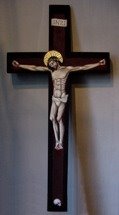
Meditations on the Way of the Cross


by Tobias Stanislas Haller, BSG

V. We will glory in the cross of our Lord Jesus Christ:
R. In whom is our salvation, our life and resurrection.

Let us pray. (Silence)

Assist us mercifully with your help, O Lord God of our salvation, that we may enter with joy upon the contemplation of those mighty acts, whereby you have given us life and immortality; through Jesus Christ our Lord. Amen

First Station

Jesus is condemned to death

V. God did not spare his own Son:
R. But delivered him up for us all.

The Lord who set his hand upon the deep,
who stretched the compass on the heavens’ face,
who planned the universe and gave it life,
here, now, is trapped — the victim of a plot.
The judge is judged, and shares a sinner’s fate,
while Pilate, at the warning of his wife,
evades his guilt with water and a towel,
delivering up the one who would deliver
the world that owed him all of its existence.
The very ones who call out for his death —
that he deserves to die — owe him their breath.
Let us pray. (Silence)

Almighty God, whose most dear Son went not up to joy but first he suffered pain, and entered not into glory before he was crucified: Mercifully grant that we, walking in the way of the cross, may find it none other than the way of life and peace; through Jesus Christ your Son our Lord. Amen

Second Station

Jesus takes up his Cross

V. The Lord has laid on him the iniquity of us all:
R. For the transgression of my people was he stricken.

The eternal word now mutely keeps his peace
and opens not his mouth. The worthy one,
held worthless now, takes up his heavy cross.
The one who bore the weight of all the worlds
now wearily takes up a cross of wood.
The Lamb of God who takes away our sins,
in meekness his last pilgrimage begins.
Let us pray. (Silence)

Almighty God, whose beloved Son willingly endured the agony and shame of the cross for our redemption: Give us courage to take up our cross and follow him; who lives and reigns for ever and ever. Amen.

Third Station

Jesus falls the first time

V. Surely he has borne our griefs:
R. And carried our sorrows.

A star shot from its place in heaven and fell
down to the depths of the abyss. Was Christ’s
descent less terrible, his humble stooping down?
Yet humbly he had washed the apostles’ feet,
so now he falls to wash away our sin.
Can we do less than kneel here and adore
the one who all our sin and anguish bore?
Let us pray. (Silence)

O God, you know us to be set in the midst of so many and great dangers, that by reason of the frailty of our nature we cannot always stand upright: Grant us such strength and protection as may support us in all dangers, and carry us through all temptations; through JesusChrist our Lord. Amen

Fourth Station

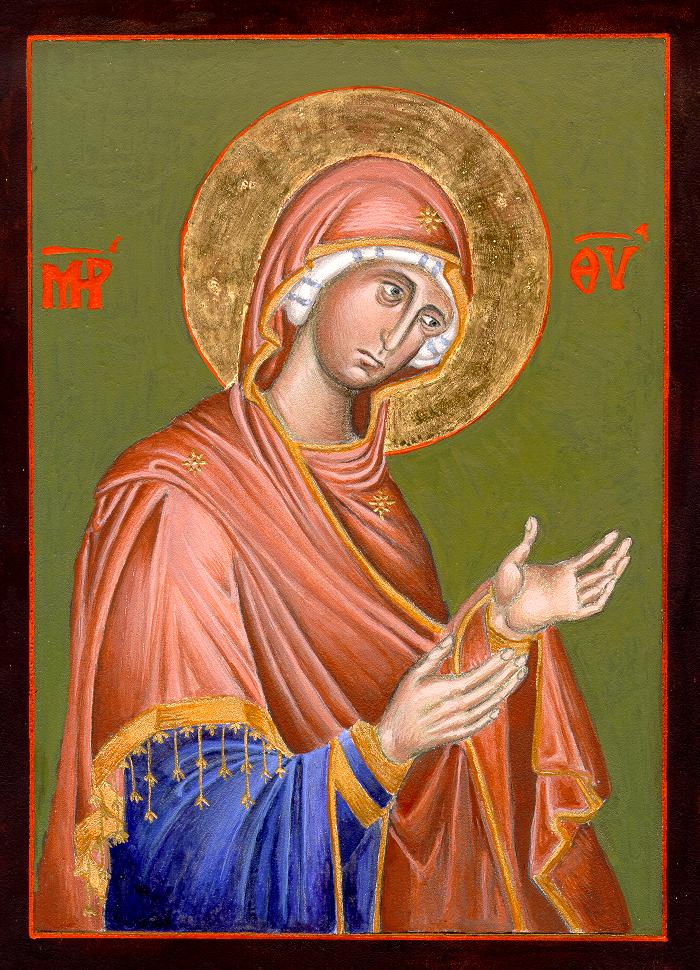
Jesus meets his afflicted mother

V. A sword will pierce your own soul also:
R. And fill your heart with bitter pain.

A mother’s pain! to see her own child die —
tragic reversal, when age sees youth undone.
The heart that stored such hope, such promised joy
now breaks to see the ruin of that hope.
Yet breaking, that heart’s hope finds its release
and brings the world the promise of its peace.
Let us pray. (Silence)

O God, who willed that in the passion of your Son a sword of grief should pierce the soul of the Blessed Virgin Mary his mother: Mercifully grant that your Church, having shared with her in his passion, may be made worthy to share in the joys of his resurrection; who lives and reigns for ever and ever. Amen

Fifth Station

The Cross is laid on Simon of Cyrene

V. Whoever does not bear his own cross and come after me:
R. Cannot be my disciple.

Simon didn’t know who Jesus was;
just that he’d better do as he was told:
take up that cross and carry it a while.
What unknown hands lift crosses from our backs?
Who serves us? And what strangers do we serve?
Whom do we serve, if not our Lord himself,
who told us that as we each do unto
the least of them we do it unto him?
To follow him we must take up that cross —
to save our lives our lives must suffer loss.
Let us pray. (Silence)

Heavenly Father, whose blessed Son came not to be served but to serve: Bless all who, following in his steps, give themselves to the service of others; that with wisdom, patience, and courage, they may minister in his Name to the suffering, the friendless, and the needy; for the love of him who laid down his life for us, your Son our Savior Jesus Christ. Amen

Sixth Station

A woman wipes the face of Jesus

V. Restore us, O Lord God of hosts:
R. Show the light of your countenance, and we shall be saved.

He came to show us all that we could be,
to stand displayed a perfect man, that we
might have a model for our lives. Instead
we turned away; and worse, we cursed and mocked
his beauty, so much greater than our own.
Yet all our hurts and harms could not deface
the inner glory of his perfect soul,
and his wounds only served to make us whole.
Let us pray. (Silence)

O God, who before the passion of your only-begotten Son revealed his glory upon the holy mountain: Grant to us that we, beholding by faith the light of his countenance, may be strengthened to bear our cross, and be changed into his likeness from glory to glory; through Jesus Christ our Lord. Amen

Seventh Station

Jesus falls a second time

V. But as for me, I am a worm and no man:
R. Scorned by all and despised by the people.

How can he bear that weight? How can he bear
the gathered sorrows of a billion souls?
How bear these sins, since he is innocent?
It is no wonder he should fall, beneath
the heavy weight of all this unearned guilt.
All we like sheep are scattered, wandering, lost;
we set the price; and he has paid the cost.
Let us pray. (Silence)

Almighty and everliving God, in your tender love for the human race you sent your Son our Savior Jesus Christ to take upon him our nature, and to suffer death upon the cross, giving us the example of his great humility: Mercifully grant that we may walk in the way of his suffering, and also share in his resurrection; who lives and reigns for ever and ever. Amen

Eighth Station

Jesus meets the women of Jerusalem

V. Those who sowed with tears:
R. Will reap with songs of joy.

What tears are these? Whence comes this grievous moan?
Is it for him, or for the loss of hope?
If this is how the world will treat its Lord,
what hope is there for anyone? For us?
If green wood burns so easily, what flames
will ravage those whose hearts and souls are dry?
It seems for our own sins we’d better cry.
Let us pray. (Silence)

Teach your Church, O Lord, to mourn the sins of which it is guilty, and to repent and forsake them; that, by your pardoning grace, the results of our iniquities may not be visited upon our children and our children’s children; through Jesus Christ our Lord. Amen

Ninth Station

Jesus falls a third time

V. He was led like a lamb to the slaughter:
R. And like a sheep that before its shearers is mute, so he opened not his mouth.

Where is the light? The candles have gone out!
There is no hope, no way to see the way;
the one we hoped would lead us has collapsed.
Yet in his fall, this third bone-weary fall,
his voice cries out, Remember me, O Lord;
and God, who hears the fallen, will not fail.
Up from the depths and darkness without light,
he calls on our behalf through our long night,
his prayer ascending God’s high throne unto:
Father, forgive; they know not what they do.
Let us pray. (Silence)

O God, by the passion of your blessed Son you made an instrument of shameful death to be for us the means of life: Grant us so to glory in the cross of Christ, that we may gladly suffer shame and loss for the sake of your Son our Savior Jesus Christ. Amen

Tenth Station

Jesus is stripped of his garments

V. They gave me gall to eat:
R. And when I was thirsty they gave me vinegar to drink.

The night before, he’d spoken of his blood,
and blessed the cup of wine, removed his robe
and kneeling, washed their feet; and later, in
the garden kneeled again, and asked his God
to let the cup of bitterness pass by.
All comes together here: wine, blood and gall.
The garments are removed, the veil undone:
We see the naked glory of the Son.
Let us pray. (Silence)

Lord God, whose blessed Son our Savior gave his body to be whipped and his face to be spit upon: Give us grace to accept joyfully the sufferings of the present time, confident of the glory that shall be revealed; through Jesus Christ our Lord. Amen

Eleventh Station

Jesus is nailed to the Cross

V. They pierce my hands and my feet:
R. They stare and gloat over me.

The carpenter of Nazareth is brought
at last to Skull Hill’s bloody, dismal mound.
Between two criminals, hemmed in by sin,
the sinless one is nailed upon the cross.
How many times had he with his own hands
wielded the hammer, pegging wooden frames,
or driven nails. He’d made good yokes, good yokes
for oxen at the plough, or at the cart.
Yet here he is undone with his own art.
Let us pray. (Silence)

Lord Jesus Christ, you stretched out your arms of love on the hard wood of the cross that everyone might come within the reach of your saving embrace: So clothe us in your Spirit that we, reaching forth our hands in love, may bring those who do not know you to the knowledge and love of you; for the honor of your Name. Amen

Twelfth Station

Jesus dies on the Cross

V. Christ for us became obedient unto death:
R. Even death on a cross.

What legacy is this, what parting gift?
A mother loses one son, gains another,
as John, belov’d disciple, gains a mother.
The end has come; time for one bitter taste
of vinegar on a sponge, a gasping breath,
the words of commendation, and of death.
Let us pray. (Silence)

O God, who for our redemption gave your only-begotten Son to the death of the cross, and by his glorious resurrection delivered us from the power of our enemy: Grant us so to die daily to sin, that we may evermore live with him in the joy of his resurrection; who lives and reigns now and for ever. Amen

Thirteenth Station

The body of Jesus is placed in the arms of his mother

V. Her tears run down her cheeks:
R. And she has none to comfort her.

Long, long ago, an angel called her bless’d
and full of grace. Did Gabriel know the course
her life would take, the life of her womb’s fruit,
the Son of God — that it would come to this?
And did he know as well that this was not
the end, that there was more — far more — to come?
Yet Mary’s grief is not relieved in this,
as on his wounded brow she plants a kiss.
Let us pray. (Silence)

Lord Jesus Christ, by your death you took away the sting of death: Grant to us your servants so to follow in faith where you have led the way, that we may at length fall asleep peacefully in you and wake up in your likeness; for your tender mercies’ sake. Amen

Fourteenth Station

Jesus is laid in the tomb

V. You will not abandon me to the grave:
R. Nor let your holy One see corruption.

His foster father was named Joseph, too;
in death, he takes another Joseph’s tomb.
He had no earthly father of his own,
nor would he have a grave but as a gift.
His birthplace was a stable let on loan,
his burial in a tomb another built.
And all this was to free us from our guilt.
The Way is ended, now the tomb is sealed —
our eyes have seen the love of God revealed.
Let us pray. (Silence)

O God, your blessed Son was laid in a tomb in a garden, and rested on the Sabbath day: Grant that we who have been buried with him in the waters of baptism may find our perfect rest in his eternal and glorious kingdom; where he lives and reigns for ever and ever. Amen

To Christ our Lord who loves us, and washed us in his own blood, and made us a kingdom of priests to serve his God and Father, to him be glory and dominion for ever and ever. Amen.

March 6, 2006

Listening, Acceptance, and Approval

In a recent interview with David Frost, Archbishop Rowan Williams observed:

I think, to find ways, as long as possible, of getting these two sides to make sense of themselves to each. The biggest problem is people don’t listen very much. That’s, you know, that’s human nature, and the Church is no exception. And so long as people are still trying to - so long as people are aware that they’ve enough in common to disagree, rather than just to tear it all up, so long as that’s true, it’s worth working at. Now the point may come where people say well we no longer have enough in common and we may reach that point - I don’t know. Meanwhile, my first priority is to try and keep the conversation going, to say do you understand why this matters.
It seems to me that the Archbishop says two things here: one false, and one true — and they are related. The false part is the accusation that “people don’t listen.” I think people have in fact listened very carefully; and that after listening we still disagree. +Rowan is betraying his liberal optimism here: if only you will understand me, you will agree with me. But arguments are not always persuasive, and a failure to agree need not indicate a failure to understand. An old priest friend of mine once told me of a conversation with his senior warden, who finally said to him, in exasperation, “Father, you aren’t listening to what I’m saying!” The priest responded, “George, I hear you perfectly. But I disagree.”

Where the Archbishop is “spot on” is in the question of how we deal with the disagreement. This is where we can choose to act in a gospel fashion, or not. Do we have enough in common to hold the church together in spite of strong disagreement about the rightness of same-sex relationships, and, whether right or wrong, how important is this particular aspect of a person’s life in terms of ordained ministry? Can those who disapprove accept the full participation of those of whom they disapprove in the church — in all orders of ministry? — that is the question for the “reasserters.” The question for the “reappraisers” is not (or ought not to be) Will you stop doing this? but Can you live with this lack of full approval — is acceptance enough? In short, can we maintain our unity in spite of a difference of opinion: even if it means various impairments in the communion, and juggling of episcopal oversight to accomplish it?

Ultimately, we have no control over others accepting us, only over who we accept. The Gospel way, for me, is the way of acceptance, not of “being accepted” — in fact, Jesus promises rejection in the short run for those who follow him. And it seems this is precisely what we are seeing: churches that are welcoming and accepting are getting a tongue lashing for not being restrictive enough. And if we criticize those calling for restriction for being restrictive — they say we don't “accept” them!

What can we do in response? I say, keep preaching the Gospel! And remain open and welcoming even to those who disagree — that is crucial, I think. I can say, “I hear what you are saying, but I disagree with you; but you are welcome to worship with me — if you want to.”

Acceptance in this sense need not mean approval — on either side. Rather we should acknowledge that we are all to some extent in error, but “accept one another as Christ accepted us” — with all our imperfections, and not as a sign of approval, but as an act of salvation.

—Tobias S Haller BSG


March 3, 2006

California Dreamin’

Some, including most “reasserters” — and even a few who in general support the ordination of gay and lesbian clergy, but have gotten antsy about our place in “the Communion” — have reacted negatively to the posted slate of candidates for Bishop of California, because it includes two people whose “lifestyles” create a stumbling block to unity in the church — something bishops are supposed to “safeguard.” Some have gone so far as to suggest that these two candidates are only there because of their sexuality. Others have gone further and implied their presence is primarily to “thumb our nose” at “the Communion.” This strikes me as a very myopic view, or at best a cynical one. I’ve know Robert Taylor for years, from before he was ordained. His name has been circulated as a likely episcopal candidate long before even GC2003 — so his presence on the California slate is no calculated surprise move.

Let me be frank. It is certainly true that out gay and lesbian bishops are a stumbling block to some Anglicans. The election of another such bishop may indeed lead to some of the provinces of the Anglican Communion severing their ties with the Episcopal Church (how many in addition to those who have already done so remains to be seen.) That would be their choice. I do not believe “the Communion” is going to vote us off the island in this case, as I do not feel that a majority of provinces feel that strongly about the matter; and if I am mistaken, and they do, it will still be their choice to do so. It would not be the first time that a part of the Body has suffered exclusion because it did what it thought was right.

But as to stumbling blocks: The cross was a stumbling block to Jews and a folly to Greeks. Jesus’ “lifestyle” was a scandal (that is, a stumbling block) to his contemporaries, shocked and appalled as they were at his fellowship with sinners — eating with them, and even letting them touch him. This led to deep and serious divisions in the religious community of his day; only a small minority of whom came eventually to join his movement. So Jesus did not come to bring unity, at least not at first, and certainly not as expected — but division. There had to be, as Saint Paul said later (1 Cor 11:19), a certain amount of partisan division and factions (Paul used the word heresy) so that what was truly genuine might be made manifest.

For true unity does not emerge from compromise, but crucifixion. The grain of wheat does not grow unless it perishes. It is through the Paschal mystery, and only thus, that the unity of the church emerges and is preserved.

You may recall that “the last temptation of Christ” was to appease those who crucified him: to deny himself and his mission, to compromise and come down from the cross, and settle down in the acceptable lifestyle of a first-century Jewish male. He did not do so. He remained the scandalous stumbling block, the great division, the wound that healed the world. I am called to follow Christ, and proclaim the unity for which he died: not the cozy fellowship of our little Anglican tea-party, as nice as that is and as loath as I am to see it split — but the unity of all who bear the likeness of God in Christ — the unity which he purchased on the cross and which no human action, whether mine or the Diocese of California, or the Primate of Nigeria, or the Archbishop of Canterbury can in any way destroy. That is the only unity worth standing for, for it is the only unity that will endure the end of days and the gates of hell. The one who was the stumbling block gave us his word, and I, for one, trust him.

— Tobias S Haller BSG


February 28, 2006

Consensus and the Spirit

My big fat dictionary lists “unanimity” as the first definition for consensus (Websters 20th Century Unabridged 2d edition). This reflects a spiritual connection between the words --- “one in soul” and “together in feeling.” It is in that “feeling” part where I think we might talk about a kind of consensus in which people feel as though they can get along with each other.

The hallmark of formal consensus — which is the Latin word for consent — then, is the lack of polarization, the lack of significant opposition to or dissent from a decision. And that, I think, is why it is fair to say that the former consensus on sexual morality no longer exists.

The emergent consensus of feeling, however, (such as it is) is represented by a moderating position in which people should be able to get along with each other. This kind of consensus is not about the hot topics themselves, but about how to deal with the hot topics. The Bishop of South Carolina spoke eloquently at GC2000 about the process of collegiality on the committee that framed GC2000.D039 even though in the end he voted against it.

After all the debate, the resolution was adopted by an overwhelming majority in the House of Bishops (119 to 19 with 4 abstentions) and by the House of Deputies (noting that the controversial final resolve on beginning to authorize liturgical same-sex blessing was narrowly defeated in the lay order, the remaining resolves were overwhelmingly adopted without resort to vote by order). Not unanimous, by any means, but clearly a common mind for all but the ten percent who simply could not go that far.

How far were they asked to go? The “emergent consensus” should be that we can agree to disagree; but at the very least, as the resolution put it, to “acknowledge that while the issues of human sexuality are not yet resolved, there are currently couples in the Body of Christ and in this Church who are living in marriage and couples in the Body of Christ and in this Church who are living in other life-long committed relationships; and that we expect such relationships will be characterized by fidelity, monogamy, mutual affection and respect, careful, honest communication, and the holy love which enables those in such relationships to see in each other the image of God...” The resolution also acknowledged that this is a departure from “the traditional teaching of the Church on human sexuality” and that some people will “in good conscience...act in contradiction with that position” but that all of us “on various sides of controversial issues have a place in the Church.” (D039) No one is going to be cast out for agreeing or disagreeing: we will get along.

So: this is the non-unanimous consensus of the Episcopal Church at this point. It offers a partial answer to the question so often posed as to the “standards of holiness” required for ordination — that the overwhelming majority of our church’s leadership believe that same-sex relationships can embody “holy love” even if they are not yet officially “blessed” by a liturgical rite. This recognition (which did not enact a reality, but expressed a feeling — a “sensus” or perception) is in part what makes possible the affirmation of the place of persons living within same-sex relationships in all orders of the church’s ministry. At this point, there is no consensus that such relationships are equivalent to marriage — but there is an “emergent consensus” that at least some of the truly moral values inherent in a good marriage may also be present in these relationships.

It is true that about ten percent of the Episcopal Church (to judge by the bishops vote, anyway) does not accept this “emergent consensus.” We do not have unanimity on thissubject within the Episcopal Church, far less outside it. The question is, can we get along with this lack of unanimity, or must there be division?

And what of the Spirit?

A significant vocal minority does indicate a lack of consensus; but I don’t believe it tells us anything one way or the other about the Holy Spirit. Some people will not recognize the Spirit no matter how manifest it is: even on Pentecost some in the crowd dismissed the Apostles as drunkards. And there can be perfectly amicable and trusting gatherings of folks sharing a common mind — and deeply, horribly wrong! So consensus tells me nothing about rightness or wrongness, spiritual or secular.

This is one of the reasons I am not a complete fan of Gamaliel, even though following his advice is often an advisable best course. As I once remarked to Archbishop Runcie from the floor of the Trinity Institute, after he had just observed on the matter of the ordination of women, “If it is of God it will survive” — “Given that a great many things we know to be of God have not survived, and many things demonstrably not of God have flourished, is Gamaliel’s approach truly an effective way to determine the rightness or wrongness of an action?” His response, “Not always.”

And I agree. It is still a way to preserve peace, but it is no guarantee of “correctness.” However, we are called to peace, not to be correct.

At the present time it appears to me that the greatest harm to the church is not coming from NH or CA, but from the reactions thereto. People need to take a chill pill, and a bit of responsibility for their own actions and reactions. Dean Zahl has just published yet another screed seeking to put all responsibility — even for his travel expenses! — on those “unscrupulous” liberals; and stamps his feet that it “isn’t fair!” But it is specious to state that GC2003 or California “forces” this reaction — it is a matter of free choice. (Of course, as a good Calvinist, Dr Zahl might pick a bone with me about that, too!)

No one needs to be “touched” by these matters unless they choose to be bothered by them. Generous provision has been made for the minority view — some quite out of keeping with our historic polity, and most of them not ample enough to please. All the Episcopal Church is asking for is the kind of independent right to elect its own bishops that the conservatives within the Episcopal Church want for themselves — maybe the whole Episcopal Church can be seen, in the communion, as being under a sort of DEPO, if need be, and let those Episcopalians who want to have a direct line elsewhere have it! How’s that for a proposal?

— Tobias S Haller BSG


February 22, 2006

Making Sense of Consensus

The Church of England Newspaper(Feb. 24) reports on Archbishop Rowan Williams as responding to the news of the release of the list of nominees for Bishop of California as follows:

Dr Williams stressed his opposition to the move. “If there is ever to be a change on the discipline and teaching of the Anglican Communion [on homosexuality] it should not be the decision of one Church alone. “The Church must have the highest degree of consensus for such a radical change,” he argued, adding he was very uneasy about the way in which change has gone forward in the American Church over this issue.
The newspaper doesn’t indicate the source of these quotations, presented as I show them with that odd floating quotation mark. Were these from a letter, an off-cuff comment, or what? [FLASH: see first comment below; these quotations came from comments made in Porto Alegre on February 17th, three days before the California nominations were released.]

Whatever the format or forum, I continue to be confused by Archbishop Williams’ asssertions concerning consensus and change.

As I have noted before, this is not the way intellectual, social, or religious change actually works in the real world. Things happen locally, and then gain acceptance (or not) more broadly. They don't “become true” when a certain critical mass of agreement is reached. Truth (or rightness, or any other reality) is not established by majority rule, nor rendered false because held by a minority.

It strikes me that Williams’ approach to the process of truth-determination in ecclesiastical polity is similar to Receptionism in sacramental theology (the elements “become” the Body and Blood based on the positive reception by the communicant) or Adoptionism in Christology (that Jesus “became” the Son of God at some point, such as his baptism, crucifixion, or even resurrection). Just as truth (or moral truth) is not contingent upon who receives it, so too the eucharist is the real presence of Christ, and Jesus is the Christ even as an infant at his mother’s breast.

From a practical perspective, this “none can act until all agree” approach would have meant the death of the church before it was born. Had the apostles heeded the Council’s warning, and stopped proclaiming Christ, and had not Gamaliel intervened and argued for restraint and tolerance for this minority opinion, we wouldn’t be here today. Had the Church of England not taken its unilateral step against Roman hegemony, we might be here, but we wouldn’t be Anglicans.

At the present time, it can be said with certainty that there is no longer a consensus on the question of the ordination of persons living in same-sex relationships. There may be a large majority who oppose it, but there is no longer a consensus.

Nor is there a consensus on how best to achieve consensus: I argue for the process of tolerance and reception, which seems to be the way the church accepts changes over time. Williams appears to think it will somehow happen in a vacuum or a flash.

The scandal of God’s truth is that the Word was made flesh in the person of a Jewish carpenter, at a certain place and in a certain time. He came to his own people, but they rejected him. But among them, and elsewhere, were those who accepted him, and they became the children of God — not born of the flesh or by the will of man, but of God. This is how the Truth of God marches — step by step. May the church keep pace....

— Tobias S Haller BSG


February 18, 2006

The Misuse of Scripture

Scripture has often been mangled, twisted, and abused to support positions in debates on many issues. The current debate on sexual morality that is raging in the Church offers many sad examples. Here are some of the commonest misuses of Scripture, and suggested ways to counteract them. Many of these errors are honest and unintentional; others are deliberate.

+++

The first errors involve the text itself.

Misquote and misattribute: a constant abuse. You can’t possibly interpret the Scripture if the text is corrupted by faulty memory. And check the origin: was it John the Baptist or Saint Paul? or was it Isaiah? Don’t trust your memory: look it up; and read, mark, and inwardly digest!

Translations: Always using one translation can give you a very narrow view. All translation involves a degree of interpretation. Check different versions and, when possible, study the text in the original language.

Reading: Sadly, clergy often leave regular intensive Scripture reading behind once they graduate from seminary. If your only contact with the Bible is through the lectionary, you will miss two things: 1) You will completely miss any text not in the lectionary. Important portions of the Old Testament will remain unread (The Song of Songs, for example). 2) You will also be reading most texts in half-chapter or smaller chunks. Besides losing the context, this destroys, for example, the sense of urgency in Mark’s Gospel, and renders much of Paul’s writing incomprehensible. His point-counterpoint technique of argument sometimes spreads over several chapters, and if you read in smaller sections, you can easily lose track. Look at the first eight chapters of Romans, for example. So, in addition to any liturgical reading, read through entire books, or at least read several chapters at a sitting.

+++

The next errors involve context.

Prooftexting: using isolated quotations which seem to support a point of view. This is a technique used by both conservatives and liberals. It is this abuse that causes people to believe “you can prove anything from Scripture.” Several correctives need to be applied: examine the textual and situational placement of a statement, and never build a case on an isolated quote.

Anthologizing: This is an editorial process in which everything you don’t like about the Scriptures is excised, or everything that appeals to you is gathered into a neat little packet. It’s another form of prooftexting. This produces the “gentle Jesus, meek and mild” half-gospel. Just don’t do it!

Ignoring the Old Testament and the synoptic references: Many New Testament texts are in fact quotations from or allusions to Old Testament sources. For example, using “You always have the poor with you” (Matt. 26:11) as a defense for lack of charitable outreach ignores the fact that it is an allusion to a text in Deuteronomy (15:11) which ends, “you shall open wide your hand...to the poor.” Use a version with good cross references, and make use of concordances and harmonies of the Gospels.

Failing to take the spiritual / emotional context into account: One often hears people discount a passage on the grounds of what they call “social context.” They will say, “Paul was writing in a different sort of world.” While this may be true, the social context is less important than the spiritual and emotional context. For example, the Pauline statements on marriage and celibacy must be seen in the context of Paul’s belief in the impending eschaton (see 1 Cor. 7:25-40). Think of Paul as rather like a father driving home after a day’s outing with his children: they’re about a mile from home, and the kids start complaining that they have to go to the bathroom. What does he say? “Can’t you hold it! We’re almost there!” So, keep the spiritual world view in mind.

+++

The last set of abuses are brought about by tradition.

Tunnel vision: This happens when a tradition is so set in concrete that it is difficult to see a given text in any other light. Tradition is meant to illuminate, not to blind. This narrowing is especially dangerous when it is enshrined in the translations. The text is then, in effect, conditioned by the tradition, rather than the tradition being informed by a fresh look at the texts. Translations are usually done by committees, and committees are usually conservative by virtue of the need to compromise. Be open to alternative interpretations, and again, return to the original texts whenever possible.

Dominicalizing: This happens when a traditional teaching or view is placed into the mouth of our Lord. It may be a teaching which is in itself sound, but the attempt to bolster its authority by attributing it to Jesus should be avoided. Watch out for statements beginning, “Our Lord taught that...” or “Jesus said that...” when they can’t be supported with citations.

Phantom Scripture: This is similar to dominicalizing. A tradition is imputed to be of biblical antiquity and authority when it is in fact completely postscriptural. Much of what we think of as “traditional” is in fact rather late; much of it doesn’t predate the Reformation, and some of it is pure nineteenth century! Be wary of “The biblical tradition of...” when it isn’t supported by biblical references.

+++

As Anglicans, we accept the Scriptures as a source of authority. But, if we are truly to embrace the Word of God as it comes to us through fallible human minds and hearts, we should make every effort to have as clear and accurate a vision of it as possible. The final question must be, Will we be able to accept the authority of Scripture if it turns out that it doesn’t say what we always thought it did?

Tobias S Haller BSG


This article was originally published in The Servant #111 (June 1987) and in Spanish translation in Anglicanos 17 (Enero-Marzo de 1988).

February 13, 2006

Costly Freedom and the Clash of Symbols

Over the last few weeks, violent reaction to the publication of political cartoons featuring the Prophet Mohammed has led to considerable property damage and the loss of several lives. Before we Americans and Christians become too comfortable upon our high horses, clucking our tongues at what we are tempted to see as the over-reactions of religious fundamentalists, it might be well to recall some of our own behavior when cherished symbols are abused or defamed. Recall, if you will, the reactions to the burning of the American flag, and the legal efforts to defend this symbol as if it were more than fabric — as if it were the fabric of our country itself. Or recall not so many years ago how the figure of a crucified woman, exhibited in the Cathedral of Saint John the Divine as part of the UN Decade of the Woman, was denounced as blasphemous and monstrous — to some it seemed almost as bad as the willfully offensive crucifix in urine or the Madonna with elephant dung that hung in a New York gallery and museum.

Symbols no doubt are powerful. But when we give them this power, and react in this way, do we not violate the purpose for which the law against such symbols was given? The voice from Sinai spoke against the making of images — to the end that they not become the objects of worship. When the Muslim rages at the insult to an image of the Prophet, when the patriot protests the burning of the flag, when the Christian seethes at the sight of the sacred symbol defaced or defamed, have these things not become, to some extent, idols? Is this the reversal of dulia — the honor given to an icon — turned upside down, so that the insult to the thing of paper, wood or cloth is somehow transferred to the sacred reality which cannot be portrayed? Or is it a dangerous overstepping into a twisted form of latria — have these physical representations themselves become so sacred that we dare not offer them an insult?

In his novel, Silence (Chinmoku), Shusaku Endo describes a Portuguese priest in feudal Japan forced to make a terrible decision. In order to prevent further torture and execution of the converts in his flock, the magistrate demands that the priest, the leader, publicly defame an image of Christ — a bronze plaque expressly created for that purpose — by trampling upon it. This will show that he has forsaken his faith, and sap his authority in the community. As he gazes on this image of Christ lying at his feet, he weighs the matter in his heart and mind. It is not a beautiful image as conventional beauty goes: it is the ugly face of the crucified one. He regards it in all of its vulnerability, until finally, he chooses to save the flock at the cost of his own position as a leader, perhaps even as a Christian. As Endo puts it:

The priest raises his foot. In it he feels a dull, heavy pain. This is no mere formality. He will now trample on what he has considered the most beautiful thing in his life, on what he has believed most pure, on what is filled with the ideals and dreams of man. How his foot aches! And then the Christ in bronze speaks to the priest: “Trample! Trample! I more than anyone know of the pain in your foot. Trample! It was to be trampled on by men that I was born into this world. It was to share men’s pain that I carried my cross.”
Who is our God? What is our nation? Who are our prophets? If they cannot bear an insult — or if we cannot bear the insult given to their shadows — are they what they seem to be, and are we? Have they become idols and we idolators indeed?

God in Christ bears the shame heaped upon him by those who know not what they do; God in Christ bears the pain inflicted upon all of his images — not the ones of wood and copper, of pigment and plaster and paint, but of flesh and blood: the brothers and sisters demeaned and defamed day by day in this fallen world of idols. As we do it to the least of them, we do it to the one whose image they bear. May God help us to turn from wrong and insult, towards mutual respect, forbearance and righteousness.

—Tobias S Haller BSG


February 3, 2006

A Case Not Proven

Over on the House of Bishops/Deputies Listserv a contributor posted a note that I think well summarized the traditional position on sexuality. In it, he asserted that the Bible accords great and consistent significance to the fact that human beings are created male and female, and that this consistent scriptural testimony, as a “practical implication,” rules out the blessing of any other sexual relationship than that between a man and a woman in the context of lifelong, monogamous marriage.

I am grateful for this succinct summation of the core of the difficult disagreement in which we find ourselves. However, I do not see the disagreement in quite the polar form that some might assume. For instance, I concur that human beings are created and exist (the rare exceptions duly noted) in a basic gender polarity of male and female. This takes physical form as a biological dimorphism (less extreme in human beings than in some species, but nonetheless abundantly demonstrable). Finally, and most importantly, I agree that this is indeed significant. That is, it is capable of signifying to us something beyond a mere biological reality. This aspect of human life was seized upon quite naturally by Israel and the Church as a symbolic “map” for the relationship between themselves and God, and the Holy Scripture testifies to this symbolic significance. So far I dare say we are in complete agreement.

Where we begin sharply to diverge is in the next step, the “practical implication.” Here he asserts that this particular human relationship, attested to in Scripture, is somehow thereby possessed of a unique status that also renders any other relationship (however like it in depth of commitment, fidelity, and charity — but lacking the single element of sex-difference) utterly and completely inconceivable, and gravely defective morally.

My question is, How do we go from A to B? Because X is normative and allowed, must Y therefore be utterly condemned? How precisely does the use of heterosexual marriage as a “map” for the relationship between God and humanity (or a portion thereof) acquire a legal significance, as well as a poetic one?

My objections include the following:

  • This sort of imagery is not unique to the Jewish and Christian traditions. The Greeks mapped heterosexuality onto Father Sky and Mother Earth (Uranus and Gaia) in their version of the Creation story, but we know what the Greeks also got up to when it came to human relationships! So wherein lies the practical implication? Must this poetry be read as if it were prose, and a law code at that? When, and how, does the implicit become explicit?
  • Male and female exist in most animals and many plants — why, when speaking of human relationships, elevate and focus solely on the aspect shared with the plants and animals, at the expense and diminishment of the truly human capacity to love which we share with God?
  • Other images for the relationship between God and humanity are attested in Scripture. For example, the image of king and subject, or master and servant, is consistent from Genesis to Revelation (and far more frequent than the imagery based on marriage). On this basis, the Stuarts advanced the notion that Monarchy alone was the divinely willed form of government. Surely this is a similar example of taking a symbol to literal extremes.
  • So, all in all, I have to conclude that this syllogism from the tradition must be marked “not proven.”

    Tobias S Haller BSG