June 30, 2006

Unity and Truth

Unity without truth may be mere conspiracy.
"Truth" without unity leads only to divisions and factions.
But unity in pilgrimage towards the truth we only know in part:
this is the path the church is called to walk,
following the One who leads us into Truth.

—Tobias S Haller BSG

June 28, 2006

A Theatrickal Masque

I'm wondering if instead of a Lambeth Conference it might not be worth staging a pageant or theatrical production. One play to which I've alluded below comes to mind: King Lear. I think +Rowan would be admirably typecast -- he certainly has the "look" -- though he might prefer to spell the title character's name by the older mythological "Llyr"! He was the king, you will remember, who decided to divide his kingdom among his children, giving the best bits to the ones who flattered him the most.

Cordelia will, of course, be the first role for our new Presiding Bishop: the daughter who truly loves but will not dissemble just to please, and must suffer the consequences of disenfranchisement. In this she stands in for the whole Episcopal Church, it seems, or 90 percent of it, anyway.

The Fool who tells the truth but to whom no one listens as the tragedy unfolds? Bishop Robinson, I think you've got a part to play: Shakespeare's fools are the wisest but also the saddest, and Lear's fool most of all. Of course, you may not be invited to the show. If so, I nominate Desmond Tutu for a special farewell performance of a part he's played not just in the church, but in the world.

The other daughters will have to be played in drag, in the tradition of Shakespeare's time. A number of US bishops seem to be vying for the roles of the sisters who butter up and then betray their father, so auditions will be held. (The star has casting approval.) So too for their husbands. Perhaps an Australian accent might be good there; with a touch of Southern Cone.

Then there's Edmund and Edgar (Akinola and Ndungane?) and a host of other characters.

It could be a very interesting production. Perhaps even instructive.

Feeling somewhat of a Fool myself (and I actually did play the role once years back in a very odd musical version of the play) I remain,

Perplexed at the haste with which people seem to be moving in widening gyres,
Tobias+

June 27, 2006

Canterbury's Latest Thoughts

Not bad; not bad at all. Finally a response that begins to make a good bit of sense, and lays out some clear paths for the future. Thank you, +++Rowan.

I, for one, could live with the "second track" solution; maybe even prefer it! After all, what does it really mean in practice to be "second class" in this new Communion: not going to Lambeth, maybe not being part of ACC (which takes a vote of 2/3ds of the primates -- including us and Canada and SA and Mexico etc.) So let's say that's what happens; as my CPE supervisor would say, "And.....?"

In one sense, Lambeth and the ACC and $2 gets you on the subway. We're talking about two weeks of meetings every 3 or 10 years! In the interim is all the good stuff of MISSION, which is what the church is FOR! What a novel idea. As Lear put it, we can be God's spies, and stop worrying about who's in and who's out, and all the intrigue and gilded butterflies of the ecclesiastical "court." And maybe spend more time on the real work of the church.

And that's my point, as I made it at the Convention when I spoke in favor of the process leading to a Covenant: the problem with the contemporary church is we're thinking about ministers instead of ministry: all this focus on personal qualities and manner of life instead of whether they do what Jesus said to do.

Jesus seems to have been completely indifferent to the "manner of life" of those he called to serve, and those who served him -- as long as they served! (Remember the woman who washed his feet with her tears, and Simon's pious reaction?) You know, Jesus never mentions personal holiness at all; it's part of the purity code he rejected. He talked about prophetic righteousness and not judging others. Hmmm... could sure use more of that in the Anglican Communion!

The only downside to Rowan's reflection is his still being mired with this particular sticky matter: "The Church's One Obsession" with its own structure, its being rather than its doing; the tendency to exalt form over function. But I'm hopeful the two-track solution might actually be liberating for us all!

So let's embrace an imperfect communion based on mission instead of a pure one based on the lifestyles of the missionaries!

June 26, 2006

What should have happened

a Swiftian catena

The General Convention should have listened to the clear directions of the Primates and repented and repudiated all that had been done to offend.

The Episcopal Church should have ignored the tradition of national church polity and remained as a missionary arm of the Church of England even after the Revolution.

The Church of England should have listened to the pope and never separated from Rome.

The Eastern Orthodox should have done the same and submitted to Rome so as not to sever communion.

The martyrs should have followed Saint Paul’s advice to obey those in civil authority.

Saint Paul, in the interest of not tearing the fabric of the early church, should have acceded to the circumcision party instead of trusting to his own private interpretation of Scripture.

The Jerusalem Council should have ignored the anecdotal evidence of Paul and Barnabas — which could only serve to make Law-abiding Jewish converts uneasy.

Saul should have ignored his personal “experience” on the road to Damascus and followed his orders from the Sanhedrin.

The other apostles should have ignored Peter’s “dream” and stuck to the letter of the Law.

Jesus should have heeded Peter’s advice and turned back from Jerusalem.

He might also have considered more seriously the various options presented to him in the Wilderness Report.

Joseph should have ignored the “personal revelation” he received — again in a dream, no less — and acted in accordance with the Law, and when he found Mary to be with child by someone other than himself, had her stoned to death, and her unborn child with her.

Then we wouldn’t be having all these problems with the Anglican Communion.

—Tobias S Haller BSG


June 25, 2006

Our New Primate: God Bless Her!

An announcement at Saint James Fordham • June 25 2006
Last Sunday was Father’s Day, but it was also the day upon which the gathered bishops of the Episcopal Church — numbering almost 200 — elected the first woman Presiding Bishop of the Episcopal Church — the first woman primate of the Anglican Communion, ready to take her place alongside the leaders of the other thirty-seven independent provincial churches of the Communion.

We have indeed come a long way from the days in which Saint Paul said it was not proper for a woman to speak in church or to teach, but that she should learn in all submission. It is evident that although Saint Paul was doubtless guided by the Holy Spirit in much that he said, he was also limited — as he admitted — as a man of his own time by the culture of his own time. Even today there are human cultures that do not allow a role of leadership to women. But divine order overturns human limitations.

In his better moments, Saint Paul knew this: that woman’s submission was not part of God’s original will for human beings; that indeed when God created man and woman he created them as equals. Adam himself recognized this fact when he greeted Eve by saying, “This at last is one like me: bone of my bone and flesh of my flesh.” Eve was meant by God to stand at Adam’s side, from which she was taken — not cringe under his feet! It was only the fall that led to her submission and subjugation to the husband from whom she came, just as Adam was forced into subjugation to the earth from which he came: to toil at it with a sweaty brow until he would return whence he came.

But as Saint Paul also recognized, in his better moments: in the redeemed life in Christ, the effects of the fall are reversed: the world is leveled out, and there is no more domination or subjugation, but rather mutual love, as God’s curse is reversed by God’s grace. As Paul wrote to the Galatians, in Christ there is no more slave or free, no more male and female. These differences have lost their importance, and more importantly, their power to enslave.

It is true that Paul found it hard to give up the cultural beliefs in which he was immersed like a fish in water. He approved of slavery — even though we now consider that for one person to own another as a piece of property is not acceptable in God’s sight. So too Paul tolerated the subjugation of women, and would not allow them to teach or hold authority.

Fortunately, Paul knew that his vision was limited, clouded as it was by his own cultural limitations, and he admitted to his partial knowledge in struggling to see the truth through a glass darkly. But even more importantly, Paul’s limitations in this regard are more than offset by our Lord Jesus Christ himself, who made no such distinctions: who in fact allowed women to be the first apostles of his resurrection, the first to bear the word that he had risen from the grave — to be apostles to the apostles.

And so it is we welcome Katharine Jefferts Schori as the first woman Presiding Bishop, Chief Pastor and Primate of the Episcopal Church — and perhaps we should, as Anglicans, be reminded that the supreme governor on earth of the Church of England is also a woman: Queen Elizabeth the Second; and that our Anglican tradition came into its own under the loving and careful direction of Queen Elizabeth the First. So perhaps Bishop Katharine might well echo the famous words of Elizabeth the First as she prepared for battle against foreign invasion, when she said: “I know I have the body of a weak and feeble woman, but I have the heart and stomach of a king, and a king of England, too!”

God bless Bishop Katharine Jefferts Schori, and may she guide this church in the light of the Gospel.

• Tobias S Haller BSG

Note: my congregation consists largely of West Indian and West African members, many of whom come from parts of the Anglican Communion that do not ordain women even to the priesthood, let alone the episcopate, and many of whose cultures still regularly subject women to a secondary status. I can report that this somewhat extended announcement was very well received!

Parliamentary Procedures

An article in the on-line Living Church describes the various actions surrounding A161 and the more Windsor-complian substitute. In so doing it somewhat confuses the procedural challenge that I offered after the chair ruled the second resolve of the substitute was in order. My constitutional objection was to the language of the second resolbe: "Resolved that the 75th GC effect a moratorium on the authorizing of all public rites of blessing of same sex unions (WR 144)," which is not the language reported in the TLC article: "that this General Convention not proceed to develop or authorize Rites for the Blessing of same-sex unions at this time." That language would have been in order, as it referred to the General Convention choosing not to do something. But that is not the language the substitute proposed.

My point, eventually upheld by the chair, is that the GC cannot "effect a moratorium" on such matters by resolution, since this is a Constitutional issue: Article X and the BCP itself give bishops the right to authorize liturgies not provided for in the BCP. Had the language of the substitute used the word "recommend" rather than "effect" it would have been entirely in order.

—Tobias S Haller BSG

June 24, 2006

Resolution Redivivus

A thought came to mind in relation to the language I used in a response to a reporter about A161 -- since widely quoted -- that the resolution had died. Little did I know it would come back in another form on the following day! Whether this was a resurrection or a case of someone having neglected a stake through the heart, it is clear that this was a sentiment that would not rest easy in a legislative grave.

But this also brings back memories of an earlier time. It seems to me that in GC2006.B033 we are essentially dealing with a resolution (and situation) not unlike GC1979.A053, except this time only consent to bishops is addressed. Like that resolution, this one is recommendatory: not because the Convention is unable to adopt binding language, but because it can only do so by amending the canons and constitution, as was pointed out in the objection to the substitute that used the Windsor language of "effect a moratorium." (Had this substitute used the word "recommend" where it used "effect" it would have been entirely in order.) As in 1979, a number of bishops have already made clear what is well within their right: they are not bound by this resolution.

The reason for this, of course, is the other principle embodied in the Windsor Report, about which I've written before: what touches all must be decided by all. It is at present within the right of any diocesan bishop or standing committee to consent (or withhold consent) to an election of a bishop, for reasons which need not be specified. The General Convention can recommend concerning this right, but not restrict it, short of expressly adding an impediment to the canons. (This was attempted in resolution D067, which I don't believe ever made it to the floor.)

My sense is that in the coming weeks and months we will see this matter put to the test: given a candidate's many qualities apart from his or her "manner of life," and the high regard in which the decisions of electing dioceses are held, whether the church will be willing to withhold consent in order to please the dissident within our church and the arrogant* without it.

--Tobias S Haller BSG


* I use the word arrogant in the somewhat archaic sense, of those who assume powers they do not have. Such as telling other provinces what to do.

Fear, Folly, & Disorder

Fear cloaked as courage, victimization masked as sacrifice, and disorderly expediency: these are the qualities that typified the dysfunction of the closing day of the General Convention meeting in Columbus.

Fear of fear itself

Our leaders spoke of not giving into our fears. But what were the fears they hoped we might set to one side? The only fears of which I was aware on the last day of the General Convention were fears we did not set to one side: fear that the Anglican Communion might split, or fear that we as a province might be excluded from the conversation. It seems very possible that in spite of the good intention, our action on the last day of Convention will not prevent the Communion from splitting, and though we may have provided Canterbury with the minimum to allow an invitation to the Anglican conversation pit, we no longer have anything to say.

How much better to have let our Yes be Yes or our No, No. How much better it would have been to tell those who accuse us of imperialism — within our church or in other provinces — that we have no wish or will to impose our views upon anyone, and are willing to take whatever steps are necessary to assure them of this willingness, including placing our future as part of the Communion in their hands. How much better to be excluded to the margins (or even off the page) for doing what we believe to be right: for Christ would be with us in our exclusion to the edge or over it, as he was always more comfortable in the company of those deemed sinners than in the synagogues of the ones who thought themselves righteous.

The sacrifice of the few for the many

I wasn’t a Girardian before this General Convention; but I have to admit I saw the Girardian principle of scapegoat-making in full play: as a few were selected to be the offering that would relieve the anxiety of the many. In the course of debate, a number of persons spoke of the sacrifice being made in the first-person plural; however, it was evident that very few of them were making any personal sacrifice at all. And while it is always permissible to sacrifice oneself, it is never so to sacrifice someone else.

As the day wore on I began to appreciate what it feels like to be the Sudetenland, as a little piece of paper marked B-033 offered the false promise of peace in our time. It is already evident this blemished sacrifice has been rejected by the augurs.

Disorderly Houses

On the last day of Convention, disorder plagued both Houses. The deputies had on the day before considered and rejected a resolution urging the church to refrain from ordaining any bishop, or blessing any relationships, that might provoke anxiety. The deputies also heard a substitute imposing moratoria à la Windsor — unconstitutional because the General Convention cannot abridge the rights and responsibilities of the various organs of the church except by amendment of the Constitution and Canons. I am happy to have pressed the point on the liturgical question, on the basis of Article X of the Constitution and the Book of Common Prayer, which gives bishops the right to authorize liturgies not provided for in the BCP; the President received my objection in good spirit and after further consultation ruled against consideration. The original resolution was rejected by a wide margin, and a motion to reconsider it similarly failed. So far the normal orderly procedures of the House.

It was on the following day that pressure began to be exerted, with the calling of a joint session in which the Presiding Bishop appealed to both Houses to pull the Episcopal fat from the Anglican fire. The Bishops departed to their chamber and adopted B-033, substantially the same as the first resolve that failed in the Deputies: calling on the various organs of the church to refrain from consenting to a bishop whose manner of life might add to the tension in the church. (We all know what that means, and to whom it refers, I assume.) In order for the Bishops to take up this matter, it was necessary for them to suspend their Rule XVIII, which forbids new legislation after the second day of Convention, and even more strongly on the final day of the session. I assume the Bishops took this necessary step prior to adopting their Resolution B-033.

In any case, this resolution was then sent to the Deputies, who had to suspend their Rule 28 governing the consideration of a matter once settled, and should likely have suspended Rule 31.b.7 on the reconsideration of a reconsideration without material change. (The Parliamentarian ruled that as the matter of B-033 did not include the resolve about rites that it was materially different.) After the vote on the second reconsideration passed, debate was engaged, into which was inserted an address by the Presiding Bishop-elect, concerning fear, swords and shields, and conjoined twins. I fear this action will cost her ministry more deeply than we can even begin to estimate at this point, and that B003 may not turn out to be so much a gift as a burden.

I remain concerned when such a scramble at accommodation combines with a helter-skelter setting aside of rules of order — rules not designed for their own sake, but to prevent this very sort of coercive (or, if you prefer) persuasive exercise of power: to protect the rights of the assembly and its many members. One of the things that could well be said of GC2003 — whether one agreed with its decisions or not — was that all canonical rules and regulations were followed scrupulously. The same, quite simply, cannot be said of GC2006: rules were not followed, but suspended.

After all is said and done, I do know one thing: Jesus is my friend. I thought the Episcopal Church was my friend, too — really. And B033 is not how you treat your friends.

In conclusion

Can good come of this? Yes, I do believe, in God’s good time and with God’s good grace. But expediency often shows itself to be inexpedient in the long run. Perhaps an icon for the Episcopal Church at this point might be the electronic voting system adopted for this General Convention. It was hoped that it would simplify and expedite our process. In fact it took up far more of our precious time together than was wise of us to expend, leaving us stumbling over ourselves in the closing hours of what I cannot call debate, but simply haste. When the means by which we do things (the institution of the church) becomes more important than, and draws resources from, the things we are called to do (the mission of the church) — well, we have made the error of Babel: as if the point was that we be united, that we not be scattered to bring the message to the world’s ends. The “unity” of Babel is the antithesis of the Gospel. Pray that God may restore the gift of distinctiveness that shatters the false unity of accommodation.

—Tobias S Haller BSG


June 8, 2006

About that bus...

As I feared, and referred to in responses to comments on the preceding post, my analogy has been misunderstood.

By "back of the bus" I did not, repeat not, mean to imply returning to a time of repression and injustice. I firmly oppose the suggested moratoria on ordination and same-sex blessings, and will not vote for their adoption. I support full and open inclusion of gays and lesbians in all orders of ministry, and favor the adoption of same-sex blessings. As a practical reality, reflecting the Anglican tradition of reception, and in order to promote broader acceptance over time, I believe such rites should be authorized on a diocese by diocese basis. This is what I meant by "local option" in the essay in Episcopal Life.

So what did I mean by the "back of the bus"?

I meant the situation in which we find ourselves at present: being out of favor with a large portion (about one-third as I reckon) of the Anglican Communion. The consequences of our not adopting the Windsor Report (whatever that means) may lead to our bishops not being invited to Lambeth, for example. So it is the "Anglican bus" as a whole I'm talking about, not the status of gays and lesbians, women, or disadvantaged people. Some have suggested that the whole Episcopal Church is to be placed in the back of the bus, so to speak, if we do not enact the moratoria. (Others have suggested we'll be thrown off the bus entirely, and some have even called for that explicitly, though I think it very unlikely given the super-majority of the Primates that would be needed to accomplish such a division in the Communion).

So it is in this respect that I am willing to "suffer wrong for doing right." I don't think that's "good" -- I wish following the gospel had no negative consequences -- I just think it is a sad fact of where the sorry-assed Anglican Communion is right now. I know it will change, and I will work for that change with every fiber of my being. But I believe the way to do that is the constant patient witness of enduring unmerited punishment.

Hope this clears up the misunderstanding.

— Tobias S Haller BSG

June 1, 2006

Comprehension

I've had a short essay published in the June issue of Episcopal Life, dealing with the current issues. It is called A comprehensive view...

An additional thought came to mind early this morning, in relation to the civil rights movement. Now, let me say right up front that I make this analogy not because of "rights" but because of "civil." There is no "right" to be ordained -- though there is a right for the church to ordain those whom the church discerns are called. But back to the "civil" part. What we are talking about is how we can live as a civitas: a civilized society in which differences are comprehended under the Sign of Love, not Judgment.

Anyway, I was thinking about the matter of the back of the bus. To put it bluntly, I am willing to stay on the back of the Anglican Bus. I am willing to accept the reality that my ministrations as a priest would not be acceptable in parts of the Anglican Communion, even in some parts of the Episcopal Church. But as long as I get where I need to go, the back of the bus works for me; for I trust that the day will come when those in the front will be willing to say, at last, "Come up higher." I am willing to "take the lowest seat."

The problem at present is that I get the feeling that some in the front of the bus don't want me on the bus at all. They'd rather I walk. What I ask of them is a willingness to let me stay on the bus. I am not asking them to leave; I am only asking them to let me stay. Because I believe the bus is going where we all want to go.

In short, my compromise is to say, Let us live with this imperfect agreement on these matters of rites and ceremonies, while relying on the perfect unity that comes in, with, and through the blessing of Christ. Let Christ be the focus of our unity and our goal -- not our own treaties and contracts.

Tobias S Haller BSG

May 26, 2006

Tearing the Fabric

One of the assertions common these days is that the actions of North American Anglicans have somehow obscured the underlying reality of our communion in God the Holy Trinity. (Primates’ Dromantine Statement 2005.12). This assertion also sometimes takes the form of an accusation that we have torn the fabric of the communion. (Primates’ meeting 2003)

Whether obscured or torn, it seems to me that two very different kinds of communion are being spoken of here. One is the pragmatic ecclesiastical communion that we talk about in ecumenical relationships, the sure and certain sign of which is mutual acceptance of ministers. On this ground, let’s face it, the Anglican Communion is not just impaired, but divided, by the lack of agreement on the ordination of women to the priesthood and episcopate, pace the historical fiction of the Windsor Report.

But I would submit that the communion referred to in the Dromantine statement, however “obscured” is not capable of being torn, for it does not lie in our power to tear it. The communion we share in God the Holy Trinity does not come about by our doing, except to the extent we participate in and carry out the mandate to baptize all nations. Once baptized, there is no human power that can unbaptize. One can depart from the ecclesiastical institution — but however far we flee, be it to the heights or to the depths, we cannot escape our incorporation into God.

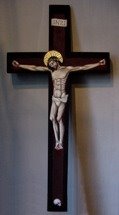
It seems to me that the concern with tearing the fabric of the communion — preserving the shreds of the partial unity we seem to enjoy in the manifestly divided church— is perhaps misplaced, as a part of our general fixation on the institution. It struck me in the early hours of this morning that a similar concern about tearing fabric took place in another context. To what extent are the powers that broker the future of our Anglican Communion like the soldiers haggling over the seamless garment, casting lots to see who will end up in possession, while the Lord of Glory hangs naked and crucified, spilling his blood for the world, and praying forgiveness for those who know not what they do?

—Tobias S Haller BSG


May 22, 2006

Doing The Lambeth Walk, In Circles

The Lambeth Commission has issued its "consultation paper" on how to move Towards an Anglican Covenant. I've read through the document, which is, of course, not a Covenant, but an additional call to outline the parameters for the possible development of a Covenant. (As such, it is even less practical than the Windsor Report, which at least offered a concrete model that few were willing to accept.)

I would like to suggest that we already have an Anglican Covenant, and it resides in the Constitution of the Anglican Consultative Council, and any more than that is only perceived as needed at this time because of the unwillingness of some in the Communion to accept that there is disagreement on a fairly narrow range of particular issues.

The Anglican Consultative Council is officially recognized in the Canons of the Episcopal Church (I.4.2) and we should by all means resume our seats as part of it.

—Tobias S Haller BSG

May 21, 2006

Two of them were walking

I've just finished realizing the orchestration of Symphonic Poem 2 -- my first in many years, written for James on his birthday. This one is built up around the themes of the walk to Emmaus, and is called "Two of them were walking into the country." It isn't strictly programmatic, but rather reflects the themes of sorrow and joy, concealment and revelation, the paschal mystery and the recognition in broken bread, "and he vanished from their sight."

The piece was written using Finale composition software and realized with the Garritan Personal Orchestra. Enjoy! (You'll need software capable of playing mp3, and a highspeed connection for best effect...)

—Tobias

May 16, 2006

Drama Queen

I'm getting very weary of the histrionics from Ambridge. Before the terrorist bomb (read, nominees in California), there was the relatively mild imagery of the Titanic and the Carpathia (read, General Convention and the rest of the Communion).

Now it's the SA and the Creature from the Black Lagoon. I begin to wonder about Dean Zahl's rationality at this point. Seriously. Is he literally seeing monsters where none exist? It is astounding to find in one short essay such a raft of argumentum ad misericordiam combined with the relatively more recent argumentum ad Nazium. Certainly he is prosecuting a "Cause" here which was settled 2000 years ago on the hill of Calvary, and which does not need his sense of persecution and threat to complete what is lacking in the suffering of Christ. That Paul can, from the relative comfort and security of his Deanship, portray himself as persecuted — while gay and lesbian people are threatened with prison sentences merely for associating in public or speaking out for civil rights (threats supported by his Nigerian ally +Peter); while gay and lesbian people are beaten to death or executed, by true believers nursed on the toxic teaching of homophobia cloaked under the vestments of religious faith, Christian or Muslim — almost beggars imagination.

But I have a good word for Dean Z. Paul, the strife is o'er. The proof of your faith will lie not in the extent of your purity, or the depths of your sense of persecution, but in how you love your sisters and brothers.

—Tobias S Haller BSG

May 14, 2006

Ekklesiastes: The Bible and the Church

I've just posted my sermon for today (Easter 5) over at my sermon blog. It's called The Bible and the Church and may be of some interest in light of present discussions concerning Scriptural authority. It concludes:

Ultimately, as Philip showed the Ethiopian, the heart of the Scripture lies in how it points to Christ. He is the living Word of God to whom the written Word of God — the Scripture — leads us in the Way into the Truth, and the Scripture is useful to us only to the extent that it performs that task, a task for which we are assured it is, as the Anglican tradition puts it, sufficient. For its ultimate purpose is to bring us to the new Life of faith — as it did the Ethiopian, who, when once on his Way the Truth was opened to him by the Spirit’s guidance and Philip’s teaching, immediately asked to be baptized into the new Life, to become himself the newest member of Christ’s body, the church.

Most of the tension in the present life of the Anglican Communion would vanish in a flash as sudden as Philip’s disappearance if we would simply take Jesus the Word of God at his word! The Scripture is not hard to understand in this respect, though we find it hard to put it into practice. He has told us mortals what is asked of us — it is amply stated in John’s teaching to us today in both epistle and gospel: the commandment of God is to believe in Christ and to love one another. Got that?

When Jesus summarized the law in his commandment to love God and neighbor, when he taught us to love our neighbors as ourselves and to do unto others as we would be done by, he meant what he said, and he gave us both a task and a promise. Those in Christ who love their sisters and brothers in this way — doing for them as they would be done by — have observed God’s commandment. All the rest is commentary.

My sisters and brothers, as I prepare for the General Convention this summer, where I will serve as a deputy from this diocese, along with three other priests, four lay persons, and the three bishops who serve New York, this is what I will keep in mind and heart. The Scripture is sufficient to salvation, for it has told me the truth that is so simple a little child can sing it: Jesus loves me, this I know, for the Bible tells me so. This simple truth is my armor against doubt, against judgment, against those who seek division and domination, against bigotry and ignorance, against pride and power, against all who would diminish human dignity or deny human worth.

So, as Christ taught us in his Word, “Let us love one another, not in word or speech but in truth,” neither condemned by our hearts nor dismayed by those who would demean us or deny us. God is love, beloved sisters and brothers, and we follow his commandments when we love him and each other.Against this the Scripture records neither law nor prophet, but rather the voice of the Lord himself to affirm us in our faith in the power of the Spirit, now and to the end of the ages.+


April 8, 2006

Adam Found the Tree of Life


For many years I searched to find this place. The way
was watched by angels armed with swords;
and yet in seeking it I felt the Lord’s
love guiding me. With hope and fear, by grace
I made my way — I’m sure it was God’s will.
It was the Tree of Knowledge God forbade.
Its bitter fruit our innocence unmade;
had we kept faith we’d be in Eden still.
But this, the Tree of Life, was only lost
because we fell. In Paradise once more,
I looked upon the Tree, and what it bore.
The Tree had brought forth fruit, but at what cost!
I saw a wonder hanging from that Tree;
a man was nailed to it; he looked like me.

Tobias Stanislas Haller BSG
1988


April 3, 2006

Who’s In — Who’s Out

The first Lambeth Conference was assembled in response to a request from the Canadian episcopate, addressed originally to the Canterbury Convocation, who then passed it along to the Archbishop. He in turn was quite clear in his invitation that he had no interest in assembling a doctrinal or legislative commission, but rather wished to share in Christian and episcopal fellowship.

There seems to be some confusion between "being in Communion with the Church of England" and "being a member of the Anglican Communion." The former, which is definitively determined (in the case of doubt) by the Archbishops of Canterbury and York, is the more expansive of the two: that is, there are any number of churches that are in communion with the Church of England which are not part of the Anglican Communion. I refer those interested to page 206 of the current Canons of the Church of England (2005).

Membership in the Anglican Communion itself is not defined by the Archbishop of Canterbury, but at present by the Anglican Consultative Council, which is a duly established entity with its own constitution, capable of deciding who is or isn't part of it by amendment of its schedule of members.

It does appear that being in communion with Canterbury could be seen as a prerequisite for membership in the more narrowly defined Anglican Communion. But what I am suggesting is that it might be possible for TEC (and the "founding member" the Church of Canada) to remain in communion with the Church of England even if for some reason temporarily removed or suspended from the Anglican Communion by a two-thirds majority vote of all of the Primates (in accordance with the ACC constitution).

This might, in fact, be a way to address some of the current concerns of other members of the Anglican Communion while retaining our historic relationship with Canterbury.

Tobias S Haller BSG

April 1, 2006

The Lay of the Land

Results are in on the pseudo-survey conducted by a new group aptly named "LEAC" (I'm not sure if it should be pronounced "leak" or "leach" -- or perhaps "leech") -- Lay Episcopalians for the Anglican Communion. The "survey" went to all bishops (not just those who actually had the right to consent to Gene Robinson's election, and to many who were not even present at GC 2003. Only 27% of those solicited responded. (You can read more about this extremely flawed "survey" at Thinking Anglicans.

I would suggest that this survey, flawed as it is, didn't even really produce the results the surveyors hoped for. First of all, the report refers to a "reversal" but doesn't indicate the percentage of those who changed their vote (if they had one in the first place: this was asked on the first two questions, each in two parts, on the survey form, but no result for the "B" section of each question is shown in this article.) How many of the 56% actually represent a change in voting?

More importantly, note the response to the crucial third question:

"Survey respondents split almost evenly on the third question, assessing relative loyalty to ECUSA and the Anglican Communion, with 46.25 % desiring to stay with ECUSA regardless of whether it remains in the Anglican Communion. Solidarity with the Anglican Communion would come first in such a showdown for 45% and 8.75% chose not to answer that question. This division could be a serious ECUSA political concern for the presiding bishop as he leads his church into a critical period through mid-June?s General Convention and beyond."

In short, there was no overwhelming support, even among the tiny proportion of respondents, for choosing continued participation in the "Anglican Communion" over continued participation in The Episcopal Church even if no longer part of that "fellowship." Perhaps the predominantly lay surveyors forgot that clergy take an oath as part of their ordination vows, and that oath is to "the doctrine, discipline and worship of The Episcopal Church" -- not to some ill-defined "Anglican Communion."

March 31, 2006

Non-Hunting Dogs of Ecclesiastical War

Dr Andrew Goddard takes up Bishop Langrish's comments to our House of Bishops and highlights this argument:

The Bishop proceeds to define precisely the difficult features of the New Hampshire consent and consecration (and hence any similar future consecration). These are two-fold in that such actions amount to:
-'consecrating a Bishop - presumably with intent to create a bishop for the church catholic - without seeking the assent of that wider church catholic (and this is about more than consultation)'
-'ordaining to the episcopate someone (and I make a general rather than a personal point here) who was in a relationship not liturgically sanctioned by the church, and to that extent at least irregular'

It is unfortunate that folks like Langrish and Goddard frame their arguments in ways that simply beg for rebuttal.

For example, are they unaware that the "liturgical sanction" of marriage in the church is not, according to the church's own teaching, what "makes" the marriage? Marriage, in the time of the church's foundation, was a civil phenomenon. The church did eventually get around to imparting its peculiar blessing on this secular institution, but never required the nuptial blessing for "regularity" until the Council of Trent! Quite simply, those of the apostles who were married (such as Peter) did not have the benefit of "Christian marriage" because it didn't exist.

(I leave to one side the observation that for most of its history, and throughout its broadest extent, being in the married state at all was a bar to the episcopate, period. Hmmmm.)

But back to church sanction: The Episcopal Church meeting in General Convention in 2000 recognized (in large part in response to Lambeth 1998.1.10) that persons living in same-sex relationships, while in tension with the historic teaching of the church, and absent any authorized ecclesiastical recogntion, nonetheless were to be given "the prayerful support, encouragement, and pastoral care necessary to live faithfully by" principles of "fidelity, monogamy, mutual affection and respect, careful, honest communication, and the holy love which enables those in such relationships to see in each other the image of God."

Moreover, the 2003 General Convention, drawing upon this resolution, recognized that indeed there is liturgical recognition being given to such relationships, albeit without provincial authority, and that those who do so are acting within the bounds of the church's common life.

Of course, Goddard would like to play a game of Whack-A-Mole with this, because the "liturgical" objection is simply a smoke-screen for his real opposition to any recognition of same-sex relationships, to say nothing of electing bishops who are living in such relationships. This is also known as the famous Catch XXII (Vicesimus Secundus).

Finally, as to bishops for the "church catholic" -- has either Dr. Goddard or +Exeter checked in with the Vatican lately to see if they are considered to be ordained in the "church catholic"? Failing such broad recognition, what are we to say of the fact that the Church of England and a number of other Anglican provinces would not recognize (at this point) a woman in the episcopate as authorized to function as such?

This dog will not only not hunt, but I am not entirely convinced it is a dog.

— Tobias S Haller BSG

March 23, 2006

Annunciation and Response


She knelt beside the neatly planted rows
of cummin, dill, and mint. The clear March sky
was bright; a flock of birds flew high.
She pinched a leaf;
                    then, suddenly, she froze —
a voice had spoken. There was no one there.
It spoke a second time; she looked around.
“How can this be?” she asked the vacant air.
Once more it spoke, yet there was not a sound.
She paused again; her answer in her mind.

In thirty years and three, her words would find
an echo: “Not my will, but thine be done,”
said in another garden by her son,
while three friends slept.
                           So here none heard her words —
except an angel, a high flight of birds,
and three neat rows of cummin, mint, and dill:
“Be it to me according to thy will.”

April 7, 1989
Tobias Stanislas Haller BSG