December 31, 2012

Christmas Special

The "must see and glad I saw it" of this Christmas season was the Call the Midwife Christmas Special --- apparently a last-minute decision on the part of PBS, as it didn't appear in the program guide. I only caught word of it because of a promo on the day itself. The new series ended its run for this season earlier this year, so the Christmas special came as something of a surprise.

And not only a surprise, but a delight. This is a wonderful tale of redemption, forgiveness, closure, thanksgiving for changing times, and the sufficiency of grace: good themes any Christmas. Keep an eye out for a rebroadcast, and keep a hanky handy. Wonderful performances by the standout cast.

Tobias Stanislas Haller BSG

December 22, 2012

Papal Fallibility

Pope Benedict XVI has chosen to make use of his Christmas message to do a bit of theology concerning human nature. In doing so he reveals a fundamental failure to grasp the meaning of the Incarnation.

...People dispute the idea that they have a nature, given to them by their bodily identity, that serves as a defining element of the human being.... They deny their nature and decide that it is not something previously given to them, but that they make it for themselves.... The manipulation of nature, which we deplore today where our environment is concerned, now becomes man's fundamental choice where he himself is concerned...
This rather misses the mark, as the whole point of the Incarnation taking place in the manner it did — via the work of the Holy Spirit and the Virgin Mary, without any participation of a human male — was to reveal the secondary quality of maleness and femaleness: Jesus derived his entire human nature from the Virgin Mary (or so says the Definition of Chalcedon). Although Jesus is male, his humanity derives entirely from a female. So the "human nature" is in itself genderless, although each particular human being has, by virtue of genetics and epigenetic factors, a sexual or gender reality expressed anatomically, psychologically,  emotionally, and socially. But as with all qualities of a person, sex is not essential to the nature: it is a characteristic particular to the individual, like height, or eye or hair color, or any of the other variable factors that individual human beings have. We even have a very clear sense of the genetic factors that produce this particular characteristic quality of the person. The quality does not make them human; their humanity gives expression to the quality.

The Pope takes what can only be described as a hard-line determinist position, pure sexism in its most precise form: anatomy fixes identity. In addition to the discontinuity of this position with the doctrine of the Incarnation, this also tends, like its cousin racism (also based on "given" characteristics), to dehumanize the human person, and reduce the concept of the person to the level of the animal nature; it puts all the weight of identity on the very aspect which the doctrine of the Incarnation shows us should not be given any weight at all, for as St. Paul so famously observed, "in Christ there is no more male and female."

Categorical difficulties
Which brings me to Genesis. One of the ongoing problems with the traditional Christian view of sex and sexuality lies in the reading of Genesis 1:27 ("male and female he created them") as referring to categories of people; that is, reading the words male and female as adjectives. However, in Hebrew, they are nouns — and would likely be better translated as "a male and a female, he created them." Although the Greek translation (LXX) elides them into adjective form, the Aramaic retains the noun form, and in one of the Aramaic versions adds specific details about the couple.

It appears from the contemporary evidence that Jesus and other Jews of the Second Temple era read and understood the text in this way, as referring to a couple. The Damascus Document of the Dead Sea Scrolls (Geniza A Col. 4:19-21), for example, uses the verse from Genesis in support of its argument in favor of monogamy. The same is true of a section of a Zadokite Document (7:1-7) that is usually classed with the Old Testament pseudepigrapha or apocrypha. (It seems to me to be from the same source as the Qumran text.)

And Jesus himself, when he cites this text in his critique of divorce and remarriage (Matt 19:4-6) is also clearly referencing not some alleged complementarity that makes male and female fit together, but rather the simpler and more obvious notion that a couple join together to form a unity: he even quotes (paraphrasing the Hebrew, as do the LXX and Targumim, by adding "two") another portion of Genesis (2:24). He then nails the matter home by his own gloss, "So they are no longer two, but one flesh."

So this isn't about categories, but about the mystery of how two become one — which is, of course exactly how St. Paul deals with it in Ephesians, which is also about how two become one — the two of Jew and Gentile (2:15) in one body as well as the two of husband and wife in one flesh.

So could we please have no more of this nonsense about categorical qualities being determinative about who and what people are, at their most basic level as human beings? People are fully dimensioned with many qualities and characteristics, and indeed free — with the freedom given by their Creator — to become all that God intends for them. The Scripture may begin with Genesis, but it ends with the Revelation of the new humanity, which transcends the merely earthly categories and qualities that each of us possess. It is not our substance or our genes that matter: but our actions of love and service to one another.

Tobias Stanislas Haller BSG

ps: Let's try a mental exercise. Surely a part of the imperative of bodily identity as male and female should be "ordered" towards what male and female exist for: sexual reproduction. So any person who fails to live out this aspect of his or her natural identity is in some way "constructing" an identity at odds with their biological destiny. So the "celibate lifestyle" is contrary to human nature.

UPDATE: You can read the full text of the address courtesy of Whispers in the Loggia. As I suspected, Benedict reads Gen 1:27 as referring to categories, not people. He's done it before, and will do it again...

December 20, 2012

Grace's Cost

Grace is not cheap. It is free. It comes as a gift, unearned, unasked for, unexpected and most of all undeserved.

He was the gift that gave it. 
He gave that gift to save us. 
That gift was costly to himself alone,
All for our sake and our salvatiòn. 
Deo Gratias.

Tobias Stanislas Haller BSG
Eve of St Thomas 2012

December 19, 2012

It's In the Cards

tsh as dr grün
Once upon a time I felt flattered to be asked to produce ID in order to order a drink or buy a bottle of spirits, wine or beer; it is now not so flattering not to be asked for ID in order to obtain a senior citizen discount...

Tobias Stanislas Haller BSG

December 16, 2012

The Unheeded Warning

In spite of how obvious it is that people should deal fairly with one another, they don’t: a sermon for Advent 3c

Advent 3c • SJF • Tobias Stanislas Haller BSG
With many other exhortations, John the Baptist proclaimed the good news to the people.

Our gospel passage this morning ends with the assurance that John the Baptist proclaimed “good news” to the people. In light of recent events, we sure could all use some good news. I have to say I am heart-broken, right now, as I know many are, at the terrible tragedy that took place last week in Connecticut. But our other Scripture readings sound like good news, no doubt about it. The prophet Zephaniah urges daughter Zion and Israel to shout out and rejoice, and to make thanksgiving for the redemption of the Lord and God who is coming to rescue and restore that kingdom and that hope. God will restore their fortunes, the prophet promises; God will give them the victory of a triumphant warrior; God will rejoice over them with gladness and renew them in love, exulting over them with loud singing as on a day of festival. Fling out the banners and light the fireworks; strike up the brass band and start the parade!

Those sentiments are echoed in the First Song of Isaiah that we used as our psalmody this morning — words full of assurance that God the Savior is at work and that God’s work is trustworthy and solid. If there were a theological “Angie’s List,” this would let us know that God gets an A-triple-plus rating — God is someone you can count on.

Saint Paul continues the celebration in his Letter to the Philippians, beginning with that word that gives this Sunday its name, “Rejoice Sunday,” or as it is known in Latin, Gaudete. What we heard as our second lesson today would have been the first words you heard on this Sunday in the Western church right on up into modern times: not only an assurance of reasons to rejoice, but a command to rejoice. We follow that tradition by using these rose-colored vestments on this day — lightening up from the somber purple of the Advent season to a brighter and more cheerful hue.

+ + +

By this time these warm-up acts have got us ready for a celebration in the gospel. But what are the first words we hear from John the Baptist: “You brood of vipers! Who warned you to flee from the wrath to come?” It seems the parade has come to a screeching halt. As if a gunman has broken into a classroom and opened fire. As if the pink of the vestments were not a celebration of life but about breast cancer awareness, awareness of that terrible disease that strikes so many; it’s as if someone in the brass band has hit a very sour note, or even worse, that a sniper has opened fire on the band, and all of the instruments have fallen silent. The towering figure of John the Baptist points with his gnarled hand at the crowds who have come out to hear him preach — like the ghost of Christmas yet to come. And if the crowd wanted something other than fire and brimstone, they are in for a surprise, for he calls them, a “brood of vipers.” And yet the Gospel goes on to say he encouraged the people with such good news. I don’t know about you, but being called a viper is not the best news I’d like to hear.

So let us look more closely at what follows that initial stern rebuke. There is good news, thank goodness. For after this powerful condemnation and threats of axes and fruitless trees being chopped down and thrown into the fire, when it gets down to brass tacks and the fate of the crowd — no doubt shivering in their sandals by that point at the prospect of what is about to be demanded of them — when the terrified crowd gets up the courage to ask what they can do to be saved, what does John tell them?

“Whoever has two coats must share with whoever has none, and whoever has food must do likewise. You tax collectors just collect the tax, and you soldiers don’t blackmail or abuse people!”

Well, if you had been there then, wouldn’t you breathe a sigh of relief at those words? After his verbal introduction and assault, John does not ask the people to do anything at all extraordinary — he doesn’t ask them to live like him out in the wilderness dressed like one of the prophets of old with a hairy mantle and a leather belt, living off locusts and wild honey. He tells them to go home and get back to work and do their jobs and live lives of honesty and fairness.

And this is really where the good news comes in — for certainly it is good news, as Zephaniah and Isaiah and Paul assure us: that salvation is not something we have to do on our own for ourselves, but something that is done for us by one who is mighty to save. For surely, as Isaiah says, it is God who saves us, and we can trust in him and not be afraid.

And on top of that, John the Baptist, after that initial stern language, gives us the good news that what is asked of us is not impossible — but is really only fair and just and right: to share our resources with those who do not have — our clothing with the naked and our food with the hungry — and to do the work we have to do with honesty and without taking advantage of or abusing anyone else.

And that, my friends, is the good news — that we have been saved by God, and that what God asks of us is to love God and our neighbor.

+ + +

And wouldn’t it be lovely if people actually did. If it’s really that simple, why did the prophets have to keep proclaiming it? Why did John the Baptist have to shout at the people and greet them as a brood of vipers? Why did he have to warn them of the coming destruction and the fruitless trees and the great bonfire at the end of time, the threshing floor and the unquenchable fire that will burn up all the worthless chaff and deadwood of unproductive lives?

You know why — because in spite of how obvious it is that people should deal fairly with one another, they don’t. Even without the awful example of last week’s shooting, ringing in our ears, impossible to avoid as you turn on any television station at all, we know that people do not do as they ought to do. In spite of the fact that everything works so much better when everyone follows the simple rules of courtesy and fairness and generosity — just common sense — people still try to take advantage — just watch the exit ramp on any crowded highway: someone will have to create a lane of his or her own, or find a creative way to nose in at the head of the line causing everyone else to be slower. In spite of the calls for spare coats to be dropped off at the library or police station for distribution to the poor and cold, the dawning day of the Lord’s Day will find plenty of closets full of clothing that people haven’t worn in years. To my own shame I realized as I wrote these very words that there was more in my closet at home than really needed to be there; and I took that unworn second coat up to the library on Eames Place and dropped it off; how about you?

If nothing else, let this reading today be a reminder to us — to all of us — of a simple command: to check that closet when you get home and find the coat you no longer wear and bring it to the library or the precinct so it can be given to someone who will actually wear it.

We are not asked to do the impossible, my friends. We are asked to do something so easy it would be a crying shame for us to fail to do so. It would be a shame to end up crying in shame when the ax is laid to the root of the trees and every tree that does not bear good fruit is cut down and thrown into the fire. That’s good news, if we are prepared to hear it, and hearing it, act upon it. God gives us the warning; may he give us the strength to do as he commands.+


December 15, 2012

Rachel Weeps

A voice is heard in Ramah, weeping and wailing.
Rachel cries for her children and will not be consoled,
because they are not.
Rest eternal grant unto them, O Lord, and let light perpetual shine upon them.
A voice is heard in Ramah, weeping and wailing.
Rachel cries for her children and will not be consoled,
because they are not.

From Requiem for Children, 1980
Tobias Stanislas Haller BSG


MP3 File

December 12, 2012

Thought for 12.12.12

Unity is not a value to be held in spite of diversity. It is a value we hold because of diversity. If we were all the same we would not need such a value.

Tobias Stanislas Haller BSG

Being Institutionalized

Sir Tony Baldry is reported as saying, "For the Church of England, the uniqueness of marriage is that it embodies the distinctiveness of men and women, so removing that complementarity from the definition of marriage is to lose any social institution where sexual difference is explicitly acknowledged."

To imply that sexual difference is essential to marriage is just a circular argument for "only mixed-sex couples can marry." To say that removing sexual difference from marriage means we have to remove it from all other social institutions is to the point, though. I mean, haven't we? Shouldn't we? Is it just that marriage is the last bastion of the social shrine of sexual difference? To what end?

Tobias Stanislas Haller BSG
h/t Thinking Anglicans

December 11, 2012

Sirens and Asparagus

It is now reported that the English Parliament, while edging towards approval of same-sex marriage, is responding to appeals by at least some in the Church of England, to make it part of the law that the Church of England (and that of Wales) be explicitly prohibited from performing such marriages.

Needless to say present law of the Church of England (and Wales) does not allow for same-sex marriages, although there has been occasional movement in that direction. It appears that some fear that if something is not forbidden it will become mandatory.

This particular "lock" or "lockout" forbidding England and Wales to perform same-sex marriages even if their governing bodies decide to do so seems a bit like our American "fiscal cliff" -- a law put in place to prevent a body from doing what it very well knows it might one day choose to do, but is unwilling to do or fearful of doing.

The fact that there seems to be a need for such an external restraint is testimony to the lack of resolve -- and the pressure for change -- within these institutions, and a sad sign of a kind of double-minded immaturity and unwillingness to deal with reality.

Odysseus bound to the mast comes to mind, knowing he has no power to resist the sirens' song, but wanting to hear it all the same, while his deaf crew row with wax-filled ears.

Of course, it also reminds me of Alice: "I'm so glad I don't like asparagus, for if I did I should have to eat it, and I can't bear it."

Is it any wonder the Church of England -- coming to resemble both of these -- lacks credibility?

Tobias Stanislas Haller BSG

December 5, 2012

Jumping the Gun?

There is a press report that the Presiding Bishop has accepted Mark Lawrence's renunciation of ministry in The Episcopal Church.

While I believe that Mark Lawrence has abandoned the communion of The Episcopal Church, I do not think he has renounced his ministry, at least in the manner laid out by Canon III.12.7, which requires a written declaration to the Presiding Bishop expressing a “desire to be removed.”

I think that rather than jumping the gun, and taking actions and speeches as if they met the formal requirements of the Canon, the process of dealing with the abandonment should have been followed to the letter. Lawrence's November 17 speech — and other actions — obviously do not constitute "a good faith retraction" of those things that led to the charge of abandonment, which is what he could have done in the 60-day period to reverse course. But continuing on the same course does not transform abandonment into renunciation under either the letter or spirit of the law.

Haste is not our friend.

Tobias Stanislas Haller BSG

UPDATE: An additional problem is that “renunciation of the Doctrine, Discipline or Worship of the Church” — which constitutes abandonment under Title IV — is not the same thing as “renunciation of the Ordained Ministry” under Title III. I think it is clear that Lawrence has done the former, but it is not at all clear he has done the latter — in the form set out in the Canon, that is, by a written statement to that effect. There has been no canonically formal, “You can't fire me, I quit.”

December 4, 2012

Unmasking

The term "Mutual Responsibility" popped up in the late 60s in Anglican circles as a way to describe how the Communion ought to work together, and it has been part of our cultural DNA ever since, right up to and including the Proposed but Not Yet Widely Adopted Anglican Covenant.  I would like to suggest that this supposedly foundational principle be unmasked for what it actually is: not a creative bit of gene therapy, but an alien virus that is ultimately harmful to the Body Ecclesiastic.

It seems to me, that beneath the mask of the high-sounding terminology works the reality of former colonialists wanting to make their former colonies (and themselves) not to feel so bad about the past and present, and pretend that "we're all equal" while knowing full well that "some are more equal than others" in terms of resources. This in part derives from the colonists' romantic (and envious) view of the emerging churches ("they have such a vibrant faith") in comparison with their own staid and stolid churches, that they feel have grown lukewarm.

Some might say I am being cynical; but this seems to cover the evidence a bit more completely than otherwise. After all, why is it that this notion emerged precisely in the era of post-colonialism if not as a part of that very movement. Who can deny that we've seen the sad results of both colonialism and post-colonialism in the secular states over the last two generations; and why should anyone assume that the church is immune from the same malady?

To test the waters, one might well ask, How can one truly be "mutually" responsible? To what extent does this "responsibility" shift from acknowledging one's own faults to the larger body, to the larger body picking out the perceived faults in the individual members — or one or two self-righteous members deciding that they can pick out the faults of everyone else? "Motes and beams" come to mind. Mutual responsibility may just end up as codependency.*

Paul, in his Letter to the Galatians, seems to have been well aware of the phenomenon of one part of the church deciding what was best for another part of the church, and the tension between missionaries and those missioned. And he neatly outlined the dilemma of "mutual responsibility" in the last chapter of that document: the tension between "bearing one another's burdens" (6:2) and "all must carry their own loads." (6:5).

The answer, it seems to me, is not so much  to stress the "mutual" as the "responsibility." People ought to take responsibility for their own actions, engaging in vigorous self-critique before daring to engage in other-critique. As Paul also says, we are called to freedom, not to self-indulgence. "The whole law is summed up in a single commandment, 'You shall love your neighbor as yourself.' If, however, you bite and devour one another, take care that you are not consumed by one another." (5:13-15) If we want anything mutual let it be mutual charity and forgiveness, coupled with responsibility to the one who actually is our judge. Not autonomy, nor neither heteronomy — but theonomy, with the knowledge that God, and God alone, is both our Judge and our Advocate.

Tobias Stanislas Haller BSG

*From Wikipedia:

Codependency (or codependence, interdependency ) is defined as a psychological condition or a relationship in which a person is controlled or manipulated by another who is affected with a pathological condition (as in an addiction to alcohol or heroin); and in broader terms, it refers to the dependence on the needs of or control of another. It also often involves placing a lower priority on one's own needs, while being excessively preoccupied with the needs of others. Codependency can occur in any type of relationship, including family, work, friendship, and also romantic, peer or community relationships. Codependency may also be characterized by denial, low self-esteem, excessive compliance, or control patterns. Narcissists are considered to be natural magnets for the codependent.
Does that sound familiar?

TSH

November 28, 2012

Lincoln as Grand Opera

a review of Lincoln by Steven Spielberg

Steven Spielberg’s Lincoln is a film that will likely stand the test of time: a splendid script, well acted and well filmed, with a weighty subject and important themes. But beyond that it has the stamp of art about it; ironically, in my opinion, less the cinematic than the operatic. This is a film of arias, duets, trios, and choruses; a film that relishes the richness of language, indeed about people who relished the richness of language and were not afraid to speak in long sentences with polysyllabic cadences and periods that clunked down at the end to make a point with no misunderstanding possible: the ponderous solemnity of sober speech as well as the rollicking ribaldry of pungent insult. These were people suckled on the twin teats of Shakespeare and Cranmer, and the film shows off their language to good effect.

The actors are all up to the performance of these roles; Daniel Day-Lewis is the leading tenor hero alternately performing the comic aria and the solemn recitative. Sally Field portrays the complex female lead, a sorely tried and trying woman with the humility of Hyacinth Bucket, the rhetoric of Foghorn Leghorn, and the emotional stability of Bill the Cat. Her verbal duel with the baritone, Tommy Lee Jones as Congressman Stevens, is an acid-etched example of the most polite and politic vitriol, razors sheathed with smiles. Jones chews the rich language placed in his mouth like a fine malt, and clearly enjoys every nuanced syllable. The operatic analogy cannot pass without notice of David Strathairn’s Seward, the standard baritone “best friend” of the leading tenor, loyal to the end.

A dramatic high point in the film is the duet between Mr. and Mrs. Lincoln caught in the dilemma created by their son Robert’s desire to serve in the military. They are each in their own world, talking past each other simultaneously — the high-minded idealism of the president crashing in a restless wave of words against the impassioned anchored anguish of a mother already bereft of two sons and unwilling to lose a third. At the end of the scene, the defeated woman collapses like Violetta into her crinolines in a visible gesture of resignation and grief as powerful and evocative as the plunge of a white satin Hindenburg.

Not since Orson Welles have we seen such exercises in fugal dialogue as in this scene and another in which young Thomas Lincoln, also known as Tad (because he looked like a tadpole when he was a baby), prattles on while the adult conversation continues around him. Gulliver McGrath is splendid in the role, and provides what I found one of the most moving, and historically accurate, moments, reacting to the news of his father’s death; for he was also at the theater the night Lincoln was shot — in a different theater, watching an Arabian adventure unfold on the stage. Spielberg’s choice not to show the assassination but to allow us to hear of it as little Tad did, indeed as most of the nation did, secondhand, is a wonderful example of his artist’s delicacy — the cinematic equivalent of a mot juste, not unlike the red coat in Schindler’s List, a film also echoed in Robert’s following a barrow of amputated limbs to see them summarily disposed of in a lime pit. Even were it not for the high-flying language, this would not be a film for children.

Another reason this film will endure is the strong political message it sends, a timely one at that. It is a political world that is also a deeply personal world — this was before corporations were thought of as people. It reminds us that the body politic is made up of individual people. It moves from the writhing, entangled bodies of the opening battle scene, a sea of blue and gray — and red — to the political battle of Congress, and the unique individual people who make it up, each and every vote counting. These too are people who in the day of decision ventured much; one might even say that decision-making is at the heart of what this film is about — a theme not at all foreign to Spielberg’s best and most serious work, echoing the powerful sentiment of Hillel and Private Ryan both, concerning the worth of each individual life. We see decisions played out not only by Lincoln and his wife and son, but the cast of Congressmen, some bought and sold, set at a price as were the slave children whose images young Tad pondered, others throwing caution to the wind as they cast a vote they know will cost them dearly. Michael Stuhlbarg, as George Yeaman, is particularly moving as he finds his voice.

If I were to fault the director on any point of this film it would have to be the ending. I had thought it might end with that long-lens shot of Lincoln walking down the hallway — after all we know how the story ends. But then we would have missed the superbly handled presentation of the assassination itself, reported by messenger as in the best Greek tragic tradition. And then I thought it might have ended with those famous words, “Now he belongs to the ages.” Instead the director gives us Lincoln in a flame, an effect all too much like a Victorian faery photograph, or Lincoln as the Ghost of Christmas Past, and a snippet from an admittedly great speech. But it seems a false step to end in this way — and is a step away from the operatic form which had served so well up to that point. What, after all could be more operatic than the leading character lying dead surrounded by the other principal players, as the curtain falls on the closing chords?
 
Some will no doubt accuse me of quibbling at this point; and I will not say that this minor flaw undoes all that went before. Far from it; but in a film that is so nearly perfect a small flaw is all the more irking, particularly as it comes at the end.

This is a film that will last, and bear repeated viewings.

Tobias Stanislas Haller BSG


November 20, 2012

Why No

I will venture to suggest that the bulk of those voting against the draft measure to approve the ordination of women to the episcopate in the General Synod of the Church of England fall into three categories:

1 & 2. Evangelicals or Anglo-Catholics firmly opposed to the idea of women bishops on the ground that a woman is incapable of holding such an office; or

3. Progressives who felt that the compromise resolution would mean that any women called to the episcopate would be equally compromised in their ministry, by the ability of the parish to request alternative episcopal oversight — which request was to be “respected.”

So it seems that the moderate middle failed to carry the day, and England will have to wait a bit longer for women to come to the office of bishop there. It was a narrow defeat, by a handful of votes in one order, but a defeat nonetheless.

Maybe next time...

Tobias Stanislas Haller BSG
h/t Thinking Anglicans

November 14, 2012

Introducing

This is Sir Bootz, a shelter cat from Pets Alive Westchester, added to the rectory population yesterday. He is a fine clerical fellow, right at home on my keyboard, in fact blocking the screen at this very moment. He has a very sweet disposition, and is fascinated by my typing on the keyboard... Perhaps I can put him to work?

Tobias Stanislas Haller BSG

November 11, 2012

Veterans (more)


O.K., two more pictures of my Mom and Dad in uniform. First, my mother with some of her WAVE classmates, in a spectacularly un-feminist pose — and yes, that's her in the front of the line! Then my Dad up a tree, in uniform. Have no idea where this was taken.

Blessed Veterans Day to all....

Tobias Stanislas Haller BSG

Veterans

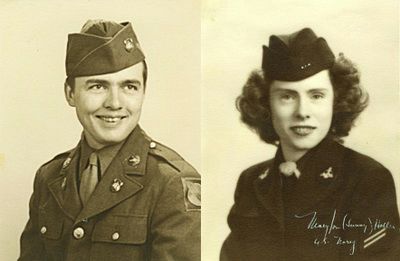
This is my father and mother, William and Mary Haller, both in uniform (Army and Navy respectively). They met during, and I suppose it fair to say, because of, the Second World War. They were together as a married couple for almost fifty years. Both are interred in the “Patriots’ Hill” section of the suburban cemetery dedicated to Veterans, not too terribly far from where my siblings and I grew up. On this Veterans Day (Armistice Day, or by whatever name you choose to know it) I give special thanks for my Mom and Dad, who served their country in wartime, and loved it in peacetime.

Tobias Stanislas Haller BSG

November 7, 2012

Note to Pundits

To all of the pundits who predicted the election of Governor Romney by more than 300 electoral votes: There is no need to acknowledge your error, explain how or why you were mistaken, or express regrets or apologies. Reality is what it is, and has a way of taking care of itself without your input. It might be as well to remember this:

If a prophet speaks in the name of the LORD but the thing does not take place or prove true, it is a word that the LORD has not spoken. The prophet has spoken it presumptuously; do not be frightened by it.Deuteronomy 18:22

So I do have to wonder why the error-prone talking heads are still nattering away on the airwaves and intertubes, and why anyone would listen to them for any other reason than to assuage their own disappointment by listening to the echoes of their ideology. Perhaps that is reason in itself. Misery loves company, the old saying has it.

Meanwhile, it is time for the country to pick itself up, dust itself off, and get to work. The Republican members of Congress should realize that obstruction will not be long tolerated, and for most of you the next election is in two years. It is time to lead, follow, or get out of the way.

Mr. President, you have our attention. 

Tobias Stanislas Haller BSG

UPDATE: See this graphic from the inimitable folks at Slate.com. It is a graphic display of who among the pundits did well or poorly in their estimations. The fact that Conservative pundits were more "off" than the moderates or liberals testifies to the stupifying effects of their ideology.

tsh

November 3, 2012

Comprehensive Reform

for the Feast of Richard Hooker: a sermon by Tobias Stanislas Haller BSG from 2004, Church of the Intercession, New York

GRANT that we may maintain that middle way, not as a compromise for the sake of peace, but as a comprehension for the sake of truth. — The Collect for the feast of Richard Hooker
There once was a vicar in an English country church of whom his congregation said, “Our Vicar is like God — he is invisible on weekdays and incomprehensible on Sundays.” I hope that I will not in my reflections today prove to be the latter.

Incomprehensible is a synonym for “impossible to understand.” Such understanding can be pictured almost in a physical sense: for to understand is to stand under, as a table stands under what is placed upon it, and so must be larger and more stable than what it holds in order to sustain or support it. To comprehend in this sense is to hold the object of knowledge on the table of ones mind.

Which is why God is incomprehensible. We cannot comprehend God because however hard we try, we cannot wrap our finite minds around the infinite God; God will not fit on the table of the human mind, however rasa our tabula, however much room we make on it, however many leaves we add, because, as the old hymn says, God is broader than its measure.

And the same goes for Truth, if we are speaking of Truth With A Capital T — not just some true things, but the whole ball of wax, the Truth as a full and complete description of All That Is — for the description must be at least as complex as what it describes. Try, for example, to describe a zipper to someone who has never seen one. And when we get to natural zippers like the string of DNA that holds us all together and builds us up at the most fundamental level, the description will take volumes — the printed listing of the human genome, a single transcribed copy of just one DNA zipper, of which we each carry trillions of the real thing in our bodies, would take 200 volumes the size of the Manhattan phone book.

To make matters worse, the truth about what is — even as it is spoken — adds to the sum of what is. If we were to write down even a mere tally of all that is, without further comment or explanation, truly the universe itself would not be large enough to contain all the books that might be written. For the books themselves would add to the substance of the world, and with every word we wrote we would be adding to the subject of our enterprise, and the bibliographers and catalogers would soon have to take up their work. As the wise man said, “Of the making of books there is no end.”

Indeed, the only way to comprehend the Truth, in this fullest sense of the word, and as appears to be the aim laid out in the Collect for this feast of Richard Hooker, is to be outside of all that is. And since only God is outside of all that is, as God is the cause of all being and becoming, so only the mind of God can truly comprehend all Truth.

We get glimpses of this outside-in structure of reality in the visions of the saints and poets — in Byzantine icons and in Dante, and in William Blake too. Perhaps it is most vividly captured in that wonderful vision God imparted to Blessed Julian of Norwich: a God’s-eye-view of the universe, as she saw in the palm of her hand a tiny thing no bigger than a hazelnut, so frail it looked as if it would cease to be in a moment. And God told her, It is all that is, and it endures because God loves it. As Blake would later write,
To see a world in a grain of sand,
And a heaven in a wild flower,
Hold infinity in the palm of your hand,
And eternity in an hour.
That is the God’s-eye-view that only the odd mystic glimpses.Now, in spite of the visions of the saints and poets — who are careful not to mistake these momentary experiences of God’s view of the world for their own accomplishment — most of us are wise enough to know our limits. As Hooker himself put it, “The true properties and operations of [God] are to know that which is not possible for created natures to comprehend; to be simply the highest cause of all things.” (5.53.1)

Yet in spite of this, some in the church from time to time do appear to think they have come into possession of the Truth, which usually turns out to be something far more prosaic and far less visionary — a set of right doctrines, or more commonly, right behaviors. And most of us have the good sense to realize that even this limited claim is a bit presumptuous. We have learned from the hard experience of the church’s history that what you don’t know can hurt you; and that often the church is at its most errant precisely when it claims to be most certain. It is rash for any in the church to claim the ability to see in a glass brightly: especially when the church’s rear-view mirror consistently warns us that objects are nearer than they appear — and we travel at our peril if we imagine that our view through the looking glass is either infallible or complete. Indeed, as we take that backward glance on the ecclesiastical autobahn, we see that behind us HeilsgeschichteStrasse — Sacred Story Street — is littered with the wrecks of time over which God towers in divine incomprehensibility.

Just ask Galileo, Richard Hooker’s contemporary, who set about the task of trying to record a few true things about the world, things evident to the senses, or at least to the senses aided and abetted by the telescope. He suffered the fate of being told that what was wasn’t, or at least wasn’t what he saw it was. Threatened with torture, he recanted and submitted to those who refused to know the truth of what is, so insistent were they on what they thought ought to be.

+++

Those on our side of the Tiber, the Anglicans, by Hooker’s day had learned their lesson the hard way. There had been enough burnings and tortures and beheadings on the scepter’d isle over mutually exclusive doctrines to satisfy the lust for certainty at least for a season. So a “settlement” to continuing vexatious matters emerged from the serendipitous arrival of a monarch like Elizabeth and a scholar like Hooker.

Now, Elizabeth, as a monarch, was probably more interested in compromise for the sake of peace than in comprehension for the sake of truth. She did not wish, as she said, to make windows into men’s souls. She knew that if she refrained from peeping into her advisors’ heads, she could benefit from the wisdom they would share around the privy council table, rather than having to commit those selfsame heads to the block and pike. As long as private opinion on divisive matters was kept in the privy closet, as long as one didn’t ask or didn’t tell, a form of peace could be maintained. Thus what Napoleon would later call the nation of shopkeepers kept the peace by means of compromise, the peaceful coexistence that falls a good deal short of true communion and community, but at least keeps heads on shoulders.

But as our collect reminds us, Hooker aimed higher. His Middle Way was not primarily a matter of compromise, but of comprehension. And the genius of comprehension lies in the breadth of its embrace, and in its confession of and willingness to live with an inevitable degree of error and ignorance. Hooker confesses that since we cannot know all things, and sometimes err in the things we think we know, we must allow room for all things, to make the table not infinitely broad (which is beyond our capacity) but broad enough to hold both the unforeseen and unexpected guest, as well as the uninvited and errant guest who shows up at the wrong party. Who knows, until the master comes, who really belongs there after all?

Hooker directs us to avoid the need for final answers on all but the minimally sufficient, and sufficiently salvific claims of the Gospel, secure truths at the heart of what it means to be Christian: centered on the existence of God, and the incarnation, death and resurrection of Jesus Christ —the eternal Gospel without which there really wouldn’t be any point in continuing the discussion, but beyond which all else is more or less provisional. As he said concerning baptismal faith: “Belief consisteth not so much in knowledge as in acknowledgment of all things that heavenly wisdom revealeth; the affection of faith is above her reach, her love to Godward above the comprehension which she hath of God.”(5.63.1)

So the final answers and the definitive positions on everything and anything, so beloved both by Calvinists and Papists, would give way in Hooker’s view to a more rational willingness to withhold and reserve final judgment on all but a very few core doctrines, to realize that mutually exclusive opinions on other matters cannot both be true — and in the long run neither might be true, and the real truth might lie somewhere else altogether. To cast the net broadly, to make the table wider; to expand the breadth of charity to include all possibilities on matters for which clear and final evidence is yet to be shown: this is Hooker’s rational and charitable mission, a willingness to treat our knowledge as sufficient, rather than complete, and certain, in certain matters, only of its own uncertainty; and above all to trust that all such knowledge and love are securely centered in the depths of God, where the Spirit moves and searches, and where alone wisdom is to be found.

For when one is truly in the communion of the Church, truly united with the other members of the body — which can only truly be a body when all the members are lovingly comprehended in it in spite of differing opinions on secondary matters — Deus ibi est: God is there. Next to this transcendent unity-in-communion all other modified and restricted uses of that word, even the one called “Anglican,” must surely pale in comparison. In the truly comprehensive communion of the whole Body of the Church, the blessed company of all faithful people, we are in God, and God is in us.

+++

And it is in this that we come to the grand reversal, the inside-out of God. Now, generally speaking, reversible garments are notable principally for being unattractive whichever way you wear them. But the inside-outness of God is quite another matter. Here we enter the amazing world — the real world, I might add — in which the inside is bigger than the outside — as observation shows us is true of most church buildings. God’s universe, it turns out, is more like those Byzantine icons or M.C. Escher lithographs than most people are willing to allow. This truth is summed up nowhere so well as in that Johannine avalanche of prepositions and pronouns from today’s gospel.

Jesus starts first from the expected greatness of God: “As you, Father, are in me and I am in you, may they also be in us” — so we are nested in God, resting in the palm of God’s hand like Thumbelina, safe in our hazelnut cradle.

But then comes the surprising reversal: Jesus prays, “I in them and you in me, that they may become completely one,” and suddenly we — made one in the mystical and holy communion of the Body of the Church, the Body of Christ, the temple to which God comes and deigns to be our guest — suddenly we hold Christ within us as he holds the Father within him, nested like a set of Russian dolls with God the Father in the innermost secret room of the human heart, the holy of holies, the privy chamber and closet of good council, and the human image and likeness become the frame to hold the true divine reality behind all that is, among us and within us always.

+++

And in this and this alone is the comprehension of the Truth, the whole Truth, and nothing but the Truth. I said earlier that God will not fit upon our mental tables; but there is one table on which God will fit, indeed, upon which God will fit in a few minutes. It’s right there in the sanctuary. In a few moments, the universe will turn inside out, the heavens will open and God will descend and condescend to be among us and with us, the Spirit will descend upon us and upon these gifts, and we will hold God in the palms our hands, and place God to our lips and, like Mary, become God’s earthly sanctuary. We in him and he in us, will become what we behold, and hold what we become.

Sanctified in this Truth, comprehended in this Body, fed with this food, may we be now and ever one, in the knowledge and the love of God, and the peace of God which passes understanding.

This is a repeat posting, but I think it worth repeating.

October 30, 2012

Cultural Dissonance

Many conservative Christians are willing to acknowledge that the Scripture reflects the cultures of its time when it comes to social and economic issues, but seem to be unable to see the same influence of long-gone culture on attitudes towards sex and sexuality. They will sometimes find ingenious ways of sheltering the latter from a social or cultural critique or amendment, such as asserting that some things are creation ordinances while others are mere management of human weakness — which doesn't hold up well on examination, since some of the commands issued at creation have since been eliminated or ignored; or by claiming that the Law of Moses can neatly be divided between "civil" and "sacred" matters — a notion the theocrat Moses would have found to be very odd indeed.

It is fine to say that the church should not bend to the culture of this age, but also fair to point out that the church need not bend to the culture of some former age, merely on the grounds that the culture in question was dominant at the time the scriptures were recorded.

Tobias Stanislas Haller BSG

October 25, 2012

Maxims on Diocesan Separation

That a diocese may have been an independent entity prior to its entry into union with The Episcopal Church is no more relevant to an asserted right to separate than that a husband was single before he married.

There is no provision in the Constitution of The Episcopal Church for the independence or separation of domestic dioceses from union with the Church.

Dioceses are not sovereign in that they are legally incapable of obtaining their own bishop absent the cooperation and consent of the rest of the Church.

A diocese cannot even divide itself without the consent of General Convention.

And that's enough for now.

Tobias Stanislas Haller BSG