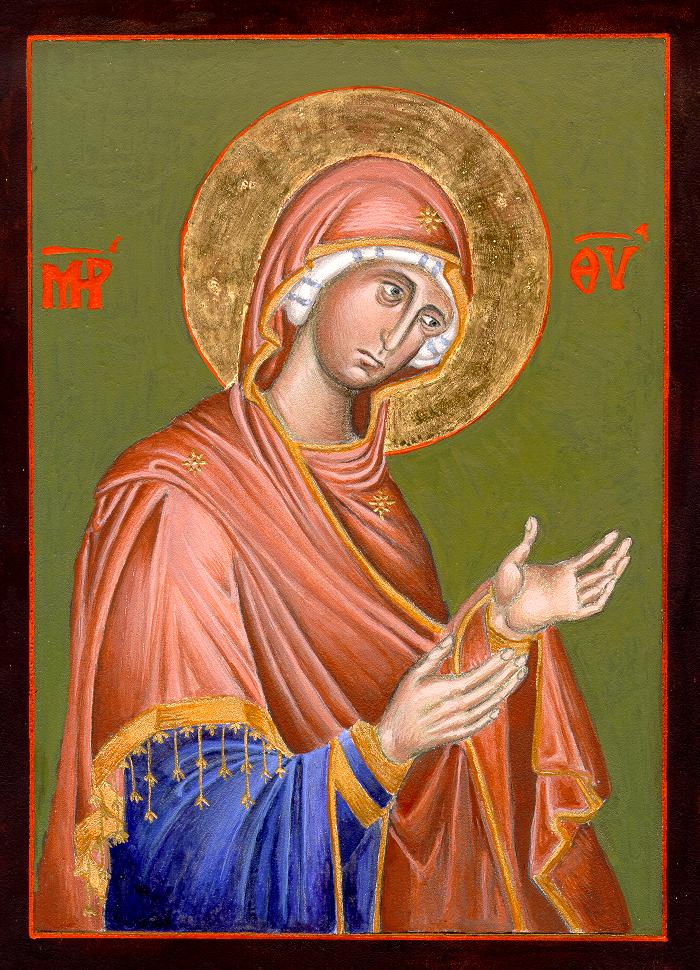
May 7, 2009

One Word

An Address to Provincial Synod II
Albany NY • May 7, 2009
Tobias Stanislas Haller BSG

Bishops and Deputies, ladies and gentlemen, I have to admit that when I first heard the theme of the next General Convention was going to be ubuntu, my heart sank a bit. Though a language major in college, and having picked up a few languages since, I have to confess my fluency in languages spoken in Africa is limited to English and French.

I can be glad ubuntu is not one of those African words with a disconcerting click in the middle. That click is represented by an exclamation point, but I prefer my exclamation points at the end of the sentence.

I know I’m not alone in my concerns about pronunciation. Like most Americans, I want to pronounce foreign words correctly. The French, as was observed in My Fair Lady, don’t care what they say in French so long as it is pronounced correctly. When it comes to foreign words and phrases, the French, like the English, don’t really give a hoot and pronounce them as if they were just French or English words, giving us things like Cervantes’ Don Quichotte and Byron’s Don Juan. But we Americans tend to want to pronounce foreign words correctly — at least until we adopt them as names for our cities, like Des Moines Iowa or, even closer, Delhi New York.

+ + +

Of course it’s not the word or its pronunciation, but the concept to which it points, that is important. And it is handy to have a convenient word or phrase in which to pack an ungainly concept. Words standing for concepts is, as Helen Keller learned in her breakthrough moment, the very heart of language itself — that this collection of letters stands for that — ushering her into a new world of meaning, a world from which she had for so long been isolated. And it is no accident that the first word she learned was water.

American English is so thirsty for words that we regularly sip, lap or chug foreign ones, especially when they handily capture a concept. We already have one of the worlds largest vocabularies — accumulated as the English colonial and imperial venture absorbed world languages better than a Sham-Wow — and the American enterprise continued it in the years of our own expansionist escapades. And we haven’t finished, as we continue to adapt or adopt words for concepts for which English doesn’t quite have le mot juste. That being just one example.

We’ve borrowed extensively from the French; I mean, where would we be without savoir and laissez faire? But the Germans have also made their contributions, from Gemütlichkeit to Schadenfreude. All of this in spite of the fact that neither the French nor the Germans are interested in a verbal fair trade agreement — the French Academy keeps other languages at bay; and the Germans prefer their own twelve-syllable word-monster rather than a shorter one on loan!

New Yorkers, of course, also lay claim to more than our fair share of Yiddish: with schmaltz, schmuck, and schmutz; drek, schlock and tchtochke, and the now widely used kibbitz — which has even made its way to the very Episcopalian House of Bishops and Deputies listserv. Oi! Or am I being too down-state?

Well, I know in this group I’m safer with the vocabulary without which the church would be at a loss for words; Latin and Greek words in particular. We can barely worship without speaking in tongues: from the Venite (there’s that English pronunciation again!) and on through the day to close with Phos hilaron, Magnificat and Nunc dimittis — we are hedged about with borrowed language: Kyrie eleison; alleluia, amen!

+ + +

Now, it is also obvious that we haven’t borrowed quite so many words from Africa. It is fitting, however, given the growth of the church on that continent, that we take note and heed those voices, and borrow a well-turned word to learn something new or say something more clearly. For it is a time-tested truth that words do not only convey meaning, but actually help us to think new things — it is no accident that creation itself owes its existence to the Word going forth at the beginning, as the formless deep was given meaning under the creative breath of God. As with Helen Keller, that involved water, too.

So, assuming that how I say ubuntu is close enough, we have this new word to help us think and act in new ways. So what does ubuntu mean? We have a shorthand definition in the theme for General Convention, echoing Jesus in his Last Supper banquet speech: “I in you and you in me.”

A longer definition, as given by Archbishop Tutu, concerns how one cannot truly be oneself without others — being is about relationship. It takes a village not just to raise a child, but to be a person, a city to be a citizen, siblings to be a brother or sister, children to be parents and parents to be children — and the church to be a Christian.

Think of that old figure and ground drawing — you may recall we used it as a logo in the Decade of Evangelism — is it two faces or is it a chalice? It depends on what you see as figure and what you see as ground. Neither is what it is without the other.

This relational understanding of existence is not just about our perception of creation, however. It is a revelation of the Creator, too. For we believe in God who although One is not alone — even within the Godhead there is this community of persons, defined by relationships of begetting or procession.

This same God, at the creation, saw that the human creature was alone — and that it was not good. Creation itself was not complete until that creature had another— an “other” — to relate to, and thus fully to be, both of them, who they really were.

And so, ubuntu means “being in relationship” — a handy new term to remind us what the church — and the world — is about from its beginning. I say “remind” because the concept is not new, is it? It lies at the heart of the biblical Hebrew hesed — the mercy of God, in Jewish mysticism pictured as God’s right arm, the power of God’s outgoing action in the world, the word which Myles Coverdale so beautifully translated by a new English compound word lovingkindness.

In the Christian context, it is what lies behind and within the mystery of agapé — what the Latins called caritas and which in English became charity. That last word lost much of its meaning by shrinking to cover only a subset of loving actions. So our modern translations light on another word, pull out all the stops and assure us that it is “love” which “never ends.” Love is the thing, at base — the essence of relationship. And love is really all you need, as John and Paul have written — Lennon and McCartney, that is.

+ + +

Far more importantly, the other John and Paul long since assured us that love is all we will ultimately have: when at the last the church is swept off its feet by its bridegoom and carried across the threshold of the life of the world to come — into that house with many mansions, a loving Father’s wedding present — and at last we know as we are known, and love as we are loved. What did Paul remind us of? Only three things endure, faith, hope and love — and love is the greatest.

And I will go further, relying on John as well as Paul: when we come at last to the end — when faith is fulfilled, and hope sees what it has so long hoped for, only love will remain — just as at the beginning it was love springing from within the community of God’s very self that first spoke the Word that called all else into being — the Word in the form of God’s own unspeakable name — “Y’hi” — as Being Itself calls out to each created thing, speaking words of wisdom, “Let it Be, Let it Be.” For there is no being without being in relationship, without being in love, without ubuntu.

This is why we become most truly ourselves when we set our selves aside for a time to embrace others, to do to others as we would be done by. There was every reason in the world for Jesus to cast his ethical message in such a relational form, mining the rich soil of his tradition for that precious gold, refined and purified in a simple summary: to love God with your whole being, and your neighbor as yourself. Note those relational words, those ubuntu words, upon which it all hinges: to love God with ourselves and our neighbors as ourselves — the vertical and horizontal relationships neatly echoing the sign of the cross — a sign by which we become who we are when we are marked as Christ’s own forever. That involves water, too.

This is a good message for the church, which is, after all, called in the meantime to be the Body of the Incarnate God at work in the world. One Body formed by one Baptism, nourished with one Bread in One Lord — One, yet not alone, through the peculiar arithmetic of ubuntu, or agapé, or caritas, or love: in which one plus one plus one still equals one — the mathematics of the faith reflecting multiplication rather than addition, as one is raised to the power of infinity by God — and yet is still one.

+ + +

Sadly, rather than multiplication, we have seen more than our fair share of division lately, haven’t we? Of course, there has been division in the church from the beginning, as Paul’s testy correspondence with the Corinthians and Galatians attests — not everybody was happy with the decisions of the council at Jerusalem. Some in those days stood firm on requiring circumcision for Gentile converts; and Paul himself seems not to have been entirely sold on the importance of not eating meat offered to idols — though he counseled the Corinthians to indulge the tender-minded by exercising restraint for a season. Some things, it seems, never change, and perhaps they never will, if we are to be in relationship, that is.

In a way, division is part of the human condition, for without it our original loneliness could not have been healed by relationship — we are, after all, individuals, each of us. And while it takes two to argue, it also takes two to tango — and the choice to fight or to dance is ours to make.

We carry our individuality in our bodies, in our race and our sex, and our social standing, in part inherited, in part carved out through our own struggles. And this has been true from before the days of Jew and Greek, and slave and free, and just after the primal division of our ancient parents, the primordial male and female.

Yet we also know that in relinquishing our focus on these and other distinctions and divisions, in setting them aside for a time, in our encounter with others, we become ironically more truly ourselves — as we relate to others, dancing instead of fighting. Our true likeness is slowly revealed as we become more recognizable as kin beneath it all, more alike in our resemblance to that original likeness, and yet also more truly who we are. Love, made possible through division mended by relationship, ultimately unites us in bonds that surpass mere affection.

In the long run, there is no such thing as a solitary Christian. There is no Christian without the church, no church without Christ, no Christ without God. For as we believe that God is love, there can be no love without relationship. This love divine, all loves excelling, is the ultimate compassion — feeling-with — the love that embraces the other, that gives itself for the life of the other, that becomes itself in losing itself, saving its life in losing it. This is the embodied love of the Incarnation, the love that died on the Cross, the love that rose again from the dead, and in whom we will one day be raised: love that becomes so united with the beloved that the old categories that ruled the world — Jew and Greek, slave and free, male and female — are overshadowed by the love which passes all understanding, yet shelters our hearts and minds under the shadow of everlasting wings.

For there is in the end, behind and within ubuntu, caritas, agapé, hesed and all the other words in which we have attempted to capture the divine compassion — one word borrowed in every human tongue, one word that is foreign to us all, and yet comes to our lips as native-born to it — or born again to it, when by water and the Spirit our citizenship in God’s realm is granted. There is one word utterly strange, and yet intimately familiar; divine and human, yet without confusion. It is the Word of God — Jesus, our Savior and our Lord, our ubuntu with God.+


May 6, 2009

Off to Synod

People who live in Manhattan sometimes wrongly refer to The Bronx as "upstate." How far off they are! I am preparing to head off early tomorrow morning for the meeting of the Provincial Synod of Province II, to be held in Albany, NY, a good 125 miles more "upstate" than I am, and there's a great deal more state to go!

Province II of the Episcopal Church includes all of the dioceses in New York and New Jersey, and as a result of some complicated history, Haiti, the Virgin Islands and the Convocation of American Churches in Europe. I look forward to making some new friends and seeing some old ones.

As the newsletter for the Province announced, I am to be the keynote speaker at the Synod banquet on Thursday Evening, addressing the theme of Ubuntu. I'll post my remarks here after I return.

Tobias Stanislas Haller BSG

The Wrong Glue

Several sources report the Archbishop of Canterbury as having said he is looking for a more "cohesive" Anglican Communion.

And right there we have the nub of the problem. Cohesion is the natural process by which the identical molecules of a substance are bound together. It is distinguished from adhesion, in which different particles are held together.

It is an important distinction. The various provinces of the Anglican Communion, although sharing a great deal in common, are not simply identical units stamped from the same mold. Even on this continent, Mexico, the U.S., and Canada have their own distinctive character as churches, and are from from identical in many respects.

+Rowan has spoken time and again of his anguish lest the Anglican Communion be nothing but a federation. He really does appear to want a single unified world-church, made up of more or less interchangeable subunits. In his current remarks, he laments that the Anglican Communion as it was 20 years ago may not survive. That seems to me to be self-evident; but his proposal to move towards a more centrally organized entity than we had 20 years ago is not necessarily any more faithful to the Gospel, and involves as fundamental a transformation (if not more so), as a movement to a less centrally organized entity than we had 20 years ago. The movement towards networks less rigidly structured seems wise in trying times.

As I've noted before, there is a model for a world-church: the Roman Catholics have it down pat. As an entity, the Church of Rome is cohesive, bound by a single central canon law and government, a teaching authority, and all the rest that goes with it. Some four centuries ago the Church of England said No to this model, and set about to be a national church, governed within its own context — not without much pain. This reality brought to the larger church such things as the common cup and the vernacular liturgy — gifts the Church of Rome reluctantly and only finally accepted within living memory — as well as things like a married clergy and ordained women which she has yet to accept. And what has the world-church brought to Christendom in her role as the Sole Western Developer of Doctrine (as Newman saw it)? Papal infallibility, the Immaculate Conception, and the Assumption.

I hope the ACC, in its meetings this week, will not exchange the Anglican birthright for a "pot of message" — as C. S. Lewis once punned. Let them remember the motto of the Anglican Communion, inscribed around that precious compassrose: The Truth Shall Make You Free. (Emphasis mine.) It is for Freedom and in Truth that we bind ourselves together — in adherence to the Truth of Christ we shall be one, not because we are all the same (for the compass points in all directions), but because He is One, and we are One in Him.

Let Him be our Unity, not some man-made Babel of a Covenant, whose meaning is already shattering into a hundred tongues, and which offers cohesion only as adhesion by coercion.

Tobias Stanislas Haller BSG

The Province is the Church

Episcopal Café reports the following answer to the question of just what "Churches" are intended by the proposed Covenant.

In Anglican ecclesiology, there is a creative tension between the understanding of “local Church”, which is that portion of God’s people gathered around their bishop, usually in the form of a territorial diocese, and “Church” as a term or description for a national or regional ecclesial community, which is bound together by a national character, and/or common liturgical life, governance and canon law. Traditionally, Anglicans have asserted the ecclesial character of the national Church as the privileged unit of ecclesiastical life. The Church of England’s very existence was predicated upon such an assumption at the time of the Reformation. Recognised in most cases as “Provinces”, these national or regional Churches are the historical bodies through which the life of the Anglican Communion has been expressed, and they are the primary parties for whom the covenant has been designed. If, however, the canons and constitutions of a Province permit, there is no reason why a diocesan synod should not commit itself to the covenant, thus strengthening its commitment to the interdependent life of the Communion.

Which is more or less what I've been saying for some time. The notion that the diocese is autonomous from the church of which it forms a part makes no sense in an Anglican ecclesiastical framework. The "national church" was the idea from the beginning of the Reformation, on through the creation of the Protestant Episcopal Church of the United States of America (because the US was now an independent nation), the creation of the PECCSA (Protestant Episcopal Church of the Confederate States of America) when the southern states believed they had formed a new nation; &c.

Although Roman Catholicism enjoys the concept of a single world-church, Anglicans have tilted more in the direction of Orthodox autocephaly, with our own peculiar twist on things as a communion of autonomous churches bound together with shared history and liturgies springing from a common trunk, with many branches and leaves, and those apparently foresaken bonds of affection. Efforts to squeeze the individual Churches of the Anglican Communioin onto the procrustean bed of international uniformity cut against the grain of our rich tradition — cutting down perhaps our greatest gift to the whole Church of God, in that our provincial structure makes possible selective development in teaching and practice, limited not by some central magisterium, but by the natural process of reception. Thus change is limited in scope until (and unless) it becomes more widely accepted. (As I've said again and again, nothing TEC or the ACoC have done necessitates the Nigerian or Ugandan Churches approval, or their doing the same thing.)

The driving force behing this Covenant is a step away from this manner of thinking. It is a step backwards, and will prove to be an tool for division and fragmentation, rather than an instrument towards unity. Unless we all just sign up and get on with our lives, allowing it to serve its symbolic function with no real power over any of those who sign it.

The fact is, all of our problems began with Lambeth 1998, when it came to imagine itself capable to make doctrinal statements beyond its competence. The fathers of Lambeth ate sour grapes, and the children's teeth are set on edge.

Tobias Stanislas Haller BSG

May 5, 2009

Book Update

Well, it's good to see that Amazon dot com has changed the ordering buttons on Reasonable and Holy from "Pre-Order" to "Add to Shopping Cart" — but now they also indicate that they are "Temporarily Out of Stock." Which I suppose is a good sign, in that they sold all the ones that they ordered from Church Publishing to fulfill pre-orders.

Also happy to hear that real live copies are available at the bookstore at the Olde Homestead at 815 Second Avenue.

Tobias Stanislas Haller BSG

May 4, 2009

The Peril of Musical Chairs

The Anglican Consultative Council has managed to engender a tad of controversy just at the beginning, as the Joint Standing Committee have declined to seat a substitute clerical member at the nomination of Archbishop of Uganda Henry Orombi. At issue is the fact that the proposed substitute wears two hats, one Ugandan, and one American. The Rev J P Ashey is both a priest of the Church of Uganda and the COO of the AAC (American Anglican Council). The Archbishop has bristled at the rejection of his substitute:

The appointment of Rev. Philip Ashey to fill a vacancy at the last minute provides the Church of Uganda with a strong voice of a priest in good standing in the Diocese of Ruwenzori. It is also a voice for the almost 100,000 orthodox Anglicans in North America who have been persecuted by TEC and the Anglican Church of Canada, who will not be represented by their delegations to ACC-14, and who will not otherwise have voice or seat at the table of the ACC.

It strikes me that Abp Orombi goes too far in this, and lays too many of his cards on the table.

By affirming that Ashey [really] represents an entity as yet not-a-member of the ACC, he demonstrates precisely why Ashey is not entitled to a seat. (Representation on the ACC is only accorded to the listed member bodies that make it up.) Although a priest in good standing in the Church of Uganda, which is such a member body, Ashey has no right to serve as a representative of a group not [yet] entitled to representation.

Had Orombi simply stuck by the authority to appoint a substitute to fill a "casual vacancy" he might have some defense; but by grandstanding and dramatizing the plight of the supposedly persecuted, he (or whoever it was composed this letter) undercuts his own position by revealing what is really at play: a desire to give a place at the table, and a vote in the assembly, to the still inchoate grumbling masses of Americans and Canadians who find fault with the respective churches of which they once were part.

Tobias Stanislas Haller BSG

May 1, 2009

Farewell, Sister

Sister Elizabeth Mary Burke, SSG, died in her sleep yesterday after a long struggle with a number of health difficulties. She was an early member of the Sisters of Saint Gregory, when it was still being brought to term within the context of the Brotherhood, and hence one of our firstborn. The photograph shows her making her life vows to Bishop Catherine S Roskam, who was visitor to the Sisters at the time of their establishment as an independent community.

Elizabeth Mary — usually known as "EM" — was a woman of great joy. She loved to sing; she loved to laugh — oh, did she love to laugh! I will miss that most of all.

Goodbye, EM. We will one day laugh together once more.

Tobias Stanislas Haller BSG


Sister Elizabeth Mary at her first profession.
Just a sample of that laughter,
as Brother Richard Thomas girds her with the cincture,
and Brothers James and Ciarán Anthony and I look on.
Joy never dies.

April 29, 2009

Comprehending that Wonderful and Sacred Mystery

I commend to your attention a statement on the nature of the church, with guideposts to its stability, growth, and mission, found at a new blog aptly named Comprehensiveness for the Sake of Truth. It provides a stable foundation for further building.

As I have reflected in the past, the only way to be sure we have comprehended truth is to lay hold of the One who is Truth. That comprehension is as much if not more so a matter of love than of knowledge. However wide the reach of our embrace, our ultimate hope is to fall into the outstretched arms of a loving God.

I invite you to read the document, which serves as an expansion of the Lambeth Quadrilateral with the addition of two more points of reference (our common liturgy and mission).

Tobias Stanislas Haller BSG

ps. at the end of the statement is a link to send an email to subscribe your name, parish and diocese.

April 28, 2009

Thought for 04.28.09

(inspired by a comment in the previous thread — thanks, Fred!)

The Insufficient Quad

The Lambeth Quadrilateral, though originally conceived as a tool to broaden the reach of ecumenical relations between Anglicans and other Christians, eventually came to be seen as a helpful tool in ordering our own Anglican household. It has not proven to be sufficient for some in this regard.

  • They not only want (rightly) to give pride of place to the Scriptures, but the their specific understanding of the Scriptures.
  • They also want to add to the credenda items in the past uniformly held to be questions of pastoral theology, not dogmatic or systematic theology.
  • They want to place extra emphasis on two of the sacramental rites (marriage and ordination) rather than focusing on the two Dominical sacraments.
  • And finally, they do not want to respect one specific local adaptation in the office of bishop to meet the needs of particular communities.

Tobias Stanislas Haller BSG

April 27, 2009

Thought for 04.27.09

"Constituent member of the Anglican Communion" in the Preamble to the Constitution of the Episcopal Church doesn't mean, "TEC ceases to be Anglican (or itself!) if it leaves or is expelled from the Anglican Communion." Rather it means that the Anglican Communion will cease to be what it was if one of its primary constituents is forcibly removed. The Preamble, added to the Constitution in 1967, affirmed a historical fact: TEC is among the first entities to stand as an autonomous church apart from the Church of England, a process that gave rise to the Anglican Communion itself. That is, the Episcopal Church was among the first bodies to be "in communion with the See of Canterbury" and autonomously governed — that is, not under the governance of the See of Canterbury (or, more precisely, the Church of England).

What McCall & Co. mistakenly claim for the dioceses of TEC is actually true of TEC in relation to the Communion.

—Tobias Stanislas Haller BSG

April 26, 2009

Legerdemain

My view, laid out somewhat tongue in cheek in the previous post, is that a diocese's signing the covenant is essentially irrelevant to whether they are part of the Anglican Communion or not. Didn't Dr. Radner say Southern Baptists could sign if they wanted to? The whole enterprise in the long Bishops' Statement appears to have little to do with the supposed goal -- remaining part of the Anglican Communion.

It is hardly necessary to argue (in the face of the obvious) that TEC is not hierarchical in order for a diocese to sign a statement such as the proposed Covenant. That is, dioceses not being autonomous -- in that they must follow the Constitution and Canons of the General Convention, and are governed by those laws -- what, in the Covenant, is contrary to the Constitution and Canons of our church? I don't see what all the fuss and bother is, on either side.

I do see a good deal of lawyerly piling up of irrelevance to "make a case" for diocesan autonomy on counselor McCall's part, but that's another matter. The case he made, bad as it is, might have a pernicious effect sooner down the road than the Covenant coming to fruition. All the talk about the Covenant may be nothing more than a smoke-screen anyway -- read the earlier ACI statement of March 12 (St Gregory must have taken a turn in his tomb) where the idea of diocesan autonomy is more clearly linked to the litigation taking place (or due to take place) in a number of dioceses — a topic bruited upon in the email thread gone public.

This is the real issue, not the Covenant. Pay attention, folks. Remember how sleight of hand works.

Tobias Stanislas Haller BSG

April 25, 2009

Inclusion and the Litmus of Communion

The Church Times has a great headline for a story:

Covenant is to be used as litmus test of Anglicanism

Well, it's about time, I say. I've always wanted to know if Anglicanism is acid or base. I've always thought, a little bit of both, but if I'm remembering my high-school chemistry (we were just emerging from alchemistry at the time) that would lead to salt and water. Tears before bedtime?

Meanwhile, I'm beginning to wonder if the right answer isn't just, "Let anyone sign who wants to!" TEC, sign up. Individual dioceses -- be our guest. The long and tedious ACI essay I commented on below, if all it was really meant to accomplish is to make a case for individual dioceses signing the covenant if they want -- well, why not? It doesn't take autonomy (which dioceses don't have) to accept the terms of the covenant, especially with the language of section four (according to the gloss by Dr. Radner) to mean that the Southern Baptists could sign if they want to. Come on, Mexico. You too, Canada. Let's all be documented Anglicans, eh? Nothing could more quickly rob the proposed Covenant of its (surmised and fading) exclusivist intents than for all to adopt it.

Let those with pens to sign, sign.

— Tobias Stanislas Haller BSG
(to be taken with a grain of Anglican salt...)

April 24, 2009

Reasonable and Holy: The Index

I've posted a pdf of the General Index to Reasonable and Holy. Copies of the book are at the warehouse and being shipped. I expect those who ordered from Amazon will also be getting copies shortly.

Reasonable and Holy: General Index

Tobias Stanislas Haller BSG

April 22, 2009

BS from ACI

The self-styled Anglican Communion Institute has issued a Bishops' Statement designed to bolster the notion that the individual dioceses of the Episcopal Church are not only independent, but "autonomous." Isn't it strange for those so keen on limiting provincial claims to autonomy to so willingly parse it down to the next level?

For, the claims of the long and tedious paper notwithstanding, there are different levels. The General Convention is superior to any given individual diocese, and establishes laws that limit what the dioceses can do. The fact that this limitation comes about because of the agreement of the dioceses acting together in Convention is not an indication of their individual autonomy -- as the paper suggests -- but is rather proof of their submission to the jointly taken actions of the whole body. This is really a basic principle, well laid out in Hooker's Laws of Ecclesiastical Polity. Once the larger body has taken a decision, dissent is quelled. (See especially the Preface, "Of the need of some kind of authority.")

This is what a hierarchical entity looks like: the constituents agree to be bound by the decisions of the group, even when they are in the minority, and disagree with the decisions. They relinquish their autonomy in order to be part of a larger entity, to whose decisions they submit.

The paper also makes the curious argument that because the dioceses (then states) that formed the original Episcopal Church were independent prior to entering into union with each other, they somehow maintain that independence. This neglects the significance of what union means. One might just as well say that because a couple were single before marriage that they retain their independence afterward. It can also be pointed out that the Constitution of the US also lacks reference to its own indissolubility -- and uses the same word, union, to capture that concept, a concept later proved on the battlefield and in the courts.

The paper also ignores basic facts concerning the government of the Episcopal Church that do not fit its thesis. For example, the disciplinary canons' list of offenses makes violation of the Constitution and Canons of the General Convention an offense, and any clergy person, including a bishop, is amenable to trial on that account. In the case of a bishop, the trial necessarily involves the larger church, outside the confines of the diocese. The court structure itself is plainly hierarchical, and higher courts can overrule lower courts. When it comes to matters concerning the trial of a bishop, the General Convention may "establish" an "ultimate" court of review in matters of doctrine, faith and worship. How can something be "ultimate" if there is no hierarchy?

Given the many authorities constitutionally assigned to General Convention in relation to the admission, division, and so on, of dioceses, it seems to be kicking at goads to say there is no authority implied in language such as consent, accept, prescribe, approve, &c., on the side of General Convention, and of accede on the side of the diocese. The article tries to make a case for unqualified accession meaning something other than "to become a party to an agreement without reservation." The fact that the term is used in treaties and other serious contracts in no way lessens its force as signifying assent and acceptance of the terms!

When we look at the worship and doctrinal life of the Episcopal Church, it is abundantly clear that dioceses are not autonomous in either regard, except in very narrowly prescribed limits: and it is the Constitution and the General Convention that set those limits. This is a clear indication of hierarchy, which includes the mandatory use of the Book of Common Prayer as adopted by General Convention, not to be amended or altered by diocesan authority (though a bishop may supplement it in specified circumstances.)

In short, the idea that dioceses are autonomous, and not part of a clearly defined hierarchy, is entirely specious. That our hierarchy is not as rigid or monolithic as that of, say, the Holy Catholic Church of Rome, and has a more federal1 structure, in no way alters the fact that there is a central governing body, which, even if it be made up entirely of representatives of the several dioceses, is a body to which those dioceses covenant to submit themselves, without qualification. After all, an individual diocese cannot even elect2 a bishop of its own without the consent of the rest of the church, either through General Convention, or (apart from its sessions) by a vote of the other diocesan bishops and standing committees.

One of the most significant facts the paper neglects is that most of the original dioceses (or "states") that went to form the Episcopal Church at the outset, did not have bishops at the time -- with a few exceptions they were "dioceses" in formation, lacking the episcopate which would only come by later action of the Episcopal Church, once they were part of it. (Surely it is strange to find scholars with such a high view of the episcopate argue that a diocese can really be a diocese in the fullest sense without a bishop! Yes, there is an ecclesiastical authority in a bishop's absence -- but one that is sorely curtailed from exercising any and all of the episcopal functions that reside in a person, not a committee.)

So while it is true that the Episcopal Church has a kind of democratic (or republican) hierarchy -- but it is hierarchical: the dioceses do not rule themselves -- that is, they are not autonomous.

So let's stop all this nonsense about free-floating dioceses, please.

Tobias Stanislas Haller BSG


Updated clarifications:

1. Note that I say more federal. Dr. Dator has argued that our structure is even more centralized and unitary than federal. I use the term here only in the sense of strongly centralized.

2. Consent is required both for the ordination of bishops, and, in the case of coadjutors (which is now more the rule than the exception) for permission to hold the election itself. I have conflated the language a bit here, but the fact is that no one becomes a bishop in the Episcopal Church without the consent of the wider church.

April 20, 2009

Fear, Loathing, and Lying

As New York and New Jersey gear up to be the next battlegrounds in "defense of marriage" I am more and more struck by the emotional edge to so much of the opposition to same-sex marriage. After the Iowa decision, I read comments from opponents filled with bitterness, people literally weeping in anguish.

The time is long past to pretend that homophobia is not the underlying issue here. Defined as "an irrational fear of homosexuality" I can't help but see the label sticks. The shoe fits so well that the sole is almost worn through. And for those who claim using this term is a discussion-stopper, let me know when the discussion has begun.

It's no use trying to have a rational discussion when people are acting irrationally. It is difficult to encourage people not to be afraid when they are acting in fear. And these two components of the homophobia complex are clearly in play in the current go-round.

One need not look far to find fear and irrationality: the rushed-to-market video ad from the National Organization for Marriage is a superb example. Don't tell me no fear is involved in the portrayal of a near-apocalyptic thunderstorm in the background, as well as in the whining complaints of the actors. Who feel the need to "defend" against something of which they have no fear?

Then there's the irrationality, the emotionality, of the responses. Of course, there is also the lying. Check out a video that unmasks the falsehoods and false witness behind NOM's bathetic ad. Why is it that supposedly upstanding citizens and self-proclaimed Christians will violate such a basic ethical and moral principle as "thou shalt not bear false witness" in their misguided defense of the institution of marriage? Why claim to be taking the moral high ground by digging in the basement? Something is afoot when people violate such basic ethical keystones of their own creed.

Which brings me to my last thoughts on this: What are they really afraid of? What marriages are in need of defense?

I think they are showing the fear so basic to human nature in the knowledge of its own weaknesses:

If this were to become acceptable I'm afraid it might become compulsory. Remember Dodgson's little girl: "I'm so glad I don't like asparagus, because if I did like it I should have to eat it, and I can't bear it."

If this were to become acceptable, I might actually be forced to face my own inner conflicts and desires, which I lack the power to control. Saint Paul would have recognized this. He also knew the power of amazing grace, to overcome his fears.

So what marriages really need defending? Perhaps the ones in which the husband or the wife are living in the closet or on the down-low, and they fear that greater toleration of what they conceal may open the doors or raise its visibility. How much of the fear is internalized homophobia? We may never know. On second thought, I think we will, some day. When the books are opened, and what is said in secret is shouted from the rooftops, it will be known. It will all be known.

Tobias Stanislas Haller BSG

April 18, 2009

Off the Press

I'm happy to report that Reasonable and Holy is off the press, and in keeping with Doubting Thomas Sunday I can attest I have actually touched and handled a copy courtesy of my angel and editor Susie Erdey.

My hope is that this volume can be a contribution to the "listening process" that the Lambeth Conference commended.

I've also set up a separate blog aptly named Reasonable and Holy, where I'm posting some additional resources (such as index material) and where I hope to focus some further discussion and comment.

Meanwhile, blessed Easter 2!

Tobias Stanislas Haller BSG

April 16, 2009

Mything Persons (3)

Myth is not only the native language of faith, it is the native language of language.

By that I mean that all language, however blunt or pointed, however plain or simple, consists of symbols, in which this is not that but stands for that. Who can forget the eloquent enactment of this in The Miracle Worker — the breakthrough into a new world of meaning, when Helen Keller finally grasped the concept of concepts and their signification — and gained entry to that human and humane world from which she had been isolated. And it is no accident that the first word she learned was water.

Language itself is then a kind of mythology in miniature, a world of symbols as rich and mysterious as that of nature, which Baudelaire described as a murmuring forest. The very act of saying that chair — this smudge of ink on a page, or flashing and impermanent illumination of patterned phosphors (or more likely, diodes), can stand for the thing I sit upon — or, if you are French, for the very substance of your body (a word made flesh indeed) — is a minor act of mythmaking.

Which brings me to the reminder that the world came to be through the Word, who was in the beginning — source and font not only of all that is, but of all the ways and means by which we grasp after reality with our minds. All of theology is finding words for God, as Bishop John Robinson reminded us, of finding the logos for theos. And that act is in itself a form of symbolic myth-making, for no word can contain the Word who is God.

I am also reminded of the Hebrew roots in all of this: that dabar means “thing” as much as “word” — and the power of God to create was manifest as God spoke the world into being.

Which brings me back to myth and magic: the favorite spell of the stage magician, abracadabra, is a corruption of the Hebrew, “I create as I speak.” As poets have long known, language can build a world in the imagination, but it can also constitute a world in reality, and make the real world a better or a worser place, enriched or impoverished as the case may be.

To think we can (or should or would want to) live without myths is a fable.

— Tobias Stanislas Haller BSG


Mything Persons (2)

It is no accident that the mid-to-late 19th century catch-up with the Enlightenment on the part of the mainstream protestants (higher criticism, etc.) coincided with the rise in popular interest in the Gothick and Magick. Nor is it unfair to observe that the flourishing of Bultmann's agenda of demythologizing, and the "death of God" coincided with the sudden appearance of flying saucers. Such is our hunger for the Transcendent Other that we will give into consuming that which is not wholesome if we lack what is. The hubris of claiming to understand the incomprehensible, to whittle the divine down to solely human dimension (neglecting that all-important Other nature in the person of Jesus, who is not just us-writ-large but God-made-present), the quest for the merely historical instead of the sacred story -- these were among the greatest missteps in the church's earthly pilgrimage. We buried our treasure in a field.

—Tobias Stanislas Haller BSG

April 15, 2009

Mything Persons

In thinking all matters of faith could be demythologized, the church ceded territory now inhabited by secular angels and devils, the vampires of Twilight and a Risen Elvis. The church's retreat from a transformative and nourishing mythic language and liturgy has reduced the menu choices to the thin broth of rationalism or the fast food of fundamentalism.

&mdash Tobias Stanislas Haller BSG

April 11, 2009

Vidi Aquam

Synthesized with the East West Symphonic Choirs. The original is for men's choir, but this is realized up an octave to take advantage of the East/West boychoir samples, which are quite lovely. The realization is not perfect, but still astounding tech and fun; and it gives one an idea of what it might sound like if a real choir sang it. Any takers? I can provide the sheet music as a pdf...

Here is the text:

I saw water flowing from the right side of the temple, Alleluia.
And it brought to people everywhere God's life and his salvation, Alleluia.
And the people sang in joyful praise, Alleluia, alleluia, alleluia.
Give thanks to the Lord for he is good; *
his mercy endures for ever.
Glory to...
I saw water...

Tobias Stanislas Haller BSG

MP3 File

April 6, 2009

Meditationes Viam Crucis

Themes of the Passion hymns are woven together with impressions of the mockery of the crowds, as the Servant King makes the perfect offering of himself for the salvation of the world. Drawing its musical inspiration from fractured versions of traditional Paschal hymnody, but culminating in a hopeful realization of O Traurigkeit:

O Jesus blest, my help and rest
with tears I pray thee, hear me;
now, and even unto death,
dearest Lord, be near me.

—Tobias Stanislas Haller BSG

MP3 File

April 4, 2009

Re-evalutation

Ideas are not true because they are old, though they may be old because they are true. The paradox is that how long a given idea has been around is of no use in proving its truth, and past staying-power is not cause for something to continue to stay.

Tradition is not self-certifying evidence of truth, but a testament to those who passed along what they believe to be true. All things being equal, we ought certainly defer to timeworn truths — but the moment a persuasive argument can be made for change, the fact that something remained unchanged prior to the new argument cannot be used in its defense. New evidence always takes us back to the question itself.

That new evidence may arise not from a new fact arising, but from a new way of seeing the question — whether a social construct or a novel philosophical paradigm. And in the long run, the truth itself — the dogma or theory — may remain relatively untouched, but be understood and expressed in new ways. The best and most vital doctrines — the deepest truths — are capable of such costume changes.

But just as antiquity is no proof of truth, neither is novelty. There are bad old ideas and new ones. Each and all must be tested with the best tools we have at hand.

Tobias Stanislas Haller BSG


March 30, 2009

Multivalent imagery

When marriage is analogized to the relationship between Christ and the church (or God and Israel) — God or Christ figured as the bridegroom and Israel or the church as the bride — it generally follows a monogamous model.

However, when the marriage is cast to reflect the relationship of the individual believer with God, it must perforce tend towards polygamy. Thus, in Jeremiah 31:32, God can lament that though he was "a husband to them," the people, individually and not just as a people have been unfaithful.

I was reflecting on this the other day in relation to the contrast between those of a more "catholic" ecclesiology versus those of a more "evangelical." (Pardon the imprecision of these terms.) The former sees salvation as taking place within the ark of the church, to such an extent that the old saying, "extra ecclesiam nulla salus" (there is no salvation outside the church) becomes a dominant theme. One is saved by becoming part of the corporate "bride" — and there is only one bride for the one Lord. The latter tends to see salvation as a more personal affair; in some cases rather radically so, the church perhaps taking the office of a kind of matchmaker, rather than the bride herself.

This might also relate to the general frangibility of protestantism.

Tobias Stanislas Haller BSG

March 27, 2009

Thought for 03.27.09

Love is the means by which two become one and yet are not alone.
—Tobias Stanislas Haller BSG

March 25, 2009

Message Received


She knelt beside the neatly planted rows
of cummin, dill, and mint. The clear March sky
was bright; a flock of birds flew high.
She pinched a leaf;
                    then, suddenly, she froze —
a voice had spoken. There was no one there.
It spoke a second time; she looked around.
“How can this be?” she asked the vacant air.
Once more it spoke, yet there was not a sound.
She paused again; her answer in her mind.

In thirty years and three, her words would find
an echo: “Not my will, but thine be done,”
said in another garden by her son,
while three friends slept.
                           So here none heard her words —
except an angel, a high flight of birds,
and three neat rows of cummin, mint, and dill:
“Be it to me according to thy will.”

April 7, 1989
Tobias Stanislas Haller BSG


written just under twenty years ago; first appearing in print on the cover of The Living Church in 1993, and on this blog in 2006. The icon dates from 1999.

March 22, 2009

Fruit of the Rule of Love

a review of Find Your Way Home: Words from the Street, Wisdom from the Heart; by the Women of Magdalene with Becca Stevens. Nashville: Abingdon Press, 2008

The Rule of Saint Benedict is commonly credited with being one of the instruments by which Western civilization was supported and maintained through some difficult times in its early middle age. The Rule’s sanity, generosity, and above all, charity, are the means by which a community of persons can foster stability, through inward conversion from inordinate focus on the self towards living with and for others.

The remarkable elasticity of the Rule led to many adaptations and revisions — and reforms — down through the years. But I think that none even of the most ardent revisers or reformers would ever have conceived that an adaptation of the Rule would bring new life to scores of women who until that transformative encounter had been living on the streets as prostitutes and drug addicts. But as the old song says, grace is amazing.

A little over a decade old, Magdalene is a two-year residential and support community for women coming out of correctional facilities or off the street, from lives marked by abuse, prostitution and addiction. It began with the Reverend Becca Stevens, Episcopal chaplain at Saint Augustine’s (Vanderbilt University). She conceived of creating a safe place for women, a place not merely as a house but as a home. We all know there is a difference, a crucial one.

We also know how sadly true it is for the church both to get and to give the second-best (“I’m buying a new microwave so I’ll give the old one to the church...” You know how it goes.) Becca insisted that this home would be properly furnished, with decent furniture and a real comfortable living room, and bedrooms with beds with clean sheets. It would also be located in a residential district; not just outside the prison doors or the city gates. Soon one house grew to two and then another, as those who lived there truly found new life. Magdalene has expanded to include programs helping male first-time offenders understand and come to terms with how demeaning their use of women is, and the harm they do in contributing to a brutal system. Thistle Farms, a nonprofit maker of all-natural body care products, was launched in 2001. It is named for the hardy plant that is the sole survivor on streets the women walked in their former lives — and again in their new lives as angels of mercy helping other women to move from the old life to the new.

In Find Your Way Home the women of Magdalene recite their Rule and tell their story. In some ways reading this tender volume is like being present at a Greater Chapter, where by tradition the members of the Benedictine household would hear their Rule and reflect on it. True to Benedict’s own injunction that the youngest shall be heard, this collection of voices reflects the range of participants in the Magdalene households.

A major feature of these households is that they are not “run” so much as lived in. Although there are staff and volunteer supporters, it is the women themselves who form the community and learn to work out their differences within that community by following the Rule and living into it. Such is its generous charity that women who had been hardened by abuse — both by others and of themselves — have found themselves transformed by love.

The Rule itself, broken down chapter by chapter into short segments, is a wonderful adaptation of Benedict’s charitable and sane spirit. The reflections by the women of Magdalene that follow each section of the Rule form a powerfully moving recitation. Remember, for many of these women this will be the first time they have lived in a real home or experienced love from another person, or in some cases for another person. Imagine the experience of a woman fresh from prison being given a key to the front door and a room of her own with clean sheets on the bed. Well, you don’t have to imagine — her testimony is there for you to read. And it will move your heart.

I am tempted to cite other of passages but instead I simply urge you to obtain a copy of this short book. I began reading it on the subway on my way to a diocesan meeting and found tears running down my face as I read of the gratitude that woman felt on being given a key, as she knelt down to kiss the floor of her new home. There are many such moments of healing, thanksgiving, and transformation in this little book. It is a reassurance that God is at work.

The Rule of the women of Magdalene has something to say to us all as well. By that I mean all Christians, but particularly in these days of tension in the Anglican Communion, it is well to remember that Gregory the Great, who sent Augustine to England and so in some sense founded the Church of England, was an admirer and first biographer of Benedict. And so I will end this brief review with one of the chapters of the Rule to which I think it would do us all good to attend:

Chapter 8: Let God Sort It Out
In community our job is not to judge or say, “I told you so.” We trust that God will sort things out, so we don’t have to second-guess every decision someone else makes.
We are here to love one another in the most radical way possible, without judgment, and to pray that others can love us in the same way.
We give drink to the thirsty, food to the hungry, comfort to the sorrowful, clothing to the naked, and companionship to the imprisoned and dying. We wash one another’s feet.

Couldn’t the Anglican Communion learn something from the women of Magdalene? They have surely grasped an aspect of the life-saving, life-giving Gospel that many of us seem to have forgotten. It is not too late to learn from the thistle and its farmers, not too late to follow the example of the woman who loved much, rather than the Pharisee who sat in judgment.

— Tobias Stanislas Haller BSG


You can hear more from the women of Magdalene at the new blog, Voices of Thistle Farms.

March 20, 2009

Art and About

Happy to see that fellow internet chum Luiz Coelho and I both have works displayed in the current Episcopal Church and the Visual Arts on-line exhibit, Gifts. There are many beautiful, moving, and strong images in the collection, and I recommend a visit... Tobias Stanislas Haller BSG

March 19, 2009

Dada Kildare

Man, Woman, Birth, Death, Bicycle.


Tobias Stanislas Haller, filling in for Dr. Zorba

March 15, 2009

Anglican Maladies

being a compendium of certain illnesses afflicting many sectors of the Anglican world, and, of course, intended completely as satire.

Akinolism A bipolar condition marked by alternating bouts of bravado and sullenness, with periodic eruptions separated by longer quiescent periods. Patients exhibit inflated but easily damaged egos. (see “Peter’s Pout” and Abujamania.)

Benign apostate enlargement An inflammation of the apostate gland, caused by an aggravated sensitivity to differences of opinion. Passing the “stone of dispute” can lead to significant pain but causes no real damage.

Cancerburioma An invasive and metastatic form of anglicancer, which overtakes healthy tissue and produces numbness and rigidity after initial rapid growth. Seldom fatal, but leaves disfiguring scar tissue that impedes further growth. (see Nigerianoma, Acna Rosacrucia)

Covenant dermatitis Obsessive compulsive disorder in which the patient collects a number of similar but otherwise unconnected things and attempts to assemble a single new entity. Often treated by simply putting all of the objects into a single drawer with a neat label, which appears to relieve all but the most extreme cases. Popularly known as “The Itch.”

Griffith’s standfirmity A condition characterized by rigor and pallor, often mistaken for catalepsy or death; can be treated by application of cardiac warming and softening. Physical therapy is often useful in a full recovery of arm motion enabling a larger embrace.

Haller’s Complaint Condition first characterized by Griffith in 2009; a delusion in which the patient continues to believe himself to be part of a Christian church, all evidence to the contrary notwithstanding. Incurable but not fatal. Best treatment is to ignore; will eventually go away whether treated or not.

Huntington’s Schoria A loss of balance induced by trying to be everything to everybody, leading to an inability to frame sentences capable of being understood in only one possible and acceptable way. Previously thought to be genetic, it now appears to be an occupational hazard. (See Rowanitis)

Loopus episcopaliensis Malady in which the patient thinks he can believe anything he wants. Condition becomes critical in bishops, causing them to turn purple and burst, spreading the infection further. (See Benign Spongiform Episcopalitis)

Myopinia Inability to see beyond ones own opinions. Condition has reached pandemic level in recent years; spread by the internet. Often produces unsightly growths known popularly as “blogs.” Efforts to produce a vaccine have so far been unsuccessful, as the virus mutates quickly or migrates to facebook or twitter. Seldom fatal but very irritating.

Pluralsy Condition characterized by bloating and loss of muscle tone, with fluid buildup due to inability to separate truth from error. (see Pluriforminoma, Griswoldism.)

Primatism Condition in which patient imagines himself to be an Archbishop even though he has no province. A number of cases have been cited in the past; at present isolated to the Pittsburgh area. CDC warns it may spread if encouraged, or even if not.

Rowanalgia State of restive dissatisfaction with unclear or vacillating leadership.

Rowanitis Rare (seldom striking more than one person at a time); a form of aphasia in which the patient appears to be speaking rationally but on reflection no one can tell what the discourse means. Unusual in that it produces irritation only in others.

Wright’s Tic Condition in which an otherwise completely sane and healthy person is given to occasional irrational outbursts of short duration but great intensity, in which he appears to forget everything he knows in his field of expertise.

— Tobias Stanislas Haller BSG


UPDATE: A number of additional maladies have been reported.

Evangelicoids: varicose veins in the neck, usually on both sides. May be caused by straining at gnats, kicking at goads, or extended speaking engagements combined with air travel. Best treated with double radical inclusivity.

Hepatitus-1,9: mild form of jaundice caused by overexposure to multiple internet partners. Moving to a dry climate without wireless access appears to offer best prognosis.

Juvenile diatribetes: compulsive repetition of any reassertion, usually involving redundancy; a form of repetitive emotion disorder. Condition is exacerbated by contact with exposed blogs.

Ortheoporosis: a condition in which the patient is theologically debilitated. May result from a diet lacking in chalcedon and nicene. Not unusual in new age.

Pantheismia: psychosocial disorder characterized by disorientation and confusion, loss of theological rigor, and weakened evangelism. May be contracted everywhere, by all, at any time.

Whiteheads: unsightly, oily skin eruption thought to be caused by overexposure to process theology.

Finally, reported by Dr. Slope in the comments:

Tranverse blogitis: crippling desire to post on blogs which have an opposite point of view to your own.

March 11, 2009

The Book: Reference Index

Reasonable and Holy was to have gone to press last week. As I await word from the publisher on final print availability, I've been busily at work preparing indexes for it, and have posted the first at the blog of that name which will provide such additional resources, and continue the discussion. As I noted earlier, this book is meant to be part of the "listening process" and continued dialogue, so I want to keep that open through the technology of the internet.

The book itself, due to cost considerations (it ended up being forty pages longer than originally planned as it is) lacks an index. So I'm providing such resources at the blog, and will eventually post them also as pdf files which can be printed out and kept with the volume for reference. Having detachable indexes might be a handy tool in any case!

So the first index, of Biblical and Other References, is up at the blog. This will give an idea of the range of materials referenced.

--Tobias Stanislas Haller BSG

March 9, 2009

Responsible Journalism

I have just about "had it" with The Living Church. The well-spun reporting has been an annoyance for some time, and the editorials for even longer. But the March 15 issue reaffirmed my sense that the continual pot-stirring — coupled with less than accurate reporting and whining opining — is not serving the church well, even if it is keeping the circulation of the magazine going. People like controversy — at least the readers of TLC, anyway — but I think the kind of writing that regularly appears in the magazine these days is not serving the church well. As I noted in the former post, the questers after truth may think they are doing well by the church; but when they are less than accurate, and argumentative to boot — well, I don't see how this serves anyone well.

For example, in David Kalvelage's editorial column in this issue, we are once again treated to more hand-wringing about a lack of General Convention's formal adoption in recent years of a resolution affirming the uniqueness of Christ. O.K., to each his own issue, I suppose. I find the BCP to be more than adequate as a statement of the theological position of the Episcopal Church, and don't feel the need for General Convention to act as a theological assembly. In fact, I don't really think I want General Convention to act as a theological assembly!

However, what really annoyed me in Kalvelage's essay is his misquotation of the Presiding Bishop. He writes

In an interview with Time magazine, Presiding Bishop Katharine Jefferts Schori described Jesus as "a vehicle to the divine."

Note the placement of the quotation marks. Here is what the Presiding Bishop actually said; this being, by the way, the entire answer to the question:

Is belief in Jesus the only way to get to heaven?

We who practice the Christian tradition understand him as our vehicle to the divine. But for us to assume that God could not act in other ways is, I think, to put God in an awfully small box.

Some may say the difference between "a" and "our" is trivial. I don't think so. But I'm also ready to admit I don't like the language of "vehicle" — or of "getting to heaven" for that matter. But to put this answer in "my" language would be to say, "Christians understand Jesus as the means by which we are saved." Is that really unorthodox? I don't think so; in fact, I think it a fairly trivial observation that Christians believe themselves to be saved by Christ; that we "know God" through Jesus Christ. That's what makes us Christians.

It is the second part of the PB's response that raises the most hackles in certain circles, however. But does it rightly so? Do we in fact believe that "God cannot act in other ways than through Jesus" or that "God is unknowable in other ways than through Jesus"? That does not seem to be in keeping with the biblical witness either to God at work with the people of Israel, or even among the Gentiles through their perception of God at work in the natural world, as Paul said in Mars Field — though, of course, he also wanted to show them a more excellent way, and invite them into his "vehicle"!

There is, of course, also a more Christocentric way to read this doctrine; one that brings Christ back to the center; and I do think it a better reading than what the PB provides — so I'm not letting her off the hook entirely. (Then again, this was an interview, not an encyclical letter or a doctrinal thesis! And, to be fair, TLC is not a theological journal, and I'm finding fault with a misquotation in an editorial.) However, fair's fair, and just as it would have been better for Kalvelage to leave off the quotation marks or move them over by a word, so too it would have been better for the PB to affirm the doctrine that Christians also believe that Christ is the means by which God acts whenever God acts, and that when the world knows God — whenever and whereever God is known — it is Christ at work bringing the knowing. There are plenty of modern exponents of this notion, so one need not rely on the traces of this understanding in John's gospel, and in Paul's reference to the water-providing rock of the desert as "Christ." God in Christ is at work in spite of our ignorance of that work. All who are saved by God are saved by Christ.

This way of seeing God's saving work has some venerable tradition to back it up, as the early church wrestled with the issue of the virtuous who died before Christ's coming in the flesh, or who died after his coming but before hearing the saving gospel's proclamation. But as I say it has modern exponents such as Karl Rahner. Even C.S. Lewis, much beloved of evangelicals, cast his own metaphorical version of this in the final volume of the Narnia series, in which he reaffirmed the old doctrine that earnest seekers after God are found by God — God "overlooks" their specific errors on the basis of their general quest. God is, in fact, too big to put into any of our boxes.

And for that, I think we can all be grateful.

—Tobias Stanislas Haller BSG

March 8, 2009

Thought for 03.08.09

Inspired by seeing the film Goya's Ghosts with Javier Bardem, Natalie Portman and Stellan Skarsgård. A well-made but rather unpleasant film — not unlike some of Goya's grostesqueries — telling a tragic story of futility and abuse of power. It is a story of extremes and tyranny, and what people do to those with whom they disagree when unlimited power is placed in their hands. Anyway, here's the thought:

The Holy Office of the Inquisition through the years did more harm to the church and to the world than any of the heresies it sought to suppress.

One thing I learned in the film, of which I had been unaware, is that as late as the late 18th century the Church (which still hadn't officially come to terms with Galileo) was also combating atomic theory as heretical, as it contradicted Aristotle and his Christian agent Aquinas, and made transubstantiation difficult to explain. The motto, "Whatever the cost, hold to your illusions," could have been written for the Inquisition. Their failure to test ideology against reality was costly to the world and to themselves.

But this also set me on a train of further Lenten reflection, for it came to mind in conjunction with thinking about how it is that things in themselves good can be misused or misapplied to bad ends. Sometimes this is the fault of the true believer pressing a point beyond its legitimate logical limits — one of the definitions of heresy, and ironically one of the sins of the Inquisition.

Even worse is the cynical manipulator who knows what he or she is doing is a distortion of some true good, but has twisted it to personal advantage. Such distortion need not be so extreme as the Inquisitor who tortures and rapes to feed his own need for reassurance or power; or the Revolutionary whose persecution of the church is guided primarily by the need for vengeance. In the film, Bardem plays both — a tour de force, a dark portrait of power run amok.

So be watchful of those who trumpet democracy and equality, but set up their private fiefdoms all the while. Democracy and equality are, I think, good things -- but in certain hands they can become paradoxical tools for domination, as when some become "more equal than others." Ideals make excellent building material for labor camps -- and the charmer who can lord it over people to his own advantage while making them think they are acting freely in a great cause has achieved a sublimely wicked work of smoke and mirrors.

—Tobias Stanislas Haller BSG

March 6, 2009

Californication

Well, Proposition 8's fate is in the hands of the California Supreme Court.

They may overturn the whole thing on the basis of its restricting a basic human right; they may allow it to stand, but also permit the marriages conducted between the last decision and this one also to remain intact. Or they may go all the way and dissolve the marriages of the Starr-crossed lovers of the state of California and return them to the state of "fornication" — to use the old word for unmarried folks cohabiting.

In all of this, one of the common arguments about which we need to be alert is that providing civil marriage equality somehow treads on religious rights of others. It doesn't -- at all! No church will be required to perform any marriage contrary to the beliefs of the church — which would be an unconstitutional interference by the state. The problem we are facing now is religious folks as individuals and as religious bodies intruding themselves into the civil arena and treading on civil rights.

As the Woodpecker Song so eloquently says, "Get yer finger out of it; it don't belong to you!"

—Tobias Stanislas Haller BSG

March 5, 2009

Kudos to ABS

Happy to report after a phone conversation with the website and services department at ABS that "Anglican" now appears as a Primary Denomination in the directory creation panel. So a parish can now identify itself as primarily "Anglican" and secondarily "Episcopal Church." (I suppose one could do it the other way around, which might reflect one's view of the matter. This may be the ecclesiastical equivalent of Chicken and Egg, or the Dual Nature in One Person dogma!)

The tech officer also told me the reason for delays in responding to other complaints was due to a glitch in the help desk support ticket system. (Those who work IT will know what that means; for those who don't, think of the "Dead Letter" office, or the mail that gets returned to you as "No Such Address" when you know perfectly well there is such an address!) In any case, the support system is now back up and running, unleashing a flood of complaints and queries that had been dammed up due to the glitch. So my heart goes out to the ABS IT and Web folk -- along with my thanks for a very quick resolution to the problems. I would all web service providers were as helpful and conscientious! — Tobias Stanislas Haller BSG

March 3, 2009

DOMA’s Irrational Basis

So I was listening to NPR this morning and was happy to hear the news that a federal suit is going to be filed in an effort to overturn DOMA —the fantastically misnamed Defense of Marriage Act. Of course, one of the opponents to a judicial overturn, a member of one of the many conservative groups out there — which one I can’t recall, something with “Alliance” in it — noted that in order to prevent the overturn, all that is needed is to show that there is a rational basis for limiting marriage to mixed-sex couples; and, of course, he said that procreation was such a rational basis.

The problem is that if something is the raison d’être (the rationale or basis) for granting a legal status, the condition for the status and all that goes with it — in this case the rights and responsibilities of marriage — should relate to all who seek that status. Even more importantly, such a rational basis for a status requires a higher standard of proof if you are going to exclude people from that status on that basis.

As I have pointed out many times before, procreation can take place apart from marriage and marriage from procreation. People who are incapable of procreation are not excluded from obtaining the legal status of marriage. In fact, in five states of the Union (AZ IL IN UT WI), the law permits marriage to first cousins only on the conditions either of advanced age or infertility or both — procreation is effectively forbidden in the case of these marriages! So it can hardly form a rational basis for them.

More importantly, many if not most of the benefits and responsibilities of marriage have no necessary connection with procreation: Social Security and disability benefits, visitation rights, pensions for surviving spouses, inheritance rights, tax status, and so on. These things all apply whether one has children or not, and whether one is capable of having children or not.

To argue that procreation is a rational basis for marriage that only applies in certain circumstances (and thus, hardly a basis), or that a factor that applies only in some marriages has greater importance than factors more likely to be important to all marriages (and thus, hardly rational) — is baseless and irrational.

The real rational basis for marriage is far simpler, though the state might want to avoid the religious overtones: it is not good for the human to be alone (Genesis 2:18) and two are better than one. (Ecclesiastes 4:9). Seems rational to me...

— Tobias Stanislas Haller BSG


Not So Fast: More on the ABS Saga

Well, yesterday things seemed to be working fine. I was able to create a directory entry for my parish listing it correctly as under the general denomination Anglican and the specific denomination of the Episcopal Church.

Today I received an e-mail from one of the tech people at ForMinistry, who told me that the problems have been fixed. He helpfully provided me with a direct link to my parish directory listing.

Imagine my surprise when I found that according to the listing I was now a part of the Anglican Church in America! I quickly went to the edit screen to make a correction, and found that “Anglican” had been removed from the list of general denominations. I was able to find the Episcopal Church listed in that category, and changed it to reflect that. However, this means that my parish is now listed under the general heading Episcopal Church and the specific heading Episcopal Church. There is no way to have Anglican as a general heading and Episcopal Church as a specific heading. Note that this is a change from yesterday.

I contacted the tech person with this problem and his quick response was,

Unfortunately the church listing on the drop down box are the only ones made available at the moment.

Sorry for any inconvenience that this may have caused you.

I wrote back to him as follows:

Thanks for the quick reply. Can you please let me know when this will be changed? It was working yesterday when I created my directory listing; that is, I was able to choose "Anglican" from the "General Denomination" list, and "Episcopal Church" from the Specific Denomination list. Which is as it should be.

Those choices are no longer available, which means that the list was changed since yesterday when I made my directory listing, to remove "Anglican" from the General Denomination List in the Directory setup — I note it still appears in the Find a Church utility, which is fine.

It appears to me that changes such as this can and have been made. Can you tell me when it will be changed back?

Thanks for your attention to this very important matter.

I will keep you posted on any further developments. Curiouser and curiouser.

UPDATE: 5/5/09 -- All is now well! Happy to report after a phone conversation with the website and services department at ABS that "Anglican" now appears as a Primary Denomination in the directory creation panel. So a parish can now identify itself as "Anglican" "Episcopal Church." The tech officer also told me the reason for delays in responding to other complaints was due to a glitch in the help desk support ticket system. (Those who work IT will know what that means; for those who don't, think of the "Dead Letter" office, or the mail that gets returned to you as "No Such Address" when you know perfectly well there is such an address!) In any case, the support system is now back up and running, unleashing a flood of complaints that had been dammed up due to the glitch. So my heart goes out to the ABS IT and Web folk -- along with my thanks for a very quick resolution to the problems. I would all web service providers were as helpful and conscientious! — Tobias Stanislas Haller BSG

— Tobias Stanislas Haller BSG


Resolution on ABS / ForMinistry

I'm very happy to report that an email note was waiting for me this a.m. from Ms. Black at the American Bible Society. She worked with the ABS IT folks and the Episcopal Church now shows up as a "specific denomination" under the general denomination heading "Anglican" at the ForMinistry "Find a Church" utility. She was most cordial, and I think we can now rejoice that the 3,000-some Episcopal parishes listed in the directory now once again show up if someone chooses "Anglican"!

Thank you, Ms. Black!

—Tobias Stanislas Haller BSG

March 1, 2009

To The American Bible Society

This is a slightly edited copy of a note I just sent to the American Bible Society.

TO:
Autumn Black, Director of Public Relations
American Bible Society
ablack@americanbible.org

Dear Ms. Black,

I was surprised this evening, on visiting the ForMinistry website operated from your Virginia offices, to discover that The Episcopal Church does not appear in the Church Directory.

I note that when one enters "Anglican" as a general denomination (there being no entry for "Episcopal"), a number of other Anglican churches appear as possible choices, but not The Episcopal Church, which is, at this time, the only U.S. church recognized as a member of the Anglican Communion.

I hope this oversight will be corrected. It is shocking to think that The Episcopal Church is not listed in this directory, considering that one of the American Bible Society's founding member and first president -- John Jay -- was an Episcopalian.

Thank you for your attention to this matter. I am sharing a copy of this note with the Bishops and Deputies of The Episcopal Church.

Yours,
(The Rev.) Tobias Stanislas Haller


UPDATE: In the "credit where due" department, I was tipped off on this matter by John White of Openly Episcopal in Albany. He provides more detail at that blog, and the additional information that the webpage for his parish hosted on ForMinistry had been rendered "inactive." I was not, of course, able to verify this, but was able to visit the ForMinistry "Church Directory" and ascertain that TEC is not listed there, under any conceivable terminology (The Episcopal Church, The Protestant Episcopal Church..., The Domestic and Foreign Missionary Society...). The only officially "Anglican" church in the US (not "in North America" as I inadvertently said in my initial note to the ABS... an oopsey for which I apologize to Canada and Mexico; no doubt induced by the overall 'American' tilt of the ABS) is not on the ABS listing. Oh, and I took screen shots of the drop-down menus, in case anyone is interested...

TSH


A further UPDATE: Our friends over at Stand Firm have picked up on this story, and note my error in referring to John Jay as the first president of ABS. I mis-remembered on that: he was a founding member in 1816 and later (1821) elected president. Interestingly enough, his involvement with ABS marked his opposition to Bishop Hobart, who wanted to support an explicitly denominational (i.e., Episcopal) Bible Society; Jay felt a Bible society should transcend such denominational concerns. This is where the present act to remove reference to the Episcopal Church seems so out of keeping with the original purposes of the Society.

February 28, 2009

One More Time

Over at Thinking Anglicans, someone has opined that the departure of individual dioceses from The Episcopal Church is analogous to the departure of the Church of England and the See of Utrecht from the Roman Catholic Church.

These are not properly analogous, however, and not simply as matters of scale. The diocese -- all claims to the contrary notwithstanding -- is not self-sufficient in the Catholic tradition, in part because it can only obtain a bishop with the consent of the bishops of other dioceses of the province of which it forms a part (or, in some places, the metropolitan or archbishop). If it is a "unit" is like a cell of a body, or brick of a building: not self-sufficient on its own.

The historic actions in the 16th and 19th centuries, whereby the Church of England and the See of Utrecht severed their ties with Rome relate both to their original autonomy and to the understanding that these bodies represent "churches" rather than simply dioceses. (This is what having an archbishop is about, in part, and having metropolitical or provincial status.) The "national church" or province was the minimal defining entity as a "church" in the Christian (i.e., Orthodox) tradition until Rome began to assert a universal primacy. Individual dioceses have no authority to withdraw from their province unilaterally; national churches do have the right to assert their autonomy from the central hegemony of Rome. Two different things.

Tobias Stanislas Haller BSG

February 25, 2009

A Follow-Up Thought

Following up on the thought from the 23rd...,

To grant special exemptions (from the need to obey laws that protect other human rights) on the basis of religion creates a hierarchy of rights in which religion trumps everything else. This is, precisely, a form of establishment of religion.

Tobias Stanislas Haller BSG

February 24, 2009

Thought for 02.23.09

When ideology interferes with human rights we tread on dangerous ground — covered, sadly, with many footprints.

— Tobias Stanislas Haller BSG,
in response to this post on Episcopal Café

February 21, 2009

Thought for 02.21.09

To demand courtesy is to rob courtesy of its meaning.

—Tobias Stanislas Haller BSG

February 20, 2009

The Book

Well, I've sent off the page proofs for Reasonable and Holy: Engaging Same-Sexuality and so I hope the production department will keep to schedule and the book will be off press by late March / early April. In the meantime, I'm starting a second blog, also called "Reasonable and Holy" to the end of continuing the conversation begun in the book, and also as a way to offer additional resources that the book didn't end up including (such as, I hope, a complete index and index of sources). These may be more useful and practical in electronic form in any case.

The book itself s intended in part as a fulfillment of the “Listening Process” mandated by Lambeth 1998.1.10, and as a response and rebuttal to the familiar arguments raised against the morality of faithful, life-long, monogamous same-sex relationships.

Should any interesting conversations develop over there, I'll flag them here. And vice versa.

In the meantime, I'm busy with getting ready for the beginning of Lent and my parish's Annual Meeting on March 1 (this was once thought a good idea for avoiding blizzards; it doesn't work so well for avoiding Lent!).

Tobias

February 6, 2009

Some thoughts on unity and division

Over at Jan Nunley's blog, there is a lively discussion between her good self and Matt Kennedy. It is the usual case of dueling Scriptures, but it seems to be going on in a good spirit, without recrimination. As I was cited briefly, in light of my forthcoming book on the subject (now in page proofs) I felt the need to make a comment, regarding matters raised, in particular regarding Leviticus 18 and Romans 1. The book addresses these things in exhaustive (and I hope not exhausting) detail. But in the world of the bite-size blog, I did want to approach my larger concern about how our current disagreements are affecting the church.

The Leviticus passage explicitly only applies to men, and at that only to Jewish men or those living in the Holy Land. That is what the text says. Broader application is reading into the text; which, of course, many have done. But then we move from sola scriptura to the authority of the church. I recognize the authority of the church in this regard, but, as an Anglican, also admit that the church can and has erred, even in matters of faith and morals.

Romans 1 is not about life-long committed same-sex relationships. It may or may not refer to female same-sexuality; some of the early church fathers thought not; a few and more later ones did. (Again this gets into the church as interpreter, rather than the text itself.) The text alone, taken as a rhetorical whole, is about the perils of idolatry: what happens to idolaters as a result of their idolatry. At that, the same-sexuality it describes is not that of commitment, but of lust, disorder, and orgy. The "context" does not apply to Christian couples.

I realize Matt disagrees with my interpretation of Scripture. But that is my freedom as a Christian, a member of the church, and I am far from being alone in my interpretation. Speaking personally, I take this to be a part of what Paul was addressing in Romans 14:14. I do not, by this, mean to be placing a stumbling block in anyone's way, and if my freedom is leading anyone to transgression in judging their brothers and sisters, I regret that. I can only counsel they consider that the creation of factions and divisions over disagreements as to what is right or not lies at the heart of Paul's concern for the well-being of the church; and the way forward, according to the Gospel, is to take an attitude of forbearance, and restraint of judgment of others, while leading a life of holiness in one's own understanding, without giving -- or taking -- offense, so far as that within us lies.

If I am mistaken in my understanding of Scripture, along with those who take Scripture as I do, I trust that God forgives me. I place my ultimate reliance not in my own understanding or performance, but upon the assurance that God forgives those who err, even when, perhaps especially when, they do not know their error. And I think that goes for others, too.

In the meantime, the question seems to me to be, What leads to peace and the spread of that gospel? -- the gospel that is not about works of righteousness through the Law, or careful observation of its strictures (which cannot save) but rather upon the mercy of God and the love shown to those who also bear Christ's name, and to those who do not yet know him. Are we presenting a face to the pagan world that would make them at all desirous of coming to know Christ?

So that, for me, points to the whole question of division and disagreement in the church. And that brings me back to the current mess in the Anglican Communion, and the quest towards greater unity through the establishment of a Covenant that will bind the churches closer together than affectionate means seem to have made possible. Christopher, ever insightful, has commented at his blog about the perils of placing any unifying authority in the place of Christ, who is the only legitimate head of the church. Not the Pope, not the Archbishop of Canterbury, not even the English Monarch. Seeking unity in some edifice other than God-in-Christ and Christ-in-us is precisely the error of Babel. It is the creation of a self-sufficient unity that has no real foundation. And the movement of Anglicanism away from its pilgrimage orientation (as C S Lewis said, as friends facing a common object of adoration outside of ourselves) towards preoccupation and infatuation with our own unified edifice, is an ecclesiastical error of the worst sort.

It strikes me that these two things go together: it is all about power over others, to make them conform to ones own understanding, rather than living under the grace that tolerates the misapprehension that befalls us all. The libido dominandi, in ecclesiastical form, will not bring us to Christ. The Law cannot save. We are called rather to accept that the kingdom of God is among us, realized in our love for each other in Christ, not in the structures and strictures we may connive to foster greater unity. There can be no greater unity than that which binds up the Father and the Son and the Holy Spirit -- the ground of all being, the creator not only of this world, nor even of all worlds, nor even only of the universe, but of every possible universe that is or might be. If we are to be one as Christ and the Father are one, we must simply open our hands to recieve that unity, which is and always will be, not of our own doing, but a gift from God.

Tobias Stanislas Haller BSG

February 5, 2009

Unsteady As She Goes

It seems appropriate for the 501st post on this blog to comment on the recently ended meeting of the Primates. Jim Naughton has some very astute observations to make about the meeting itself, its communiqué, and more importantly (as he recognizes) the Windsor Continuation Group report.

I will confine myself to observing that the latter seems set on continuing to press a course towards what it regards as a safe harbor, which to my eye resembles a world-Church rather than a communion of churches-in-fellowship. There is also a continued drift towards more authority for the Primates themselves, which I can't help but see as redundant and troublesome. I make no bones about my traditional Anglican preference for a group of churches in communion, as opposed to a single world-Church. If I wanted the latter, I could have joined one; and I see no need to create another one, since the Roman Catholic Church does a very effective job of being one.

Still, there is enough leeway in the proposed direction of this chart to allow for adjustment, should the proposed harbor not prove to have the depth to accommodate the Anglican vessel. Or should it become apparent that it isn't a harbor, but a shoal upon which our efforts might well run aground.

In the meantime, there is certainly no joy in Mudville, as the angriest dissidents will see little promise in the present document at all. Those who have jumped ship in hopes of swift rescue by another commodious steamer are, I think, going to be treading water for a while.

Tobias Stanislas Haller BSG

February 1, 2009

Presentation Triptych

Variations on Rosa Mystica:
Left Panel: "They brought him to the Temple"
Center Panel: "A sword shall pierce your heart"
Right Panel: "Lord, let your servant go in peace"

A work for string quartet from 1980

Tobias Stanislas Haller BSG

MP3 File