January 19, 2007

Peter, Feed My Sheep

It is Friday and time for the Friday Satirical Comment. But before getting to satire, I want to make an observation about ecumenism. I do this in light of my previous posting, which has met with enthusiastic approval in some circles and withering disdain in others. (I suppose if nothing else it goes to prove two truisms: “Everyone’s a critic” and “You can’t please everybody.”)

That sermon was written and delivered in an atmosphere of hope, and a setting in which sharing of the Holy Eucharist was then, as now, impossible — at the Mother House of the Roman Catholic Society of the Atonement, whose founder, Father Paul, a former Episcopal priest, was among those who can rightly claim to have “invented” the Week of Prayer for Christian Unity.

The inability to share the Holy Eucharist with fellow Christians due to the strictures placed upon such sharing by the Roman Catholic Church has long been a source of some sadness for me. I was once at a conference of Anglican religious orders held at a Roman Catholic Benedictine monastery. The abbot made it very clear that he was happy to have us there, but under no circumstances would there be any relaxation in the rigor of the rules about sharing the Eucharist. Then-Bishop of Chicago Frank Griswold, who was conducting the meeting, observed the simple truth that Anglicans tend to see the Eucharist as a means to unity, while Roman Catholics see it as a sign of unity.

It has always seemed odd to me, to affirm the unity of all Christians in the first dominical sacrament of Baptism, but to deny sharing that baptismal unity-in-Christ in the second dominical sacrament, the Holy Eucharist, on the basis of the imperfect unity-in-the-institution of the visible church, in particular the one headed by the heir of Peter. Yet this is the position the Roman Catholic Church has taken, and, to judge by the recent statement from the US Conference of Catholic Bishops, continues to take. For it makes quite clear that,

Through Baptism and our shared faith in the Gospel of Jesus Christ, we become members of the visible Church, under the apostolic authority of the pope and bishops. The celebration of the Eucharist expresses and enacts this communion in Christ. With few exceptions, only those who are members of the Catholic Church may receive Holy Communion at a Catholic Eucharistic liturgy. (emphasis mine)
What makes this somewhat strange is a quotation from the present Pontiff, which also forms a part of this document (again with my emphasis)
Union with Christ is also union with all those to whom he gives himself. I cannot possess Christ just for myself; I can belong to him only in union with all those who have become, or who will become, his own. Communion draws me out of myself towards him, and thus also towards unity with all Christians. We become “one body,” completely joined in a single existence. Love of God and love of neighbor are now truly united: God incarnate draws us all to himself.
It appears to me that we have in this statement, the seeds of a better and more generous understanding — and grounds for a more open sharing of communion — than either the past or present policy appears to favor. It is my fervent hope that the heir of Peter will indeed come to embrace a desire to “feed the sheep.”

+ + +

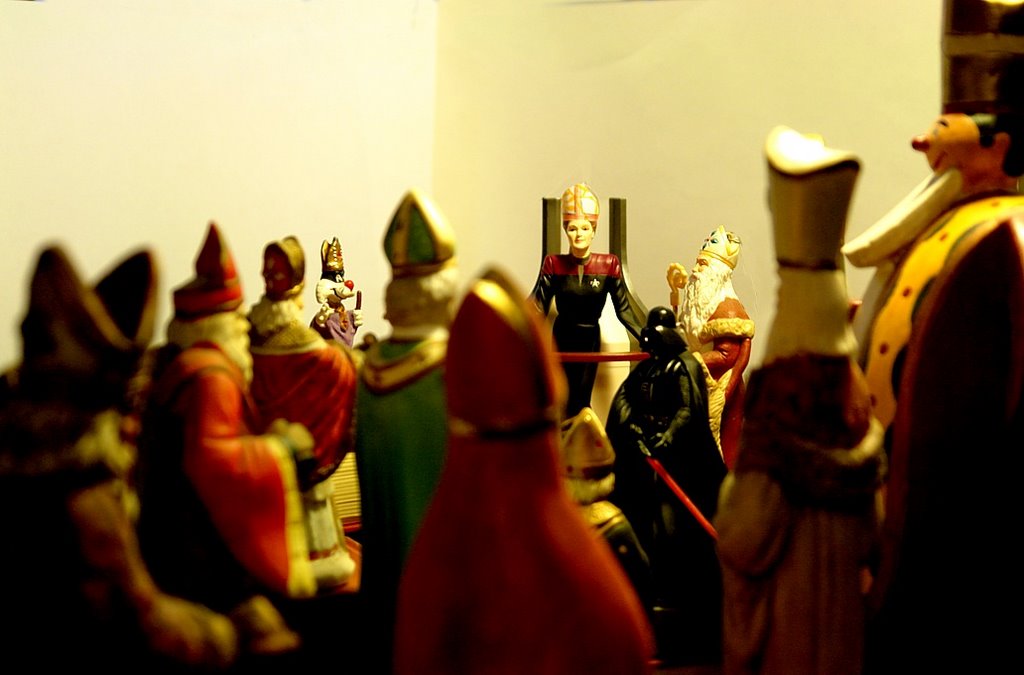
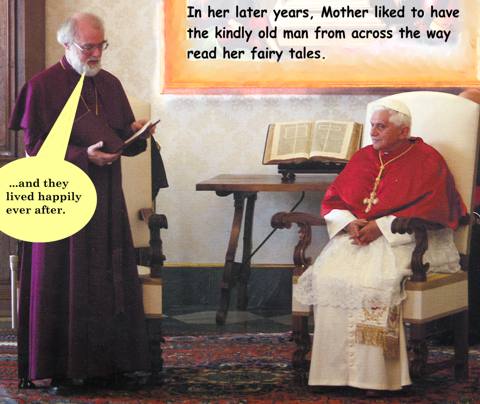
Now, all that being said, it is still time for Friday Satire. So, without further ado, and without wishing to tear down any good feeling that may have been built up, but also unable to resist the influence of my inspired Photo-shopping colleague from across the pond, MadPriest, here is the protected speech of the afternoon. Just remember, in spite of all appearances to the contrary, I live in hope!

Tobias Haller BSG


January 16, 2007

Nothing will be lost...

Meditation for Wednesday
in the Week of Prayer for Christian Unity, 1994

The Society of the Atonement at Graymoor

Genesis 9.8-17; Psalm 148; Romans 8.18-23; John 1.1-5,9-14

Tobias Stanislas Haller BSG

Beloved sisters and brothers, let me tell you a mystery.
Nothing will be lost. All will be restored.
In the economy of salvation, nothing goes to waste.
Our God is not a God of acceptable losses.
Nothing God has made deserves God’s hatred.
Everything that is was created in love.
Each atom, every blade of grass,
and most of all each human soul,
reposes in the assurance of divine, unalterable love.
Nothing will be lost. All will be restored.

The whole creation groans,
subjected for a time by the divine command
to wait on tiptoe and in expectation:
waiting for the children to grow up,
waiting for the children to inherit,
waiting for the glory to be revealed.

For glory came down from heaven,
and hid itself within a tiny child,
a child some tried to kill,
a child some tried to ignore,
a child that others worshiped,
a child destined to be the rise and fall of many
not just in Israel but throughout the world.
The glory hid itself,
but could not hide itself for long.
It shone as light in darkness,
and the darkness could not hold it in.
The darkness tried to turn its back,
the naughty children hid their eyes and said,
“You can’t see me,”
but the light was so relentless,
it was so strong it shone right through the darkness.
The darkness never knew what hit it;
for when the light was come, the darkness wasn’t darkness any more.

Beloved, nothing will be lost.
All will be restored.
Creation groans, waiting for the promise,
waiting for the branch to bud and blossom and bear,
waiting for the children to inherit,
waiting for the children to stop their fighting,

waiting for the children to open their eyes
to behold the glory shining from each others faces.

“Never again,” God said, “never again;
I’ll never kill you all again.
Never again will water wash a world away.
I promise you, and set the contract in the clouds,
the covenant in the storm-cloud,
my Name in shining light.
I’ll keep my word; my word is good.
It lasts for ever.
I will do more.
I’ll send the Word,
I’ll send my Son to seal the contract with his blood,
blood shared with you
— your blood, your human blood.
Nothing will be lost. All will be restored.”

“All? All?” I ask. “What, all?
Even those who turned their backs?
Even those who through free will
rejected you, the Will that gave them freedom?”
“Yes,” says the Lord, “all will be restored.
Nothing will be lost.”

“How, Lord?” I ask.
“How will they be redeemed
who turn away? How will their blind eyes see?
How will their hard hearts melt?”
God answers patiently,
“Love will turn them ‘round.
My love turns stars, you know,
it turns the universe;and though a human heart is heavier in my eyes
than a thousand, thousand white dwarf cores,
my love will turn it; wait and see!
All will be restored. Nothing will be lost.”

“When, Lord?” I ask.
“When will the wound be healed?”
“Don’t you know, my Child?” God answers.
“The healing has begun.
It started with the coming of my Son.
This was the new beginning,
just as long before,
when through him all that is was made.
You should have seen it!” God laughs softly.
“It only took the gentlest touch,
the merest breath of Love
to start the universe to being.
The quarks began to sing,
the particles to spin,
the forces to divide
under the strong even pressure of his compass.
The angels were impressed.
The Spirit hovered, kibitzing,
offering suggestions
for the value of Planck’s Constant
and the speed of light,
and recommending
that space would be more pleasing
with a gentle curve.
It was a good week’s work,
when the Word made the world.
And so it will again.
The healing has begun.
Nothing will be lost.
All will be restored.”

“Is it really that simple?” I ask.
“Can the wound be healed with a touch?”
“The healing will take a bit longer,”
God answers, then pauses.
“O.K., I’ll be honest; it’s you subcontractors,
the partners in redemption with my Son.The specifications are clear,
‘Love God and each other,’
and the plan is concise:
‘one house, many mansions.’
But you seem so intent on constructing outhouses,
rock gardens and car parks!
Instead of a banqueting hall
you construct fast-food stands!
There are times I regret I extended the work force
past Yahweh & Son.
But what’s done is done.
The only thing in all my creation
I don’t mind losing is time.
I’ll have the job done right
if it takes forever,
and we’ll keep at it together until we get it right.
I am not a God of acceptable losses.
I won’t cut corners;
cost overruns don’t phase me.
Nothing will be lost.
All will be restored.”

And so, my beloved in Christ,
I give you this word:
now is the time for the children to grow up,
now is the time for the heirs to inherit.
Nothing will be lost.
All will be restored.
And now is the time.
The whole world is waiting,
the stars hold their breath,
the wild beasts and cattle regard us with growing impatience,
the birds hover over us, the fish all tread water,
the trees shrug in wonder, or stand limbs akimbo,
and deep in our hearts
God’s Spirit is groaning:
“Be reborn, beloved, become what you are
and the world will be free.”
The Spirit is crying:
“Look up to the light, your hearts will be whole
and the wound will be healed.”
The Spirit is singing: “My children, my children are home!”


January 15, 2007

MLK-Day in the Bronx

Martin Luther King jr Day had been a big event in the beautiful Bronx for a number of years, as our congregations (all 23 of them) join together for a festive celebration in a different parish each year, usually followed by a wonderful feast. At this gathering (and on the Sunday before) a special offering is taken up to support the MLK jr Scholarship Fund of the Bronx Council -- which supports young people with modest grants for their first year in college, as recommended by the parishes and chosen by a board.

This year was special, though. Not only were we gathered at one of the city's oldest church buildings (and the Bronx's oldest) -- St Ann's in the South Bronx -- but we had the special joy of our Primate and Presiding Bishop Katharine Jefferts Schori being celebrant and preacher. And all I can say, echoing Barbara Harris is, "What a time, what a time!" The fairly sizable church was filled to capacity -- and as Bishop Don Taylor noted, the congregation represented "a microcosm of your [++KJS's] Province" with faces in every complexion, representing several different languages, and a number of countries of origin. It was a grand celebration, and Bishop Katharine's message was "spot-on" -- as was the gift to her from the joyous gathering: prayers for strength through the coming days and months and years.

As Dr. King said, "How long...? Not long!" God is at work, people; and let the people say Amen!

January 12, 2007

Beginnings, Ends, and Friends

a sermon first preached at the Church of the Ascension, Manhattan, on the Feast of St Aelred 2004

Paul wrote to the Philippians, “Let each of you look not to your own interests, but to the interests of others.” And Jesus told his disciples, “This is my commandment, that you love one another as I have loved you.”
In all the struggles with which the church has struggled during the last few decades, nothing has stirred the pot so much, raising it from a simmer to a boil, as the vexed matter of human sexuality. The problem with our vexation is that we have focused so much on the aspect of humanity which is not uniquely human — sex — and largely ignored the aspect of human nature that is (as far as we know) unique to human life: the capacity for self-giving and self-sacrificing love. This vexation and ignorance are no help in keeping our kettle from boiling over and making a mess of our ecclesiastical stove-top.

For conservatives in particular sex is almost always “the problem” — for at the same time they want to talk about what is “natural” they also want to preserve a strong distinction between humanity and the rest of nature. Thus, as archconservative Archbishop Akinola of Nigeria said concerning homosexuality just a few months ago, “Even animals don’t do such things.” Obviously the arrogant Archbishop is ignorant of the well-documented same-sex behavior among scores of animal species. But then, he and those who take his point of view aren’t interested in nature and whatever truth it might reveal to us; for they are quite content, upon being shown that animals do engage in such behavior, to turn around and accuse gays and lesbians of being “inhuman” for acting like animals — so I suppose in their view we really are neither fish nor fowl — nor human! — and shouldn’t even exist. As the wife of one of the bishops at Lambeth put it, that would be the final solution to the whole problem — “We don’t have homosexuals in Africa,” she said, “because we kill them.”

Though they might reject such genocidal homophobia, even more moderate conservatives display a similarly perverse exaltation of natural law that takes no account of real nature. For instance, as Roman Catholic moral theologians put it, Human sex is distinguished from animal sex in that only human sex leads to the birth of human beings. This surely qualifies for the theological “Duh” award of the decade. And while those who advance this triviality as if it were a helpful insight do so to preserve the dignity of human personhood — which of course only exists in human persons — in the end they are left with a dehumanized biological determinism, in which the primary good about a married couple is their fertility. This reasoning ignores the facts that not all heterosexual sex (even in the most loving of marriages) leads to the generation of new human beings — nor do we grant marriage annulments at menopause; nor are all heterosexual relationships loving; and some of those that are least loving may be the most fertile. It is not our capacity to breed — even to breed humans — that makes us human.

When one thus eliminates fertility and the creation of new human beings from the discussion, the conservative argument shifts in an enthusiastic appeal to a surmised “complementarity.” This circular argument limits the only legitimate human “other” for appropriately human relationships solely on the basis of the so-called complementarity of the sexes. In doing so it again reduces all human beings, male and female, to the status of mere prongs and holes, as if we were nothing more than the loose ends of biological extension cords, plugs and sockets designed to pass along some kind of live current, without regard to what that current is or is for. One conservative writer waxes eloquent on the imagined “fit” of male and female, which he says is like the fit of hand and glove: of course, notice who the glove is, and who the hand; women sure must get tired of being portrayed as accessories! So this supposedly noble effort to exalt human nature also ultimately undercuts human dignity.

These arguments also betray a kind of genealogical fixation— as if what most makes us human is our birth, rather than our life, as if the beginning of human life is all that counts, and not the human life lived to its human end; as if Genesis were the end of the story rather than the beginning. And it is this story which I wish to revisit and comment upon today.

I do this, in part on the basis of an appeal to our animal past, and the claims of nature, but more on the basis of the Gospel, and its supernatural claims upon our human present for our human future.

For what the Gospel shows us is the astonishing truth that love is unnatural. I’ll say it again: love is unnatural. Put another way, love doesn’t come naturally: perhaps that sounds less threatening! Love has to be urged and commanded. You have to work at it. Left to our own devices, our animal natures, the drive for life we share with all living things, we would seek only our own self-interest, only our own wants and needs, or at best the wants and needs of our species, as if human life were only meant to produce more human lives; as if we were nothing more than organic copy machines driven by our DNA to produce more DNA-producers, in some ways no better than a particularly large and noisy virus infecting the surface of the globe.

This driving energy, what the romantics used to call the “life-force,” is not love. On the contrary, “The force that through the green fuse drives the flower,” and drives the upbuilding of the universe is love’s opposite: self-interest, self-preservation, the survival of the fittest, call it what you will; this is the force that drove the rise of the universe from quarks to dust to stars to cells to animals and finally to us; it is this property of self-cohesion and self-preservation, the redundancy that what endures endures, and (as Doris Day sang) what will be will be, and that only what can reproduce will reproduce, that drove and drives the natural world. And although this leaning towards self-interest can take evil forms — Saint Augustine once said if you needed any proof of original sin, just watch a baby for a while — the tendency to self-interest is not evil in itself, even in human beings.

God, after all, created it as the means to build up the creation. God created the natural law of self-interest that alone could lead to the complexity capable of sustaining life. God provided nature with this inclination to self-preservation, and we have inherited it as part of our nature. So it is not evil in itself: as the rabbis taught, were it not for the yetzer ha-ra, the inclination towards self-interest, no man would build a house, or take a wife, or start a business.

But, as we know, when this drive predominates we get into trouble: and we’ve been troubled by it for a long time, from the moment we became aware of it. As the old, old story goes, it was the impulse to self-preservation that both drove Adam and Eve to their primal act of self-assertion, and convicted them with the knowledge of what they had done, when they fell into the knowledge of good and evil, the naked consciousness of the needy and assertive self, and knew what they had done, and what they had lost.

But they also learned what they still had. For in their fall they became aware that God had already given them something else, the good they weren’t aware of before they chose the evil, indeed before they knew the difference. God had balanced the force that launched the world at its genesis with another more personal gift.

God had imbued human hearts with love: which is not a creature, but the image of God’s self. Love is the gift which gave us the capacity to see and feel beyond our needs, beyond the needs even of our family or clan or society, the knowledge that we are not simply creatures living off each other, but creatures living for each other; that life is not based ultimately upon need but upon gift, and that life is not about the accumulation of assets and the preservation of the self or the species, but about the compassionate generosity that sacrifices even life itself for the sake of the beloved. God made us human, when to us, out of all creation, he gave this incredible energy that goes by the name of love. It is love itself, unnatural and counterintuitive love, which at its greatest sacrifices even its own life so that the beloved might live; it is love, the gift of God and the supernatural spark of the divine likeness that glows within each human soul, that makes human life truly human and most truly alive. It is love beyond price that makes life worth living, and worth giving up.

And when the time was ripe, God showed us this love in person, perfected in Jesus, who commands us to love each other the way he loved us: which is to say, not for what he could get out of us, but for what he could give us. God’s love is not based on need — God doesn’t need anything — but is rather God’s gift, stemming from God’s own nature, God who is love. The natural law of self-interest was merely God’s creature used to build up creation. But love is God’s self: and the love of God is not about transaction, but incarnation.

And when he had taught us this, we ceased being mere servants — who do as they are told but do not know why — and became friends, who do as they are commanded not in ignorance or out of fear, but out of trust, and in the knowledge of the love of God, who gave us life at our genesis, and gave us life again in the revelation of the Son of God, the beginning and the end, who became not only our savior, but our friend, who shared our life and of his great mercy allowed us to share in his.

* * *

This is the gospel truth as Jesus spoke it, the gospel truth that Saint Aelred of Rievaulx preached and lived. He did it in the setting of the monastery, among men committed to a life of common prayer and work, and most of all of unnatural love: the deeply unnatural love that Jesus commanded, the love that gives itself up and places others first, that sees other people not as means to an end (however good or exalted that end might be) but as ends in themselves, icons of Christ and images of God, and above all, as friends.

Now, let there be no doubt that whatever the experiments of his youth, in his later years we can rest assured that Aelred took the vows of celibacy seriously, both for himself and for the monks under his charge. But he also knew that human affection is a great gift, a gift that requires expression, and allowed his monks the familiarities of friendship that sterner ascetics would have found scandalous. Aelred walked that middle way between the biological determinists who saw human beings only in terms of their capacity for breeding, and the gnostic dualists who — misunderstanding the incarnation itself — wrongly thought they could escape the realities of their own embodiment. And so he allowed the signs of friendship to flourish in his monastery. And the monastery, the school of charity, became in its time, the preserver of the world. Not because it set out to do that, not as a means to an end, but because it was full of the love of God.

* * *

Today we have a great opportunity, not just to keep our ecclesiastical kettle from boiling over, but to preserve the world anew, and to teach the mystery of charity to a world hungry for love but steeped in self-interest. Our world has forgotten Sirach’s wisdom, that true friendship is beyond price and cannot be bought or sold in the marketplace.

And I firmly believe that gays and lesbians — whether they have legalized their domestic partnerships, had their unions blessed, or gone off to Canada to get married — can be teachers in this new school of charity for the church and the world, to offer a teaching as powerful as what the monastery taught in the days of Aelred.

And I don’t just mean more Queer Eye for the Straight Church — we’ve been there and done that for centuries; writing the hymns, playing and singing the music, crafting and leading the liturgies, designing the buildings and generally making the church more attractive than it would have been without us. No, what I mean is far more serious and far more challenging. I’m talking about the practice of the presence of God, who in Jesus Christ commands us to love each other as he loved us, with the love that does not abide in relationships built on quid-pro-quo or cost and benefit.

For I believe with all my heart that same-sex couples not only can show forth the great mystery of mutual love as well as different-sex couples do (or fail to do), but may well be able to do it better, and with greater freedom. Free from the shackles of biological determinism by which human cultures have falsely and conventionally come to believe that men and women are naturally and separately suited only for particular roles and destined as means to particular ends, we can emphatically declare and show forth in our lives that human beings are not roles, nor are they means to an end: whether that end be the brief spasm of sexual release or the procreation of a family, the maintenance of a home, or of a society. For as long as marriage is seen primarily for what one gets out of it: as a contract for the interchange of property or the grant of rights, for the building of a family or a home, for the maintenance of the social status quo — rather than for what goes into it: as a covenant of the mutual gift of two persons to each other for no reason other than for love, as long as we see the union of two hearts and minds primarily for its extrinsic worth rather than for its intrinsic value, it will be branded with the hallmark of commerce, rather than blessed as the sign and sacrament of generosity.

Such true freedom and mutuality are difficult when church and society still harp on what they call “appropriate” roles for men and women, when they place their trust in a nuclear family that even at its best was not the means by which God chose to enter creation when the time came to come among us as one of us. True freedom and mutuality are difficult when people talk the talk of self-sacrifice, but walk the walk of imposing sacrifice on others — and how many women have been told it is their natural lot to suffer in silence when men take advantage of them or neglect them, all in the hopes that it will make those men more “domesticated.” True mutuality is most difficult precisely when people are perceived to be unequal, complementary or incomplete.

And this is why gays and lesbians, free from any necessary or conventionally preassigned roles, can staff the school of truly mutual love and friendship, most especially love nourished by friendship.

And, my friends, the greatest irony of all is that such loving relationships, same-sex and different-sex, will save the world, just as the monasteries did through the troubled times of the middle ages, not because that is what they set out to do, not as means to that end, but because God wills it so, and has willed it so from the beginning, when he saw that it was not good to be alone. For just as only self-interest could build the world, only love can finally save and preserve the world. The rabbis were right: the yetzer ha-ra, the inclination to self, plays its role in building up the world; but love is at the heart of tikkun olam, our partnership with God our friend in preserving and bringing to perfection the great work of creation. As Saint Paul’s spiritual grandfather Rabbi Hillel, reflecting on both the inclination to self and the love of others, said, “If I am not for myself, who will be? But if I am only for myself, what am I? And if not now, when?”

Christ has done us, you see, the great honor of calling us friends, friends of God in Christ and friends of each other. Friends, not servants: no longer in the dark about our friend Jesus’ plan, no longer fallen but raised to new life in him. As God is our true beginning, so too this is our true end: to honor and love God in each other and to find ourselves transformed in this honor and this love. Out of this love a broken world is pieced together, and all illusory divisions lose their capacity to divide — all of them — each and every one: and there is no more slave or free, or Jew or Gentile, or male and female, but all are one in Christ our friend. With this powerful and God-given spirit of friendship, this spirit of encouragement, this consolation and compassion, let us, at the commandment of Christ and following his example as friends together, of the same mind, having the same love, heart to heart and hand in hand, show the world, beloved, what love means. And if not now, when?


— Tobias Stanislas Haller BSG

January 8, 2007

Leviticus and the Anglican Deformation

a comment in response to Ashley Null’s “Thomas Cranmer and the Anglican Way of Reading Scripture,” Anglican and Episcopal History Vol LXXV No 4, December 2006, pages 488-526
Canon Ashley Null has written a helpful commentary on Thomas Cranmer’s way of reading Scripture as part of a broader search for a distinctively Anglican approach to Bible-reading. I am happy to say that in large measure the approach Canon Null summarizes at the end of his article is remarkably similar to that which my co-authors outlined in our 2002 paper “Let the Reader Understand.” (This document is available on the website of the Episcopal Diocese of New York.)

Null affirms the obvious truth that a particular approach to Scripture is embedded in the “historical Anglican formularies” — but he gives, in my opinion, a bit too much credit for this to Thomas Cranmer, and inadequate weight to the interplay between Cranmer and the other bishops and scholars of his day, and the crucial adjustments and alterations made to these formularies in succeeding generations. He takes note of Elizabeth’s addition of authoritative weight to the church in matters of controversy — surely the point at which an authority is needed — but fails to note how very much this undercut Cranmer’s main agenda — to downplay the church’s role by expanding that of Scripture. (Null 520) One might also add that one of the things Cranmer was most eager to remove from Biblical discussion — the scholastic tradition — shortly found its way back into classical Anglicanism via Hooker’s reliance, for good or ill, on Aquinas’ methods and the theories of natural law. By emphasizing Cranmer’s admittedly central role, and neglecting these and other later developments in the interest of recovering a “thoroughly Protestant” voice for the “historical formularies” Null engages in a subtle kind of dispensationalism, not unlike that which Cranmer himself applied to the understanding of Scripture.

For Cranmer was, as Null points out, an ardent defender of the notion of the Scripture-over-the-church — opposed to the Catholic notion that “defended the priority of the church over the Bible.” (Null 495) Cranmer accepted his favorite theologian Augustine’s teaching that the witness of the church certified what was Scripture and what wasn’t — but Cranmer held that this power belonged to the ancient church alone. Even at that, as Null duly notes, the church’s power was strictly limited, and did not allow even the Apostolic church to be a vehicle for revelation. The church was to be the interpreter, not the speaker, of the heavenly message of salvation once set down. Cranmer allowed even the Apostles only the same capacity he allowed the later church: establishing ceremonies and changing only those traditions not based on God’s moral commandments.

Cranmer also minimized the role of the larger church in interpreting Scripture, advocating as his primary tool for understanding Scripture a method by which one part of Scripture illuminates another and witnesses to a coherent gospel within the enlightened mind of the faithful reader; as the Homily on Scripture put it: “there is no thing spoken under dark mysteries in one place, but the self same thing in other places is spoke more familiarly and plainly.” These themes echo through the Articles, the Collects, and the Homilies, and represent a thoroughly Cranmerian — and Anglican principle.

* * * * *

Unfortunately, this idealized theory falls down in practice, and it has since the time of Cranmer himself; which is why, in succeeding generations, beginning with the Elizabethan revision, the formularies of Anglicanism have been amended and refined — and in some ways fundamentally altered — in practice if not in form. Ecclesiastical dispensationalism — an effort to find ad fontes some “pure” Anglicanism, begs the question of what Anglicanism is today, and even more what it is to become. For if Cranmer, why not Ridley and Jewel; why not Hooker, Laud, Maurice, Pusey, Temple, and, dare we say, ourselves? The church is not simply a source, but a continuing stream, and that living stream has many tributaries that join it along its course, and add their unique contribution to what we now call “Anglicanism.”

The primary flaw in Cranmer’s theory of the self-explaining Scripture — and the primary reason scholars such as Hooker added an authoritative role for the church — lies in his two-fold failure adequately to understand the nature of revelation itself, and to give proper dignity to those who receive it. For revelation is always revelation to — God does not speak (except at the moment of creation itself) into the void: rather the Word that goes forth “accomplishes that which God has purposed.” (Isa 55:11) And the Word of God is efficacious precisely because it is “read, marked, learned, and inwardly digested” — and the “body” that does this is the church, only beginning with the individual Christian but finding its true locus in the larger community, as the Word cooperates with human flesh in its coming into activity.

This is no novel post-modernist observation dependent on communication theory, but lies at the heart of the Scripture’s own testimony to itself, as well as the method of the church up until Cranmer’s essentially hopeless effort to recover a “pure” method of biblical interpretation, in which the plain meaning of Scripture would be obvious to each, as if protected from abuse by the meddlesome all: the church. Jesus himself advanced the idea later discerned by communication theory: communication requires a recipient. Jesus the Word incarnate portrayed this parabolically in the famous image of the sowing of the Word-as-message: the sower broadcasts the seed over all sorts of terrains, only some of which receive it, where it comes to bear fruit —even as it dies (John 12:24). Broadcasting requires a receiver if it is to “accomplish that which is purposed.” We are after all surrounded at every instant by countless radio waves — but they only become music when received and amplified. In this case the church — in its individual members and in the broader community of faith — is the body which faithfully receives, amplifies, and interprets the message of God transmitted through Scripture. Ironically, pace Cranmer’s peculiar eucharistic theology, receptionism is a far more accurate representation of the church’s engagement with the Word in Scripture, than of the individual believer’s encounter with the Word in the Eucharist — for it really is only in the reception of the Scripture by the church that it truly lives.

To a certain extent Cranmer acknowledged all of this — and the Homilies even make use of the figure of Philip offering timely help to the Ethiopian as testimony to the church’s role in unpacking hard Scriptures. But with the temper of an idealist and an individualist Cranmer resisted the obvious implications of the need for some authority external to the Scripture, suggesting instead a supernatural enlightenment attendant upon continued prayer and study, and sifting of texts.

Where this conflict of ideal with reality came to a head was in the limitations Cranmer placed on the church in its role as the “keeper of Holy Writ.” It is all very well to say that the church is bound not to ordain anything contrary to Scripture, and not to require anything as necessary for salvation that cannot be proved from it; and that the church has the authority to change rites and ceremonies instituted only by human authority, but not the moral law. The problem — recognized and addressed by Hooker — is that without the voice of the church speaking authoritatively as to the intent, meaning, and effect of Scripture, individuals and sects will come up with all sorts of private interpretations — even when they use the method of intertextual comparison advised by Cranmer, or simply read diligently and pray for enlightenment. As Hooker would say, there must be a final authority in the church in order to have some end of contention, even as to the meaning of Scripture itself.

* * * * *

The failure of Cranmer’s method — and the proof that even supposedly pure methods are capable of deformation under the influence of extraneous agendas — is revealed in a superb example which Null cites for other reasons: Cranmer’s misunderstanding the Apostolic Council in Acts 15 — in which he placed his own judgment (and the judgement of those of his contemporaries who shared his view) over that of the Apostles themselves. In this we see Cranmer (and his church) doing the very thing he thought the church incapable of doing.

In his understanding of Acts 15, the conclusion of the Apostles — that Gentiles were to abstain from fornication (porneia), food sacrificed to idols, the meat of strangled animals, and blood — a decision which the Apostles themselves attributed authoritatively to the Holy Spirit (15:28), was to be rejected as far as the latter two items were regarded, as these were merely ceremonial and dietary, while the first — the prohibition on porneia — was to be understood as part of the eternally binding moral law.

According to Null, Cranmer and the team of scholars summoned to address “the King’s matter” understood the prohibition on porneia to be related to the sexual laws of Leviticus 18, seen as

universal moral commandments that were still biding on the faithful under the New Testament, since these regulations defined the nature of the sexual immorality forbidden by Paul’s epistles and Acts 15. Cranmer owed his place on the king’s team to his sincere insistence that any honest academic would recognize the truth of this understanding of Leviticus. (Null 498)
The problems with this thesis begin with the determination that the prohibition on blood was merely a ceremonial or dietary commandment, set down by human authority — these being the only commandments Cranmer believed capable of alteration even by the Apostles themselves. As I pointed out in an appendix to “Let the Reader Understand” the blood prohibition was given to Noah directly from the mouth of God in Genesis (9:4), and therefore was held in Jewish tradition as binding on all humanity. This prohibition was repeated in the Law of Moses (as a “perpetual ordinance” in Lev 3:17, 7:26-27; in 17:12-14 with specific reference to resident aliens as well as the people of Israel, 19:26; and in Deut 12:16,23; 15:23). The prohibition was observed in the historical period (1 Sam 14:34), and later noted by Ezekiel in conjunction with other grave sins (33:25-26). Most importantly it was affirmed by the Apostles — who, it must be presumed, knew that the Lord had set aside the dietary laws, and that this was a different matter entirely. Moreover, the prohibition was continued by the post-apostolic and conciliar church, in some places up to the present day.

So much for what Cranmer set aside. The situation was rendered the more inconsistent in what he chose to retain: asserting that the Apostles were thinking of Leviticus 18 when they forbade porneia. This is singularly odd since none of the sexual crimes described in Leviticus 18 are referred to as porneia, a word (in its various forms) which in the LXX version of the Old Testament is restricted to prostitution or (by metaphorical extension) idolatry. Surely the context of the decision in Acts would suggest one or the other as being at issue — and although idolatry is alluded to in Leviticus 18 by reference to Molech and the use of“abomination” (to’evah, a term intimately connected with idolatrous cults) porneia is not mentioned.

Null does not explore these contradictions, however, nor does he expound on what led Cranmer to focus on the 18th chapter of Leviticus in the first place, and instead returns to his theme of the various authorities to be ascribed to the church and to the Scripture itself. This leaves a hanging question: Why Leviticus 18 and not 19? For the latter chapter is of much more obvious relevance to the matter at hand, and of more evident weight through its dependence on the Decalogue. Chapter 19 expresses high moral principles — and also includes the prohibition on blood (26), and (unlike chapter 18) a specific reference to porneia (29). Why should Cranmer argue that the Apostles were thinking of Leviticus 18 (which has no obvious connection with their decision) when their action has clear connections with the following chapter?

* * * * *

Clearly the Apostles were thinking no such thing, but Cranmer was. The wonder is that he bothered addressing the overturn of the blood-prohibition — and that Null sees fit to go into it, since it rather undercuts Cranmer’s emphasis on the authority of Scripture-over-the-church. For Cranmer’s church (that is, the scholars and leaders of mid-16th century English Protestantism) held that it was only within their power to set aside or alter “rites and ceremonies established by human authority” — but, most importantly, assumed an unspoken power to decide which items belonged in that category. And once they granted themselves the capacity to declare any given text of Scripture — in spite of what the text itself said — to be merely a human invention or commandment, it was a simple matter then to set the offensive commandment to one side.

But why did Cranmer — with his ostensibly high regard for Scripture — run upon this particular ground? Why bring up the overturn of the blood prohibition (unless perhaps to take some heat off of his favorite theologian Augustine of Hippo, who was among the first to seek the overturn of this ancient commandment)?

But more importantly, Why this peculiar emphasis on Leviticus 18? There was a reason for Cranmer’s focus on this chapter, and it represents the powerfully deformative force that political agendas can have on even the most pious. It all comes down to one verse: Leviticus 18:16 — “You shall not uncover the nakedness of your brother’s wife; it is your brother’s nakedness.”

Let us not forget the reason and by whom these biblical scholars had been assembled: Henry VIII had married his late brother Arthur’s childless wife Catherine of Aragon, and the Cranmerian team were marshaling any argument they could find to end the marriage, including that it violated the timeless and eternally binding law from Leviticus.

Rather than use his own method and apply the most obvious text relating to a coherent understanding of this law, and addressing the specific exception to it granted at Deut 25:5-9 (whereby a man is expected to marry his brother’s childless widow in order to raise up an heir — an exception eminently applicable in Henry’s case, as it related to the continuation of the succession); failing to note that Jesus had ample opportunity explicitly to overturn the Deuteronomic law in his confrontation with the Saducees (Mar 12:19, Luk 20:28), Cranmer’s team stuck with Leviticus, for they were interested only in adding weight to this commandment, not in taking any away. They were driven by an agenda — not their own, but Henry’s. Cranmer was, after all, tasked with finding a way to legitimize a second marriage (already anticipated in an adulterous relastionship) on the basis of divorce or anullment, the former rather clearly at odds with any coherent reading of the Gospel, and the latter unknown to it. And so they bolstered the commandment in Leviticus by settling upon the decision of the Apostles in Acts 15— a decision they had also undercut in the furtherance of Cranmer’s other agenda: the diminution of the authority of the church.

* * * * *

Since closer examination of this treatment of Acts 15 hardly builds a strong case for Cranmerian consistency, one is forced to ask why Canon Null brings it up. His article comes at a crucial time in the development of Anglican self-understanding, in particular a wish to outline an Anglican way with Scripture. To do so, Null brings up Cranmer’s treatment of Acts 15, including the assertion that the Apostles were against porneia as outlined in Leviticus 18. However, as I’ve shown, on close examination this did not advance Cranmer’s biblical agenda and teaching (that the Apostles were not to be held authoritative on the blood prohibition, even though they ratified Leviticus 19), but served only his royal agenda (whereby he claims Apostolic ratification of Leviticus 18 as a matter of universal moral law.)

Just as at the first English Reformation, an appeal to Leviticus 18 is now being made in our present Anglican Deformation. It is a different verse this time, 18:22, which is again being subsumed by some under the Apostles’ decision at Acts 15. Some, such as Robert Gagnon, go further and suggest that Jesus himself referred to Leviticus 18 when he spoke of porneia in Mat 15:19 / Mark 7:21 — interestingly enough, in the context of setting aside the dietary laws. Jesus did indeed distinguish between the eternal laws of God and the commandments of men — including commandments given by God through Moses (such as the one allowing for divorce, Deut 24:1); but Jesus supplied a touchstone for making the determination as to which was which: not consistency with some other biblical text (as Cranmer suggests) but rather consistency with the eternal law of Love of God and Neighbor.

The need on the part of some with a particular agenda to broaden the scope of Leviticus’ admitted condemnation of male-male sexuality among Jews in the Holy Land (as the leading scholar in the field of Leviticus, Jacob Milgrom, accurately describes it) into a timeless moral requirement binding forever on all humanity (including, apparently, women, significantly missing from the Levitical text) — and the need to summon up dominical support for this commandment — is deforming rather than reforming the Anglican Communion today.

Rather than looking for guidance to the moral principle laid out by Jesus — loving ones neighbor as oneself, and giving oneself for the welfare of others — cultic regulations and selected sexual offenses of ancient Israel are elevated to a status unwarranted by either moral or ethical principle, while others are hastily explained away. This is not the way forward.

We need honestly to face the fact that the vast bulk of rites and ceremonies and moral laws of ancient Israel were based on a direct ordinance of God recorded in the Scripture. Ancient Israel made no distinction along Cranmerian lines, and the laws are found interwoven throughout the Torah, and serious penalties are attached to some plainly “ritual” acts. Further, many, if not most of these commandments and ordinances were not overthrown by Christ, or by the early church. Their overthrow came only with the passage of time, in part upon application of Cranmer’s principle of distinguishing between ritual and morality, or a general presumption of lack of current applicability.

And in this one sense Cranmer was right: the church does have the authority to set aside commandments — not only the ones made by human authority, but the ones which even though placed in the mouth of God by the Scriptural authors, can be determined to reside only upon human culture and human agendas and human failings. Ultimately all of Scripture comes to us through human agency — and it is no good idealistically pretending otherwise; to do so is to turn the Scripture itself into an idol. The Scripture is not the Word of God spoken, but the Word of God written — and in all cases apart from the purported engraving of the original Decalogue, the writing is made by human hands. For Israel in its long wanderings, for the church in its pilgrimage, and for us today, the Scripture is an instrument through which God’s will is made known, but an instrument which must be played: and the people of God are the musicians.

Cranmer was quite right to hold that the prohibition on blood was no longer binding — but not because the Scripture described it as a human institution. Rather it is clear that the Scripture contains a great many such cultural artifacts and beliefs which, despite the self-authenticating claims of Scripture, will not stand against right reason, and will not stand against the Gospel standard for all morality, given by Christ himself: to love neighbor as self, and do for that neighbor what one wishes for oneself: as Saint Paul observed, such love fulfills the law. (Rom 13:9-10)

It is this reason and this love which the church today is called upon to exercise: to look with eyes enlightened by an understanding of culture and the human capacity for hatred of the other, and to turn aside from the cultural norms of a defunct world, and embrace the Gospel imperative given by Jesus Christ for the life of the world to come.

It is to be hoped that all of us can return to the principles that Canon Null summarizes at the end of his essay, which echo the conclusions of “Let the Reader Understand,” and which form a core upon which to build a sound biblical understanding and engagement. As I would rephrase them here:

  • that our understanding of Scripture be unified around Christ and his commandments — primarily the commandment to love;
  • that our reading of Scripture nourish our hearts and minds;
  • that the Scripture empower our personal and corporate repentance and reformation;
  • that we remain true to the whole Scripture in its redemptive context and avoid the agenda-driven approach that sets texts against each other, and against our sisters and brothers; and
  • that we rejoice thereby in the restoration of the divine image in humanity, empowered to mission for the good of the world for which Christ died.

— Tobias Stanislas Haller BSG


I welcome comments on this reflection, but reserve the right to moderate comments posted here. I would respectfully ask two things:

1. That those who wish to comment anonymously at least adopt a “pen name” if they lack the sense of trust to stand by what they say under their own name, and

2. That comments address the primary concern of this reflection: the authority of the church to determine which portions of Scripture are of continuing relevance. As the character in the Python sketch observed, I am interested in cogent argument, not mere contradiction.
January 6, 2007

Confession of a Wise Man

“... and they went back by another way.”

“Wise men” — I think that’s what you call us now,
and we were wise, according to our lights:
for we spent many long and studious nights
in watching stars, and plotting where and how
and when their influence would be most strong.
Time was I’d chart the future for a prince,
based on his natal day. and then convince
him it was right when it proved wrong.
A charlatan? Perhaps. But once, I cast
a horoscope that caused my heart to stir;
and bearing gold and frankincense and myrrh
my friends and I went traveling, til at last
we saw a sight that made us feel ashamed
at all we’d done before, and warmed our hearts.
And we discarded all our former arts.
Two bright stars by a stable door were framed;
all other constellations seen beside that one
were dimmed: it was The Mother and Her Infant Son.

— Tobias Stanislas Haller BSG, 1984


January 4, 2007

The Archbishop and Camp Allen

The second Camp Allen meeting is under way, though clear word on exactly who is there and what is happening is hard to come by. I remain, however, on another matter, somewhat confused over one phrase in the Archbishop of Canterbury's recent letter, and I don't know if it represents a different understanding of the episcopate in England (or Wales). The passage in question states

I am sure that other Primates, like myself, will welcome the clear declarations by several bishops and diocesan conventions (including those dioceses represented at the Camp Allen meeting earlier this year) of their unequivocal support for the process and recommendations of the Windsor Report.
Now, I may be confused (once again) by the Archbishop's prose, and he may be referring only to bishops from dioceses whose diocesan conventions have taken some action in support of the Windsor Report -- and to which he refers immediately prior to his parenthetical insertion. But he seems to be speaking more broadly here, as if to suggest that dioceses are represented by their bishops even when they have not specifically been asked to do so.

I can find no indication of this in our polity: that is, neither the ordination rite nor the Constitution and Canons suggest that bishops have a "representative" role for their diocese; in fact, they sit in the House of Bishops by virtue of their Order, not their Ministry -- and that includes Suffragans and Assistants. The several dioceses are "represented" by the Deputies elected in each diocese -- and even here the "representation" is finessed by the distinction between "delegate" and "deputy."

The ordination rite (for priests and bishops) appears to provide the ordained with a faculty of participation rather than as one of representation in the councils of the church and its governance. As with bishops in the House of Bishops, it is the same with priests in most diocesan synods: who do not do so because they are vicars or rectors, but because they are priests -- and who do not "represent" their parishes; the lay delegates do that.

So in the present case, with the exception of dioceses that have made an explicit statement in support of the Windsor Report, I don't think it right to describe dioceses as "being represented" by their bishops at this meeting -- if ever. I've long believed that the priest's or bishop's role is to speak to, not for the church.

--Tobias Haller BSG

December 29, 2006

Dar Trek II: The Wrath of C.O.N.

Bishop Katharine receives a warm welcome at the Primates' Meeting in Dar es Salaam. ;-)

Happy feast of Thomas Becket, and a blessed New Year!

December 23, 2006

Unity By Division

A leaked letter from the Archbishop of Canterbury more or less confirms the suspicions I outlined below concerning the Primates' Meeting. The Primate of the Episcopal Church is to attend as Primate. But Canterbury is working out how to invite some additional persons from "that Province" to attend a gathering prior to the official Primates' business meeting. (I guess that couldn't include +Minns, since he's not part of "that Province" any more, but part of another Province that will be represented via its Primate. Then again, there is enough logical inconsistency around to bend that principle too.) On the whole, ++Rowan is showing himself once again to be flexible to the point of injuring himself and others. I suppose years from now this era will be known as the Deformation.

The problem grows more serious, of course, in relation to the Lambeth Conference, for which ++Rowan still suggests support for the flawed Windsor Model of Consensus by Subtraction — in which those who disagree are asked not to be part of the discussion. He says, "at the moment, we urgently need to create a climate of greater trust within the Communion, and to reinforce institutions and conventions that will serve that general climate in a global way." Naturally, by not having someone who disagrees at any meeting one can create a greater climate of agreement. Perhaps this should become a new practice for Vestries? After all, comfort levels count for more than discernment, and it is above all important that the troublesome be removed so that the "peace which avoideth understanding" can continue undisturbed.

The problem with this "solution" is that it second guesses the outcome, and works by division rather than comprehension. It represents a kind of "unity by division" that deems, a priori, a part of the body with its own point of view to be expendable in order to preserve a very questionable communion of whatever is left. It is a classically Protestant approach, which is odd coming from a man of supposedly catholic sensibilities. It will produce a Rump Lambeth, and institutionalize a Rump Communion, consisting of those who will not tolerate disagreement.

—Tobias Haller BSG

December 22, 2006

Duty

to KMY

Somewhere a child is crying.
Lord, help me find him
that I may do my duty to my King.
Led by what dark star
to the outskirts of the capital,
as a man under orders,
commanded, I go.

All of them, he said,
up to the age of two.
I passed one by a while back,
perhaps small for his age;
the soldier behind me thought otherwise.

Soldier. Is this soldiers’ work?
Up to the age of two, he said.
The King is a hard man.
It’s no disloyalty to acknowledge it.
You don’t build a kingdom being soft.
He cuts a broad swath, our King.
All of them, he said,
up to the age of two.

It’s quieter now the screaming’s over.
The cobblestones are slippery
and it’s too dark now
to see with what.
But somewhere up ahead
a child is crying.
Lord, help me find him
that I may do my duty to my King.

— Tobias Stanislas Haller BSG
A mirrorwise reflection between Matthew 2.16 and John 16.2


this poem was first published in The Witness online, December 2003

December 20, 2006

The Wounded Soldier's Song

This Monday I attended an ordination liturgy at which Bishop George Packard was the preacher. He mentioned, among other things, the fact that the Iraq/Afghanistan conflict has produced a high incidence of head injuries resulting from concussion as a result of those roadside bombs we keep hearing about with all too much regularity. This reminded me of a project I’ve had on hold for about a decade, ever since studying Hebrew poetry with Dr Richard Corney at GTS. As we were reading the twenty-third Psalm, it struck me that the vocabulary had at least as many military overtones as pastoral ones. Admittedly, this Psalm has a lot going on: there are also Messianic allusions to the rod and staff, the anointing, and the kingly meal in the presence of defeated enemies.

But the line that has always stuck in my mind is the one with the image of a leader laying hands on the head of a wounded soldier — dare I say, “A little touch of Harry in the night.” In any case, here is my first effort at trying to do justice to this “note” in this very rich Psalm, followed by a few critical comments on why I made some of the choices I did.

This is an offering for all the wounded, for all the casualties. May wars soon cease in all the world, and may our only pursuers be goodness and mercy, all the days of our life.

The Wounded Soldier’s Song
a Psalm of David

1. The LORD is my commander,
therefore I lack nothing.

2. In a green field he causes me
to pitch my camp, resting by calm waters.

3. He restores my life;
he leads me on the right track on account of his Name.

4. Even deployed in shadowlands, I fear no evil,
for you are with me; your baton and your staff give me courage.

5. You set up the mess-tent before me in the midst of hostilities;
you salve my head with ointment, and my cup can hold no more.

6. From now on my only pursuers will be Goodness and Mercy;
and I will furlough for ever in the house of the LORD.

Comments

1. commander: (shepherd — noun and verb — is used as a metaphor for a leader; David himself at 2 Samuel 5:2, Isaiah 44:28 = Cyrus!)

2: pitch my camp / resting (menuha is a resting place for the wandering Israelites at Numbers 10:33, and as “quartermaster” at Jeremiah 51:59) - this is a very “dense” verse

3: life: nephesh is the whole self, including the physical body
track: the ruts of wagon wheels

4. deployed: to “go” as one led.
shadowlands: the dark valley; many scholars reject the connection with “death” but this is my compromise
baton: (as in Judges 5:14, the marshal’s staff)

5. the mess-tent: shulhan is “table” but recognizing the (false) Arabic cognate for “a leather unrolled to form a place to gather for meals in the rough,” the sense of a mess-tent is resonant, and I can’t resist it
hostilities: “those hostile to me”

6. an ironic usage — from now on (for all my life) / pursuers — the sense is that the only “hostile pursuit” will be by Goodness and Mercy — no more enemies!
furlough: w’shavti b’beit adonai = I will return in the house of the Lord; one is tempted to say “demobilized” or “discharged” — but the sense of an “endless leave” strikes the note I’m seeking.

— Tobias Haller BSG


December 18, 2006

Plowman's Farewell

Who was that man? I’m busy with my plow;
I’ve rived these furrows twenty years, and now
he tells me, “Follow me” — but can’t say how
or where I’ll earn my bread, or where I’ll stay
to pass the frigid night.
                                          What did he say?
“Foxes have holes but I’ve no place to lay
my head.” Some invitation! On your way,
idealist; perhaps some other day.

Tobias Stanislas Haller BSG
December 18, 2006


December 16, 2006

Ugandan Spin Cycle

Archbishop Orombi of Uganda issued a stern statement the other day, and his Provincial Secretary has issued a "clarification" which says, among other things,

The actual words of the Primates' 2005 Communiqué from their meeting in Dromantine notwithstanding, our understanding of the decision of the Primates was captured in Archbishop Henry Luke Orombi's press release following that meeting: "In our Ireland meeting the Primates suspended the Episcopal Church of America and the Canadian Church until they repent." Therefore, to sit with the new Primate of ECUSA when they clearly have not repented is to surrender commitment and follow-through on a previous decision.
Ah, the delicate sound of postmodern hermeneutics at work. The "actual words" which would appear to say one thing, actually mean quite something else. The "actual words" were
we request that the Episcopal Church (USA) and the Anglican Church of Canada voluntarily withdraw their members from the Anglican Consultative Council for the period leading up to the next Lambeth Conference.
but they mean, "These two provinces have been supsended until they repent." I am forcibly reminded of Humpty Dumpty's comments to Alice: "When I use a word, it means just what I choose it to mean, neither more nor less." At least we know the spin-cycle is still fully functional in Uganda, as the gyre keeps widening.

December 15, 2006

Please Sir, I Want Some More

As a follow up to an earlier post, I am happy to report that in spite of the Anglican Church of Tanzania House of Bishops' statement that they consider themselves in a severely impaired communion with The Episcopal Church, and wish to recieve no further financial or material aid from anyone who does not share their views on sexuality, the program with which my parish, and others in the Diocese of New York, is involved will continue to receive funds.

As I noted in a comment in the earlier post, it is no good saying, "Give your money to someone else" or "Let someone else provide the money who is acceptable." Charity isn't random or general -- it is always to real live individual people. The act of the majority of the Tanzanian House of Bishops will impede real support to certain real people. Children will go hungry, people will die of preventable causes. I am glad to say that one bishop in Tanzania at least has the will to stand up to the prevailing sentiment against receiving help from those with whom one disagrees.

By the way, here are some of the orphans who would be affected by this embargo, were it to succeed. Look upon them, Bishops, and explain your rationale for their hunger.


For more on this and the Bishops' statements on it, see this story at the Episcopal Diocese of New York website.

And pardon me if I appear the slightest bit angry about all of this.

Comment concerning the preceding

Someone has asked me in another forum if this statement by Canterbury is an effort to do an "end run" around requests that Minns be seated as the APO representative at the upcoming Primates' Meeting. Here is what I have to say:

I've long ago given up trying to penetrate the translucent mind of ++Rowan Williams! Even his words are, as you see, orphic.

My guess is that this may be an effort to block an end run by Minns. ++Akinola has basically given up on the Network for their pusilanimous refusal to "leave the burning house," and it is ++Akinola who is in the position to make demands of Canterbury. Not that I think he will be successful -- which is in part the message being sent here. In addition, it may be a reminder or warning to ++Rowan's own Church of England dissidents that this will not fly as a way forward.

I also seriously doubt Cantuar would consider +Duncan as a Primate, since the Network has no standing except as loyal members of the Episcopal Church. Besides, he only gets one plus sign. ;-) (I know the Network has spun ++Rowan's comments into whole cloth, but I think they leave out the threads they don't like!) Whatever else Duncan may be, he is not a Primate of the Anglican Communion, and it would take 2/3rds of the Primates voting to make him so. The Panel of Reference report on New Westminster makes it clear that no internal divisions in Canada have been recognized, and that people are members of the Anglican Communion by virtue of membership in their own Province; by extension, no such division is recognized in the US. There is a Primate of the Episcopal Church, and as even San Joaquin points out, they haven't yet withdrawn fully from the Episcopal Church.

All in all, I look to the Primates' Meeting being short some of the more irascible Primates, but hope and pray ++Rowan simply leaves the door open for all Primates of the legitimately constituted Anglican Communion to come, but any to leave. We will then see who it is wants to walk apart.

Tobias Haller BSG

On CANA from Cantuar

ACNS 4229 | ACO | 15 DECEMBER 2006

>From the Secretary General of the Anglican Communion

'In response to a number of queries, and following consultation with The Archbishop of Canterbury, the Secretary General of the Anglican Communion has issued the following statement:

"The Convocation of Anglicans in North America (CANA) is, to my knowledge, a "mission" of the Church of Nigeria. It is not a branch of the Anglican Communion as such but an organsation which relates to a single province of the Anglican Communion. CANA has not petitioned the Anglican Consultative Council for any official status within the Communion's structures, nor has the Archbishop of Canterbury indicated any support for its establishment." '

The Revd Canon Kenneth Kearon

December 13, 2006

The Problem with Covenants

The English Evangelical Group Reform and some collegaues have proposed a Covenant for consideration. I commend it to a careful reading, but I am far from optimistic of its adoption beyond a fairly narrow Evangelical circle.

For at base there is a problem with covenants that focus on doctrines rather than upon unity in Christ, pure and simple: the Spirit gives life and the letter kills. Christ unites, but doctrines divide. The genius of Anglicanism was to have "as few doctrines as possible while yet insisting on those doctrines." (W. R. Huntington).

The effort here to enshrine as doctrine a traditional teaching on sexual morality, now no longer the consensus, is left a bit late in the game; the arguments against this teaching have proven too persuasive to too many to pretend that there is universal consensus. So the only options are division over this issue, or patient continued dialogue in mutual admission that one side or the other is mistaken until a new consensus emerges.

At the same time, to suggest, as ++Roawn has in his own inscrutable way, that no action can properly be taken in the absence of a new consensus is to ask for the ahistorical. The Jerusalem Council didn't settle the issue of Gentile inclusion -- there were those who opposed it and they bedeviled Paul's ministry for years. Later, some die-in-the-ditch issues of the continental reformation (access to the Cup, and vernacular liturgy) were eventually adopted by Rome, after a considerable delay. This is how change works in the church, here and there rather than all at once.

Change in the church (and it has without doubt changed) comes about at various paces in various places. The Internet has short-circuited the process, literally (as ++Rowan has also noted), and the insulation that physical space once afforded (along with a clear sense of geographical autonomy) is disappearing.

The question is then, How do we handle disagreement, since it is clear we disagree? If the issues at hand are do-or-die, then some will choose not to reason why, and tear the fabric further. Others of us, South Africa, for example, are content to disagree on the sexual morality issue, but say it is not one over which we need divide the church. Whoever has the better right to the name "Anglican" is, ultimately, of little import. What is important to me is the rending of the mission that division of the institution will produce, and in this Reform suggests a course I cannot commend. It isn't ultimately, as I've said before, the institution that matters, but the work assigned to it by its Lord.

— Tobias Haller BSG

December 12, 2006

Trouble in Tanzania

Word has come from the Church of Tanzania that communion is “severely impaired” with the Episcopal Church, and there will be no further dealings with anyone who is “homosexual” or who has approved of just about anything having to do with “homosexuality.” In addition to the condemnation and the declaration of impaired communion, the Church of Tanzania joins the Church of Uganda in stating that it will no longer accept financial or material support from The Episcopal Church or its tainted coffers.

Frankly, I don’t know what theological justification there can be for refusing financial help from those deemed unclean. Certainly Israel was instructed to take as much as they could from the Egyptians when they set off on their Exodus (3:22). And I don’t recall the pericope about the Good Samaritan (Luke 10:35) ending,

And when the man recovered from his wounds, and hearing that the one who had helped him was a Samaritan, he cursed the day of his birth, saying, “Woe is me that I should be helped by an unclean sinner.” And entreating the host to cast the coins he had received onto the dungheap, for they were unclean as coming from unclean hands, he wrote letters to his friends in a far country, earnestly desiring that they should send him money that he might pay the host all that he owed.
Nor did Jesus refuse the help of the Samaritan woman, though he had better water for her than she for him (John 4:7). So the idea that money from TEC should by no means be allowed to taint Tanzanian hands seems to be a novel idea based on notions of ritual purity; which would explain a great deal.

Now, if this refusal of funds merely meant one less perk for the bishops who passed this legislation, that is, if it really concerned them directly, I would say, fine. But the money these bishops are refusing isn’t meant for them — it is for ministries to the hungry, the poor, the widows and orphans — of which there are hundreds of thousands in Tanzania. The bishops are holding a metaphorical gun to the heads of these suffering hostages, and threatening to pull the trigger unless The Episcopal Church repents and recants. Do you think that image overwrought? We are talking here literally of life and death for many of these innocents. And while going on a hunger strike oneself to force others to an act of conscience is one thing, to make others undertake a starvation strike seems altogether immoral. I don’t know what ethical system these bishops were instructed in, but in my book (you know, the one with an Old and a New part) the primary duty of those who would serve God is to serve the suffering, not to demand adherence to a purity code.

Of course, this is only the latest chapter in the continuing saga of those who think of themselves as holy versus those who do the things Jesus actually commanded his disciples to do. Let me explore one of the earlier chapters with you, and how Jesus dealt with one who thought he knew where holiness was to be found — and not found.

+ + +

In the present debates the story of “The Woman Taken In Adultery” has come up more than once. This episode from our Lord’s ministry, appearing only in some versions of the Gospel of John, and occasionally in Luke, is cited by “liberals” for its notes of tolerance and suspension of judgment and by “conservatives” for its call for reformation of life. As with much of Scripture its one-size message apparently fits all.

There is another gospel episode, however, that I find much more apposite to our present case, called “The Anointing in Bethany.” John (12:1-8) places the scene in the hospitable and somewhat irregular household of Martha, Mary and Lazarus, while Matthew (26:6-13) and Mark (14:3-9) place it in the home of Simon the leper. All three evangelists highlight the extravagant offering of perfume, the diversion of resources that might have served the poor, and Jesus’ response that serving him in this instance takes precedence. (In these cases the Tanzanian and Ugandan fund-refusers might — by a squint-eyed misunderstanding of Jesus — have some remote justification for letting the poor be “always with them” while they serve Jesus directly. Point is, Jesus has now told us, in his absence, to serve him in the poor. Sorry, bishops.)

Luke (7:36-50), however, with his characteristic urge to highlight issues of salvation and redemption, places the scene in the enemy camp, in the home of Simon the Pharisee, whose concern is not with perfume or the poor, but with the woman, or rather, with the sort of woman he knows her to be, not an individual person so much as a member of a despised class of people.

The Pharisee no doubt thinks that he has escaped the snares of sin by his careful observance of the rules. There is no hint that it ever occurs to his purified conscience, “If this man were a prophet he would not accept my invitation to dinner, for he would know what sort of man I am.” No, the Pharisee is prudent; he is temperate. Like his confrère who compared himself favorably to the tax collector, the great gulf between his upright life and this fallen woman’s lifestyle is obvious to him. “Yes,” he might say, “we are all sinners; but some are clearly more sinful than others.”

And Jesus appears at first to ratify this assessment: he offers the analogy of debt forgiveness, forgiveness to one who owed much and to one who owed little. But Jesus doesn’t stop there, with what the Pharisee could well take as a flattering assessment, a pat on the head for his correct answer to the moral drama unfolding at his dinner table.

Instead Jesus presses home the significance of the answer: the Pharisee has judged himself, correctly this time, and Jesus goes on to compare and contrast Simon’s parsimonious welcome with the woman’s lavish and costly service.

The Pharisee welcomes Jesus to the table, but keeps him at arms’ length and sits in judgment — and in error. For Jesus not only knows what sort of woman it is who is ministering to him, but knows it better than the Pharisee possibly can, better than the Pharisee knows himself. The Pharisee cannot fathom why Jesus would allow a sinner to be a minister to him, or at least such a sinner. Of his own trifling sins he cares but little, for he is sure of his own righteousness. But this woman! That is another matter altogether. And so he sits in double judgement, of the woman and her Lord.

She, on the other hand, isn’t worried about her sins, which indeed are many. Nor is there a mention of repentance concerning her tears — unusual for Luke! Rather these are responsive tears of love flowing from faith and hope, from the knowledge of forgiveness, the theology of virtue encompassed and expressed in a woman thought by the Pharisee incapable of goodness, a woman who incarnates and enacts the liturgical sacrament of baptism with her confession of faith, the washing of her tears, and anointing her Lord with fragrant ointment, sealed with the kiss of peace.

So we are presented with two models for our own encounter with Christ, with Christian ministry, with service to the body of Christ which is the church. All who serve the Lord are sinners, all who serve the Lord are forgiven. Some will prefer to spend their time worrying about other people’s sins and how the church can tolerate them. They will seek to obstruct their service, thinking all the while that they protect God’s body from the touch of unclean hands. Others will get on with the works of faith, of hope, and of love. Is there any question at all which Christ would rather have us do?

— Tobias Haller BSG


December 11, 2006

When Theology Cloaks Bigotry

Rowan Williams is in the midst of a political correctness debate concerning student unions and the right of folks to express traditional views without fear of being called bigots. I will note in passing Williams' apparent disregard for the Pauline justification for marriage ("better to marry than to burn") when he suggests that all homosexual persons could without harm to themselves remain celibate -- certainly Paul didn't expect that of all heterosexuals! The Anglican Scotist has explored this with his customary depth of insight.

More importantly to the issue at hand, he seems not to be fully aware of the core ethical dilemma: Does the fact that a negative opinion towards another rests on some theological opinion or belief wipe away any guilt? One needs to examine, I think, first, if the opinion is indeed a matter of the faith, or a mere cultural artifact. In the present situation "homosexuality" has been elevated to a place in our discourse that a cold-blooded examination of Scripture hardly warrants. (One might also do well to see if the "belief" is true or not; that is, does it truly reflect what the tradition and reason and the Scripture point to?) But secondly, must we not also consider the harm done by holding the negative opinion, even if it is justifiable on the foregoing bases; to ask, What is the fruit of this opinion? Does it build up, or does it in fact cause suffering? For generations, it was held as a core theological belief, justified by Scripture, that women are inferior to men; I need not retail the suffering such a theological opinion has wrought, and wreaks. Racism too finds ample justification in Scripture and the tradition -- and it is no use suggesting that such matters are trivial or medieval when the Dutch Reformed Church in South Africa only finally repented of their doctrinal support for apartheid in this last decade.

Finally, it would seem that the highest standard, one our Lord himself advised, was not to judge others, that is, not to have opinions about other people's moral standing. Even if such opinions are justified, it is best, we are told, not to indulge them.

&mdash Tobias Haller BSG

All Dressed Up

a sermon preached at Saint James Fordham on Advent 2c — Tobias Haller BSG
Take off the garment of your sorrow and affliction, O Jerusalem, and put on forever the beauty of the glory from God. Put on the robe of righteousness that comes from God; put on your head the diadem of the glory of the Everlasting.
I’m going to start my sermon today with a question. I won’t ask for a show of hands, but I do want you to be honest with yourselves when I ask it. Ready? How many of us here have ever made use of the snooze button on our alarm clock or radio? How many of us here — if any — can honestly say that when the alarm clock goes off in the morning we pop right out of bed like a firefighter ready to jump into the boots at the foot of the bunk, strap on the uniform and slide down the brass pole?

Or put the shoe on the other foot: how many of us here haven’t stood at the foot of the stairs or down the hall, calling for the third or fourth time to a son or daughter or niece or nephew or grandchild, “It’s time to get up!” And how many of us have been on the other side of that call — enjoying the extra few moments in bed even more than the whole night that went before?

Well, I don’t think I am alone in this! It is, after all, a law of physics — Newton’s First Law, no less: a body at rest tends to remain at rest unless some outside force acts upon it. And in this case whether the force is an alarm clock or an insistent elder who has made breakfast and is beginning to threaten applying a most definite force to your most recumbent body — there comes a time when you know you actually do have to rise and, if not shine, at least feebly glimmer.

The next thing is that you have to wash and get dressed. And if it is Sunday, you know that you will be expected to put on, not just lounging-about-the-house clothes, not just everyday work or school clothes, but your Sunday Best. You will be expected not just to get up and get dressed, but to get all dressed up.

Nations and peoples act the same way as individuals, of course. Nations and peoples are, after all, just collections of individual people — prone to the same errors and bad habits; the same laziness and reprobation and backsliding — and sometimes the number of people can multiply the problem rather than correct it.

When someone comes along and says to the people, “It is time to get up and get dressed,” it is a rare thing indeed for the people to respond the first time around. It takes repeated calls and repeated warnings before most nations will rouse themselves to do what is right, to do what is just — to do what God calls them to do.

We see this clearly laid out in our Scripture readings today. Baruch calls on Jerusalem to put off her widow’s weeds, to arise and get herself ready and put on her party clothes — assuring Jerusalem that the path is going to be cleared, the hills made low and the valleys filled in, to bring about restoration and rebirth, a new life to the sorrowful land.

But, of course, Baruch wasn’t the first prophet to use such language. Years before, Isaiah spoke in exactly the same way, calling on Jerusalem to awake and arise and put on her beautiful garments. He also described God’s massive earth-moving plan — leveling mountains and filling valleys to prepare the way for a grand procession.

Nor, as we see from our Gospel today, was Baruch the last prophet to use such language. For here is John the Baptist, once again a prophet arising in that old tradition, dressed in the garments of Elijah, announcing once more the promise of God’s highway construction plan — and calling on the people to open their eyes to see the coming salvation of God — and if not to get dressed, at least to prepare for it by the washing of baptism, a baptism of repentance for the forgiveness of sins.

Israel needed to hear this wake-up call over and over. For it seems to be a part of the prophet’s fate not to be listened to — hence the need for repetition. People don’t want to listen to the prophets’ warning: remember what happened to John the Baptist! Try too hard to shout-out God’s wake-up call and you’ll get your head handed to someone else on a platter!

Yet Israel desperately needed to hear that repeated wake-up call. And we do too. That is in large part why we continue to hear these passages of Scripture year by year, every Advent hearing anew the call and the promise: the call to rise and shine, and the promise that the new bright garment of grace is there ready for us to don when we have washed away our sins, repenting our past ways and preparing for the great time that lies ahead. We are told that the way is clear — mountains leveled and valleys filled in — not just for God to come to us, but for us to go with God.

The question is — are we ready? Have we risen and washed, and are we dressed? Or are we still lying in the warm cocoon of slumber, with a pillow over our head to shut out the light? Well, we’re here in church — it’s true! But we all know how just as a body at rest tends to remain at rest, a body in motion will tend to stay in motion once it gets moving. So what I want to challenge you and me to ask ourselves this morning is: are we really awake and ready, or are we only sleep-walking? We are dressed up — but have we someplace to go? Are we truly motivated, or only going through the motions? Do we take advantage of this Advent time to examine our hearts and minds, to dig down deep and clean out the rubbish of old habits; to rub the sleep from the corner of our eyes, sweep up the old sins we’ve gotten accustomed to, or the old ways of the world we’ve come to accept as given?

For the world and its peoples love inertia — love to stay at rest, or move along predictable pathways, running downhill instead of mounting the heights. I was listening to a BBC reporter grill UN Secretary-General Kofi Annan earlier this week; and much as I admire Annan, I must say the BBC reporter was playing prophet to his Jerusalem — again and again asking, What use is the UN if it can’t actually do anything to stop the genocide in the Sudan? The powder-blue helmets look very nice, but what use are peace-keepers who don’t keep the peace?

And I would amplify that question, as the genocide continues there in the Sudan, and Northern Uganda is torn with violence, and civil strife is brewing in Nigeria. Do we ever learn? What use is it to say, “Never again” when the powers of this world just press the snooze alarm and say, “Just once more, please”; when the prophets call upon the powers of this world to lay down their swords, and the nations say, “How’s that again?” How many genocides does it take for the world to realize that if it keeps going that way there will be no one left?

The Secretary-General was not without his answer, however, and it was a good one, a realistic one, if not an optimistic one. He said that the UN can only do what people are willing to do. It is not an all-powerful force that can bend the world to its will. As I noted earlier, just as the world is made up of people — and since people are fallible the world makes mistakes — so too the UN is just what it claims to be: it is made up of all those nations, and if those nations individually don’t have the will to act — they will not act collectively. Bodies at rest will remain at rest unless an outside force is applied; bodies in motion, in motion — headed down the same old valleys of disaster.

And this is why, in the final analysis, we will not be able to solve our problems on our own. We will not because we cannot. An outside force is needed, just as Newton said. So this is why, in these last days, God sent his Son, born of a woman, born for us to be with us, born among us — but not merely one of us, but also the power of God incarnate, his way prepared by generations of prophets repeating the same message. Only God in Christ can finally and perfectly rouse us from the slumber in which we lie, even as we seem to be awake. Only he can truly waken us with his bright light, and wash us with the cleansing power not only of water but of his blood, and of the Holy Spirit’s fire. Only he can strip us of the robes of sorrow round us, and clothe us anew with the wedding garment we were meant to wear from before the foundation of the world.

And then, how can we not follow through? How can we not join our voices and raise them, calling out for Righteous Peace and Godly Glory. How can we not call for justice and work for justice, demand that peace be made, and that the innocent no longer suffer — we who have wakened, and who are called upon to rouse our sisters and brothers who still slumber in a world of violence and mischief, a world of hatred and fear, of ignorance and rebellion?

Sisters and brothers, a voice cries out for us to prepare the way of the Lord. A voice calls us to arise and shine and put on our festival garments, to climb to the heights to proclaim what we see. That voice has been calling for a long time, through Isaiah and Baruch and John the Baptist, and countless other prophets since. They point the way to the one who was, who is, and who is to come — the great External Force that can move all our bodies from rest — even from the rest of death — and put them into motion for his purpose, who has called us not merely servants but friends, and clothed us for the wedding banquet.

Let us then this season heed the prophets’ warnings, forsake our sins, be clothed with the garments of righteousness, and greet with joy the coming of our Redeemer and the Redeemer of the world, even Jesus Christ our Lord.+